Polarimeter

102.6K views

Overview

Source: Vy M. Dong and Diane Le, Department of Chemistry, University of California, Irvine, CA

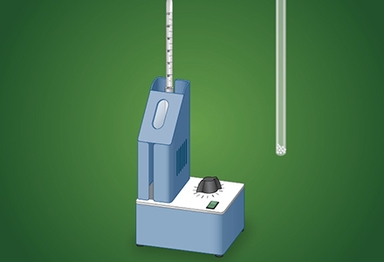
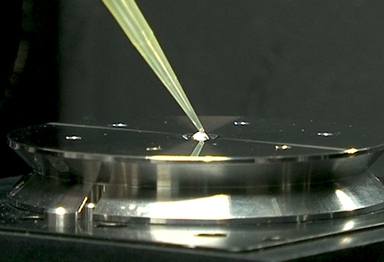
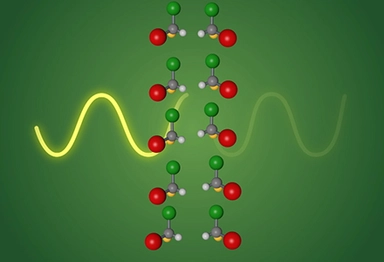
This experiment will demonstrate the use of a polarimeter, which is an instrument used to determine the optical rotation of a sample. Optical rotation is the degree to which a sample will rotate polarized light. Optically active samples will rotate the plane of light clockwise (dextrorotatory), designated as d or (+), or counterclockwise (levorotatory), designated as l or (−).

Procedure

1. Preparing the Polarimeter

  1. Turn on instrument and let it warm up for 10 min.
  2. Make sure instrument is set to "optical rotation" mode.
  3. Prepare a blank sample in the polarimeter cell (1.5 mL total sample volume, 1 dm in length) containing only CHCl3. Make sure there are no air bubbles present.
  4. Place the blank cell in the holder and press "zero."

2. Preparation of Analyte Sample

  1. Prepare a stock solution of 10-15 mg of the ch

Log in or to access full content. Learn more about your institution’s access to JoVE content here

Results

Representative results for the measurement and calculation of specific rotation for Procedures 1-4.

Procedure Step Reading on polarimeter
1.4 0.000
3.2 +0.563
4.1 [α]25D = +77° (c 0.73, CHCl3)

Log in or to access full content. Learn more about your institution’s access to JoVE content here

Application and Summary

In this experiment, we have demonstrated the principles behind the polarimeter and how to measure and calculate the specific rotation of an optically active compound.

The polarimeter is an important instrument in the fine-chemical and pharmaceutical industries to assess the identity, purity, and quality of a compound. It is specifically used for the measurement of optical rotation of chiral compounds, which can be used to distinguish the identity of two enantiomers by confirming whether it is

Log in or to access full content. Learn more about your institution’s access to JoVE content here

Tags

PolarimeterPurity AssessmentChemical PropertiesEnantiomersMirror image VariantsBiological ActivitiesPharmaceuticalsDrug ThalidomidePrinciples Of PolarimetrySetup And OperationApplicationsOrganic CompoundsStereocentersChiral CompoundsMirror image IsomersEnantiomersPhysical PropertiesOptics

Skip to...

0:00

Overview

0:49

Principles of Polarimetry

3:51

Initialization of the Polarimeter

4:24

Calibration and Measurement

5:23

Applications

6:52

Summary

Videos from this collection:

Now Playing

Polarimeter

Organic Chemistry II

102.6K Views

Cleaning Glassware

Organic Chemistry II

127.0K Views

Nucleophilic Substitution

Organic Chemistry II

101.3K Views

Reducing Agents

Organic Chemistry II

43.9K Views

Grignard Reaction

Organic Chemistry II

150.8K Views

n-Butyllithium Titration

Organic Chemistry II

49.1K Views

Dean-Stark Trap

Organic Chemistry II

103.0K Views

Ozonolysis of Alkenes

Organic Chemistry II

68.2K Views

Organocatalysis

Organic Chemistry II

17.5K Views

Palladium-Catalyzed Cross Coupling

Organic Chemistry II

35.3K Views

Solid Phase Synthesis

Organic Chemistry II

42.5K Views

Hydrogenation

Organic Chemistry II

50.8K Views

Polymerization

Organic Chemistry II

98.4K Views

Melting Point

Organic Chemistry II

158.5K Views

Infrared Spectroscopy

Organic Chemistry II

223.1K Views