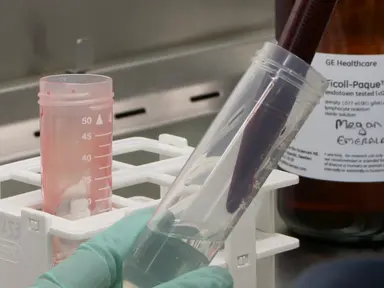
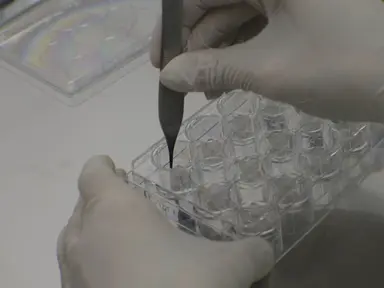
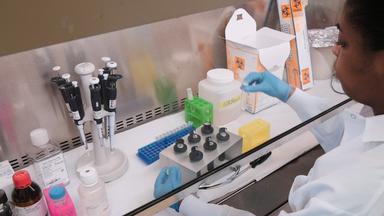
The overall goal of this procedure is to evaluate the effects of tobacco product preparation on cytokine secretion and target cell killing by P BMCs. This is accomplished by first treating cultured P BMCs with whole smoke condition, medium or nicotine, and then intracellular staining of the treated p BMCs is performed to determine their cytokine production. Alternatively, CFSE labeled K 5 62 cells are co-culture with whole smoke conditioned medium treated PBMC effector cells and the viability of the K 5 62 cells is qualified by seven A a d staining.
Ultimately, the effects of the combustible tobacco product preparations on the P BMCs from either assay are measured by flow cytometry. The main advantages of our techniques or the existing methods, such as chromium release assay or ALI spot are our methods are high throughput, non-radioactive, and we can measure the cell functionality. Though this method can provide insight into the biological effects of tobacco product preparations.
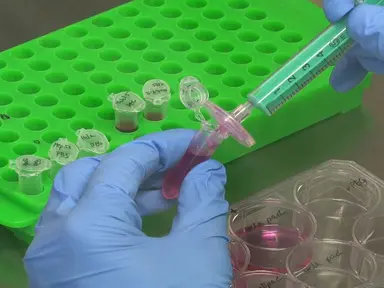
It can also be applied to the evaluation of other compounds that impact the tolike receptor mediated and STIC functions of PBMC effector cells Before beginning the staining procedure. Dilute whole smoke condition, medium and nicotine at the listed concentrations. In RPMI complete medium to a total volume of 100 microliters per well in a 96 well plate.
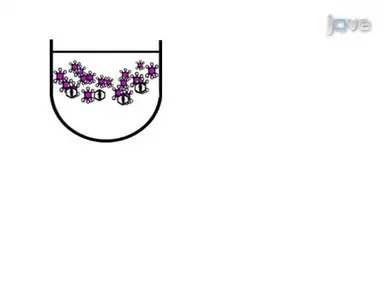
Then add 100 microliters of P BMCs, suspended in complete medium at a concentration of one times 10 to the six cells per well for a total volume of 200 microliters per well. Next, cover the plate and incubate it at 37 degrees Celsius and 5%CO2. After three hours, wash the cells and aspirate the supernatant.
Then cover the plate again and vortex it to dissociate the pellets. Wash the cells two more times, once in ice cold running buffer, and once in complete medium after the second wash. Treat them with 200 microliters per well of complete medium supplemented with Golgi plug and LPS for six hours at 37 degrees Celsius and 5%CO2.
Then wash the cells with ice cold running buffer and treat them with 100 microliters of cyto fix per well at four degrees Celsius after 20 minutes, wash the cells three times with ice cold perm wash. Then add 45 microliters of cyto perm to each well followed by five microliters of each of the listed antibodies. After 30 minutes at four degrees Celsius, wash the cells three times and fix them in 200 microliters of ice cold, 2%para formaldehyde.
Then transfer the cells into 12 by 75 millimeter tubes and analyze the samples on a flow cytometer. After preparing a plate of tobacco product treated pbmc as just demonstrated, wash a culture of K 5 62 cells, harvested at an 80%co fluency in 10 milliliters of DPBS.Resus. Suspend the pellet in five milliliters of DPBS and count the cells.
Then add one milliliter of freshly prepared CFSE working solution to one to two times 10 to the seventh K 5 62 cells in one milliliter of complete medium and disperse the cell stain by vortexing. Incubate the cells at room temperature after exactly two minutes, add 200 microliters of FBS and vortex the cells again, incubating them for another two minutes. After the second incubation, wash the cells in 10 milliliters of complete medium, then resuspend the pellet in another 10 milliliters of complete medium and count the cells.
Now centrifuge the tobacco treated p BMCs and decant the supernatant. Then replace the cover, resuspend the cells by vortexing and wash them in 200 microliters of complete medium per well. To initiate the killing assay, add the CFSE labeled K 5 62 cells to the pbmc at a one to 15 ratio and incubate the co-culture at 37 degrees Celsius and 5%CO2.
After five hours, spin down the cells and discard the supernatant. Suspend the pellets by vortexing and then wash the cells with 200 microliters of running buffer per well then add 95 microliters of running buffer, followed by five microliters of seven A a d for a total volume of 100 microliters per well. Finally incubate the cells in the dark at room temperature for 15 minutes.
Then add 100 microliters of running buffer to each well and transfer the entire volume to the appropriate corresponding fax tubes to determine the percentage of seven a a D and CFSE positive cells. By flow cytometric analysis, A dose dependent increase in cell death is observed with whole smoke conditioned medium at 24 hours with a near 80%of cells dead at four micrograms per milliliter of equin nicotine units. However, treatment of the p BMCs for only three hours does not result in a significant toxicity even at five micrograms per milliliter of equin nicotine units of whole smoke conditioned medium at 24 hours.
A comparable degree of cell death is not noted before treatment with 3000 micrograms per milliliter of nicotine after three hours, nicotine treatment does not cause measurable cell death before the 2000 microgram per milliliter concentration treatment with whole smoke condition, medium and nicotine, followed by stimulation of the TLR four receptor by LPS results in a dose dependent decrease of secreted cytokines. Although the degree of suppression varies among the individual cytokines. Further, when cells are cot treated with LPS and Golgi plug for only six hours, a decrease in the number of intracellular cytokine positive cells is observed after exposure to whole smoke condition medium, even at the lower equin nicotine unit concentrations compared to nicotine exposure.
Indeed, the results of this killing assay illustrate that exposure to 1.56 micrograms per milliliter of whole smoke condition medium significantly reduces the killing ability of the effector PBMC population compared with the control and the lower dose concentrations. Whereas nicotine treatment at either high or low concentrations does not interfere with the killing ability of the effector PBMC population While attempting these procedures. It's important to be precise with the CFSE labeling as well as antibody dilutions labeling time and incubation temperatures.
After watching this video, you should have a good understanding of how to utilize antibody labeling techniques in flow cytometry to determine the effects of tobacco product preparations or other treatments on peripheral blood mononuclear cells.