To evaluate pure sensory neuro-cochlear dysfunction caused by blast exposure, resulting tympanic membrane perforation, we develop an experimental animal model of blast-induced cochlear injury using the Razor induced shock wave. This method can avoid tympanic membrane perforation and concomitant systemic injuries and reproduces the functional decline in the sensory neural hearing loss component in an energy dependent manner after a direct exposure. This animal model could be an ideal platform for studying the pathological mechanisms and exploring potential treatment for the blast induced cochlear dysfunction.
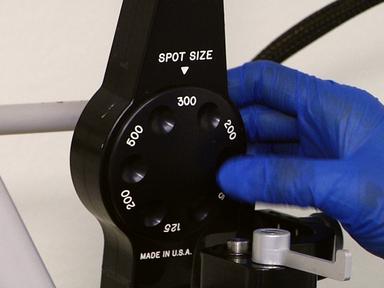
To begin, prepare a laser induced shockwave or LISW exposure assembly. Irradiate the exposure assembly with a 532 nanometer Q switch ND YAG laser to generate the LISW behind the target. Focus the laser pulse through a plano-convex lens to a three millimeter diameter spot on the laser target.
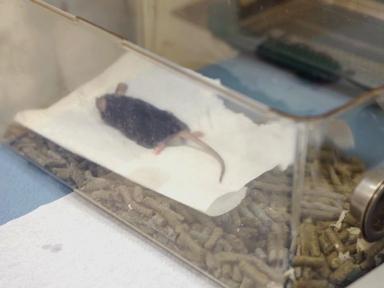
Use the LISW irradiation to generate plasma at the bonding surface of the two materials and vaporize the rubber, leaving vaporized rubber in the cavity. Carefully shave the postauricular regions of the anesthetized mouse to avoid retaining the trapped air in the fur. Fix the mouse on a plate with their postauricular regions positioned upwards towards the LISW focal area.
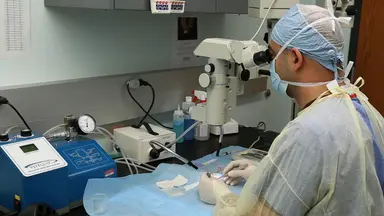
To ensure acoustic impedance matching, use an ultrasound conductive gel between the laser target and the skin surface. Attach a black rubber target percutaneously to the postauricular region of the mouse ear. Apply a single LISW pulse to the cochlea via the temporal bone at three energy densities.
Insert a ground electrode under the caudal region of the tail. Then insert a stainless steel needle electrode for electroencephalogram recording under the ear canal and frontal region of the ear. Present the stimulation sound over a small earphone and measure the sound pressure level near the tympanic membrane of the mouse.
Generate output burst stimuli from a sound generator at 37 cycles and amplify the sound pressure from a 20 decibel sound pressure level to 80 decibel SPL in five decibel SPL steps. Measure the auditory brainstem response or ABR peak one amplitude to evaluate the cochlear functions. Then ABR peak analysis software automatically analyzes the ABR waveform with respect to the hearing thresholds and ABR P1 amplitude.
An auditory function assessment using ABR post LISW exposure revealed significant ABR threshold shifts at one day persisting for one month at higher energy levels. ABR thresholds in the two joules per square centimeters group showed recovery to pre-exposure levels, indicating energy dependent effects. After one day and one month of LISW exposure, significant decreases in ABR P1 amplitudes were observed in all LISW irradiated groups across frequencies.
One month after LASW exposure, conduct a pathological examination of the mouse's cochlea. Start hemo perfusion with lactated ringers solution, followed by trans cardiac perfusion with 4%paraformaldehyde. After decapitation of the mouse, remove the cochlea and perfuse directly with 4%paraformaldehyde at four degrees Celsius overnight.
After acquiring the entire image of the cochlea, using ImageJ software, compute the cochlear frequency map to precisely localize the specific cochlear regions at different frequencies. Using the given formula, calculate the survival rate of the hair cells at each frequency. After acquiring high resolution Z-stack images of the inner hair cells, calculate the number of synapses.
Visualize the Hematoxylin and Eosin-stained cochlea sections, and count the number of spiral ganglion neurons in the middle turn of the Rosenthal's canal to calculate the spiral ganglion neuron survival per control. Compared to the control, fluorescent immunostaining showed intact cochlear structures with no significant loss of hair cells or nerve fibers across all groups. However, quantitative assessments indicated that the survival of outer hair cells was significantly lower in the 2.5 joules per square centimeter group.
Meanwhile, inner hair cell survival was consistent among groups. Synaptic ribbon counts were notably reduced in higher frequency groups. This was paralleled by a decrease in spiral ganglion neuron density in the 2.5 joules per square centimeter group, indicating that cochlear degeneration is dependent on LISW energy exposure.