
4.17 : Quantitative Aspects of Drug-Receptor Interaction
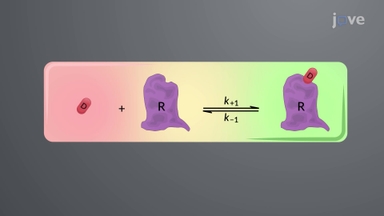
The receptor occupancy theory connects a drug's response to the number of occupied receptors. With higher drug concentrations, more receptors are occupied, leading to increased responses. The formation of drug-receptor complexes involves association and dissociation rates, which reach equilibrium when the forward and backward reactions are equal. The equilibrium association constant (Ka) and its inverse, the equilibrium dissociation constant (Kd), indicate drug affinity. Higher Ka and lower Kd values signify greater affinity, enabling more receptor binding even at low concentrations. Fractional occupancy, the ratio of occupied to total receptors, reveals the extent of binding at specific drug concentrations. When plotted against drug concentration on a logarithmic scale, fractional occupancy increases as free drug concentration rises, reaching 0.5 (50% receptor occupancy) when concentration equals Kd. As concentration continues to increase, fractional occupancy approaches unity, resulting in a maximal response.
来自章节 4:
Now Playing
4.17 : Quantitative Aspects of Drug-Receptor Interaction
Pharmacodynamics
934 Views
4.1 : 药物作用原则
Pharmacodynamics
5.7K Views
4.2 : 药物作用的目标:概述
Pharmacodynamics
6.0K Views

4.3 : 信号转导:概述
Pharmacodynamics
8.2K Views
4.4 : 换能器机制:G 蛋白偶联受体
Pharmacodynamics
1.8K Views
4.5 : 配体门控离子通道受体:门控机制
Pharmacodynamics
2.1K Views
4.6 : 换能器机制:酶联受体
Pharmacodynamics
2.3K Views

4.7 : 换能器机制:核受体
Pharmacodynamics
1.3K Views
4.8 : 剂量-反应关系:概述
Pharmacodynamics
2.9K Views

4.9 : 剂量-反应关系:效力和疗效
Pharmacodynamics
4.2K Views
4.10 : 剂量-反应关系:选择性和特异性
Pharmacodynamics
6.4K Views
4.11 : 治疗指数
Pharmacodynamics
4.1K Views
4.12 : 药物-受体相互作用:激动剂
Pharmacodynamics
2.3K Views
4.13 : 药物-受体相互作用:拮抗剂
Pharmacodynamics
2.7K Views
4.14 : 药物的综合作用:拮抗作用
Pharmacodynamics
8.3K Views
See More

版权所属 © 2025 MyJoVE 公司版权所有,本公司不涉及任何医疗业务和医疗服务。