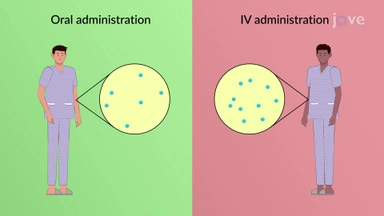
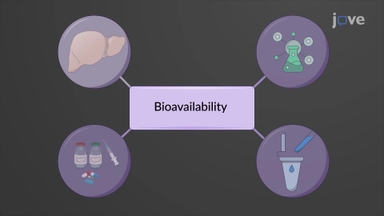
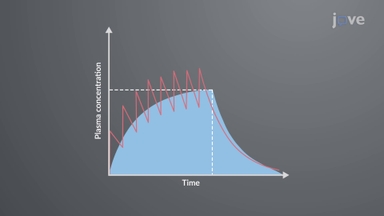
Bioavailability refers to the proportion of an unaltered drug that, after administration, enters the systemic circulation and can be distributed to the desired action site. Factors such as gastrointestinal (GI) absorption and liver biotransformation influence the bioavailability of a drug when it is administered orally. When a drug is administered intravenously, it enters the systemic circulation directly; by definition, its bioavailability is assumed to be 100%. The bioavailability of an orally administered drug can be determined by comparing its plasma concentration with that of the same drug administered intravenously. A graph can be plotted that shows the plasma concentration of a drug over time, given in equivalent doses both orally and intravenously. The total area under this graph for each method of administration signifies the degree of drug absorption via that particular route. By calculating the ratio of these areas, an estimate of the bioavailable fraction of an orally administered drug can be obtained.
From Chapter 3:
Now Playing
3.5 : Bioavailability: Overview
Pharmacokinetics
2.1K Views
3.1 : Pharmacokinetics: Overview
Pharmacokinetics
3.4K Views
3.2 : Drug Absorption Mechanism: Passive Membrane Transport
Pharmacokinetics
3.0K Views

3.3 : Drug Absorption Mechanism: Carrier-Mediated Membrane Transport
Pharmacokinetics
3.0K Views
3.4 : Drug Absorption: Factors Affecting GI Absorption
Pharmacokinetics
3.3K Views
3.6 : Factors Influencing Bioavailability: First-Pass Elimination
Pharmacokinetics
5.5K Views
3.7 : Bioequivalence: Overview
Pharmacokinetics
753 Views
3.8 : First Pass Effect
Pharmacokinetics
4.5K Views
3.9 : Time Course of Drug Effect
Pharmacokinetics
1.7K Views
3.10 : Drug Distribution: Tissue Binding
Pharmacokinetics
2.2K Views
3.11 : Physiological Barriers
Pharmacokinetics
3.1K Views
3.12 : Drug Distribution: Plasma Protein Binding
Pharmacokinetics
3.1K Views
3.13 : Compartment Models: Single-Compartment Model
Pharmacokinetics
1.8K Views
3.14 : Compartment Models: Two-Compartment Model
Pharmacokinetics
4.6K Views
3.15 : Drug Distribution: Volume of Distribution
Pharmacokinetics
2.8K Views
See More

Copyright © 2025 MyJoVE Corporation. All rights reserved