
1.4 : Types of Errors: Detection and Minimization
Error is the deviation of the obtained result from the true, expected value or the estimated central value. Errors are expressed in absolute or relative terms.
Absolute error in a measurement is the numerical difference from the true or central value. Relative error is the ratio between absolute error and the true or central value, expressed as a percentage.
Errors can be classified by source, magnitude, and sign. There are three types of errors: systematic, random, and gross.
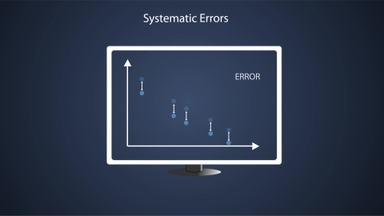
Systematic or determinate errors emerge from known sources and are reproducible during replicate measurements. Defective equipment and experiment design flaws are familiar sources of these errors. These errors can be minimized by employing standard reference materials, independent analysis, or varying the sample size.
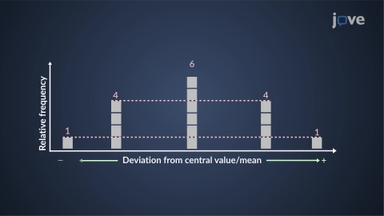
Random errors or indeterminate errors are difficult to reproduce by repeating measurements. These errors originate from uncontrolled variables like electronic noise in the circuit of an electrical instrument and irregular changes in the heat loss rate from a solar collector due to changes in the wind.
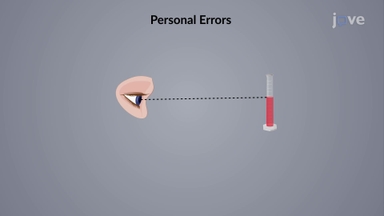
Gross errors are caused by human mistakes. The magnitude of these errors is often high. The origin of such errors is entirely based on the observer.
Bölümden 1:
Now Playing
1.4 : Types of Errors: Detection and Minimization
Chemical Applications of Statistical Analyses
1.4K Görüntüleme Sayısı

1.1 : SI Units: 2019 Redefinition
Chemical Applications of Statistical Analyses
1.4K Görüntüleme Sayısı

1.2 : Degrees of Freedom
Chemical Applications of Statistical Analyses
3.0K Görüntüleme Sayısı
1.3 : Statistical Analysis: Overview
Chemical Applications of Statistical Analyses
6.1K Görüntüleme Sayısı
1.5 : Systematic Error: Methodological and Sampling Errors
Chemical Applications of Statistical Analyses
1.4K Görüntüleme Sayısı
1.6 : Random Error
Chemical Applications of Statistical Analyses
814 Görüntüleme Sayısı

1.7 : Standard Deviation of Calculated Results
Chemical Applications of Statistical Analyses
5.7K Görüntüleme Sayısı

1.8 : Introduction to z Scores
Chemical Applications of Statistical Analyses
342 Görüntüleme Sayısı
1.9 : Uncertainty: Overview
Chemical Applications of Statistical Analyses
515 Görüntüleme Sayısı

1.10 : Propagation of Uncertainty from Random Error
Chemical Applications of Statistical Analyses
645 Görüntüleme Sayısı
1.11 : Propagation of Uncertainty from Systematic Error
Chemical Applications of Statistical Analyses
471 Görüntüleme Sayısı
1.12 : Uncertainty: Confidence Intervals
Chemical Applications of Statistical Analyses
3.1K Görüntüleme Sayısı
1.13 : Significance Testing: Overview
Chemical Applications of Statistical Analyses
3.3K Görüntüleme Sayısı

1.14 : Identifying Statistically Significant Differences: The F-Test
Chemical Applications of Statistical Analyses
1.6K Görüntüleme Sayısı
1.15 : Comparing Experimental Results: Student's t-Test
Chemical Applications of Statistical Analyses
1.5K Görüntüleme Sayısı
See More

JoVE Hakkında
Telif Hakkı © 2020 MyJove Corporation. Tüm hakları saklıdır