
26.5 : Resistência
When a current moves through any conductor, the conductor causes some level of difficulty for the current to flow. The measure of that difficulty is known as the resistance of the material and is represented by R. Every material has its own resistance. In the case of conductors, heat is emitted whenever a current passes through them. Resistance depends on the resistivity of the material. Resistivity is a characteristic of the material used to fabricate electrical components, whereas the resistance is a characteristic of the component itself.
To calculate the resistance, consider a section of conducting wire with a cross-sectional area of A, a length of L, and a resistivity ρ. A battery is connected across the conductor, providing a potential difference of ΔV across it. The potential difference produces an electrical field that is proportional to the current density:

The magnitude of the electrical field across a segment of the conductor is equal to the voltage divided by the length, and the magnitude of the current density is equal to the current divided by the cross-sectional area. By substituting the values and recalling that the electrical field is proportional to the resistivity and the current density, a relation between voltage and current can be established:

The resistance of a material can be defined as the ratio of the voltage to the current passing through it and is represented in ohms. The resistance of a cylindrical segment of a conductor is equal to the resistivity of the material multiplied by the length divided by the area:

The resistance of an object also depends on the temperature. For a given cylinder, if the length and area do not change greatly with temperature, the resistance of the material has the same temperature dependence as the resistivity:

where R0is the original resistance at room temperature, R is the resistance after a temperature change, and ɑ is the temperature coefficient of the material.
Do Capítulo 26:

Now Playing
26.5 : Resistência
Corrente e Resistência
4.3K Visualizações
26.1 : Corrente Elétrica
Corrente e Resistência
5.6K Visualizações
26.2 : Velocidade de Deriva
Corrente e Resistência
4.0K Visualizações
26.3 : Densidade de Corrente
Corrente e Resistência
3.8K Visualizações
26.4 : Resistividade
Corrente e Resistência
3.4K Visualizações

26.6 : A Lei de Ohm
Corrente e Resistência
5.4K Visualizações
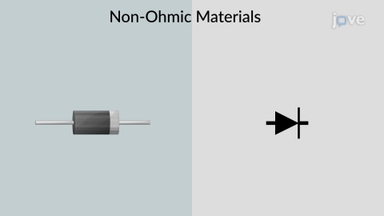
26.7 : Dispositivos Não-Ôhmicos
Corrente e Resistência
1.0K Visualizações
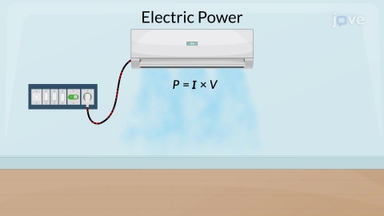
26.8 : Energia Elétrica
Corrente e Resistência
3.0K Visualizações
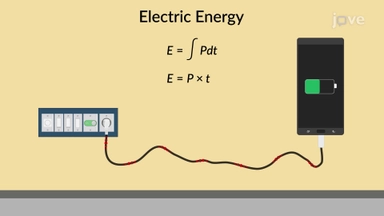
26.9 : Energia Elétrica
Corrente e Resistência
1.2K Visualizações
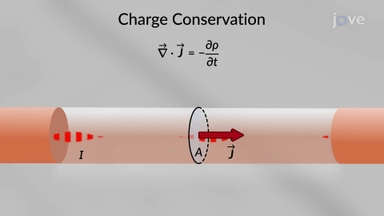
26.10 : Equação de Continuidade
Corrente e Resistência
792 Visualizações
26.11 : Condições de Contorno para Densidade de Corrente
Corrente e Resistência
797 Visualizações
26.12 : Condutividade Elétrica
Corrente e Resistência
1.1K Visualizações
26.13 : Teoria da Condução Metálica
Corrente e Resistência
1.3K Visualizações

Copyright © 2025 MyJoVE Corporation. Todos os direitos reservados