
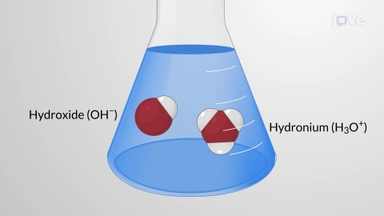
The potential of hydrogen (pH) is a measure of the acidity or basicity of a water-based solution determined by the concentration of hydronium ions (H3O+). In one liter of pure water at neutral pH, there are 1×10⁻⁷ moles of hydronium ions. However, the extensive range of hydronium ion concentrations present in water-based solutions makes measuring pH in moles cumbersome. Therefore, a pH scale was developed to convert moles of hydronium ions into the negative logarithm of the hydronium ion concentration.
The pH of pure water, 7, represents a neutral solution. Most solutions have a pH between 0 and 14, but some solutions, like carborane (with a pH of −18), exceed this. One liter of carborane has 1×10¹⁸ moles of hydrogen ions.
As more hydronium ions accumulate, the pH value of a solution falls below 7. Coffee, lemon juice, and gastric acid (digestive juices) are acidic solutions with pHs around 4.5, 2.5, and 1.5, respectively.
Solutions with a pH above 7 are called alkaline, as they have lower hydronium ion concentration. Saltwater and soapy water are examples of alkaline solutions, with pHs of approximately 8 and 12, respectively.
Buffers are solutions that can prevent significant changes to pH. Buffers are critical because most biological functions occur in near-neutral pH conditions, approximately 7.35 to 7.45. For example, blood has an average pH of ~7.4, maintained by a buffer system involving carbonic acid (H2CO3), bicarbonate ions (HCO3–), and carbon dioxide (CO2).
Bicarbonate is also used to buffer chyme as it moves from the stomach to the small intestine. Without it, the acidity of the digested food would damage the lining of the intestine.
From Chapter 2:
Now Playing
2.15 : pH
Chemistry of Life
132.7K Views
2.1 : The Periodic Table and Organismal Elements
Chemistry of Life
172.1K Views
2.2 : Atomic Structure
Chemistry of Life
189.9K Views
2.3 : Electron Behavior
Chemistry of Life
98.1K Views
2.4 : Electron Orbital Model
Chemistry of Life
67.0K Views
2.5 : Elements and Compounds
Chemistry of Life
95.9K Views
2.6 : Molecular Shapes
Chemistry of Life
56.5K Views
2.7 : Carbon Skeletons
Chemistry of Life
106.9K Views
2.8 : Chemical Reactions
Chemistry of Life
88.0K Views
2.9 : Isotopes
Chemistry of Life
56.3K Views
2.10 : Covalent Bonds
Chemistry of Life
144.7K Views
2.11 : Ionic Bonds
Chemistry of Life
117.2K Views
2.12 : Hydrogen Bonds
Chemistry of Life
119.9K Views
2.13 : Van der Waals Interactions
Chemistry of Life
62.8K Views
2.14 : States of Water
Chemistry of Life
50.2K Views
See More

Copyright © 2025 MyJoVE Corporation. All rights reserved