
12.1 : Dual Nature of Electromagnetic (EM) Radiation
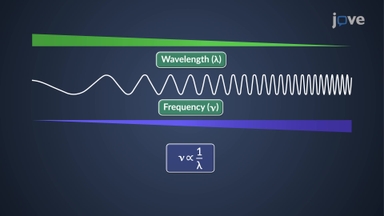
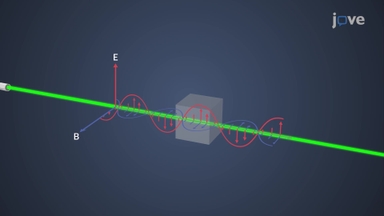
Electromagnetic (EM) radiation consists of electric and magnetic field components oscillating in planes perpendicular to each other and mutually perpendicular to radiation propagation through space. EM radiation can be classified as a wave, characterized by the properties of waves such as wavelength (denoted as λ) and frequency (represented by ν).
Wavelength is the distance between two consecutive peaks (the highest point) or troughs (the lowest point) in the wave. Frequency is the number of repeating waves or wave cycles that pass a given point in a fixed time. Different types of electromagnetic radiation have varying wavelengths and frequencies. The electromagnetic spectrum is the ordered collection of electromagnetic radiation grouped by frequency or wavelength. The wavelength and frequency are related to the speed of the radiation through a medium. The speed of radiation in a vacuum (denoted as c) is a universal physical constant with a value of approximately 3 × 10⁸ m/s.

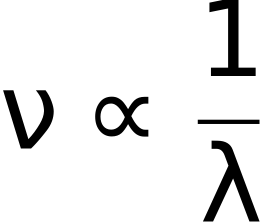
Therefore, wavelength and frequency are inversely related. Radiation with a high frequency features a low wavelength, and vice versa.
In addition to behaving like a wave, electromagnetic radiation can also be considered a collection of particles called photons. A photon is the smallest unit or "quantum" of light or electromagnetic radiation. It has no mass or charge but carries energy. Each photon possesses a definite quantity of energy, which can be transferred to matter upon interaction. The energy of a photon (denoted as E) is directly proportional to the frequency and inversely proportional to the wavelength. The equation relating a photon's energy to its radiation frequency is known as Planck’s equation.
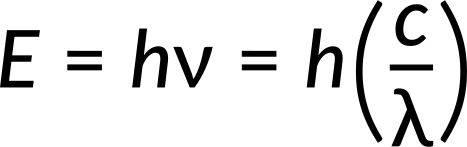
Planck’s constant is denoted by h with a value of 6.626 × 10⁻³⁴ m2 kg s−1.
From Chapter 12:
Now Playing
12.1 : Dual Nature of Electromagnetic (EM) Radiation
Introduction to Molecular Spectroscopy
1.9K Views
12.2 : Interaction of EM Radiation with Matter: Spectroscopy
Introduction to Molecular Spectroscopy
1.4K Views

12.3 : Molecular Spectroscopy: Absorption and Emission
Introduction to Molecular Spectroscopy
1.7K Views
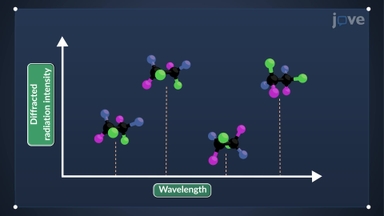
12.4 : Spectrophotometry: Introduction
Introduction to Molecular Spectroscopy
2.9K Views
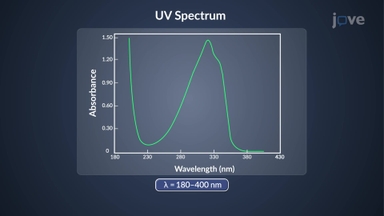
12.5 : Ultraviolet and Visible (UV–Vis) Spectroscopy: Overview
Introduction to Molecular Spectroscopy
2.5K Views
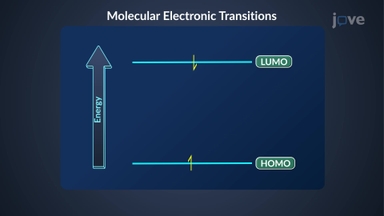
12.6 : UV–Vis Spectroscopy: Molecular Electronic Transitions
Introduction to Molecular Spectroscopy
1.3K Views
12.7 : UV–Vis Spectrometers
Introduction to Molecular Spectroscopy
1.3K Views
12.8 : UV–Vis Spectrum
Introduction to Molecular Spectroscopy
1.0K Views
12.9 : UV–Vis Spectroscopy: Beer–Lambert Law
Introduction to Molecular Spectroscopy
2.0K Views
12.10 : Photoluminescence: Fluorescence and Phosphorescence
Introduction to Molecular Spectroscopy
1.5K Views
12.11 : Variables Affecting Phosphorescence and Fluorescence
Introduction to Molecular Spectroscopy
474 Views
12.12 : Deactivation Processes: Jablonski Diagram
Introduction to Molecular Spectroscopy
560 Views
12.13 : Photoluminescence: Applications
Introduction to Molecular Spectroscopy
363 Views
12.14 : Fluorescence and Phosphorescence: Instrumentation
Introduction to Molecular Spectroscopy
518 Views

Copyright © 2025 MyJoVE Corporation. All rights reserved