
3.2 : Drug Absorption Mechanism: Passive Membrane Transport
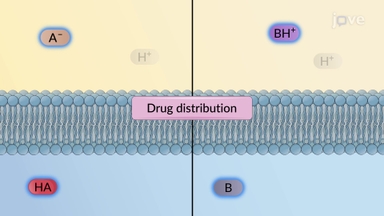
Passive transport is a method of drug absorption where small, lipid-soluble drugs can move across the cell membrane. This movement happens along the concentration gradient, which is a natural flow from higher to lower concentration areas. The speed at which the drug moves is directly related to its lipid–water partition coefficient. This means that the more a drug dissolves in lipids, the faster it diffuses or spreads throughout the body. It is important to note that most drugs are either weak acids or bases. The ionized forms of these drugs cannot dissolve in lipids and cannot cross the cell membrane. However, the nonionized forms that can dissolve in lipids can diffuse readily.
The distribution of a drug across a cell membrane depends on two factors: the drug's pKa and the pH gradient across the membrane. pKa refers to the acidity constant of the drug, while pH measures the acidity or alkalinity of the environment. Consider an example of a weakly acidic drug in stomach gastric juice. In the stomach, where the pH is lower than the drug's pKa, the drug remains primarily undissociated and can easily diffuse across the barrier. The drug dissociates readily once in the plasma, where the pH is higher than the drug's pKa. Because the ionized form of the drug cannot diffuse back through the barrier, this form is primarily found in the plasma.
From Chapter 3:
Now Playing
3.2 : Drug Absorption Mechanism: Passive Membrane Transport
Pharmacokinetics
3.6K Views
3.1 : Pharmacokinetics: Overview
Pharmacokinetics
5.4K Views

3.3 : Drug Absorption Mechanism: Carrier-Mediated Membrane Transport
Pharmacokinetics
3.5K Views
3.4 : Drug Absorption: Factors Affecting GI Absorption
Pharmacokinetics
3.8K Views
3.5 : Bioavailability: Overview
Pharmacokinetics
2.7K Views
3.6 : Factors Influencing Bioavailability: First-Pass Elimination
Pharmacokinetics
6.1K Views
3.7 : Bioequivalence: Overview
Pharmacokinetics
915 Views
3.8 : First Pass Effect
Pharmacokinetics
5.0K Views
3.9 : Time Course of Drug Effect
Pharmacokinetics
1.9K Views
3.10 : Drug Distribution: Tissue Binding
Pharmacokinetics
2.5K Views
3.11 : Physiological Barriers
Pharmacokinetics
3.4K Views
3.12 : Drug Distribution: Plasma Protein Binding
Pharmacokinetics
4.8K Views
3.13 : Compartment Models: Single-Compartment Model
Pharmacokinetics
2.1K Views
3.14 : Compartment Models: Two-Compartment Model
Pharmacokinetics
5.2K Views
3.15 : Drug Distribution: Volume of Distribution
Pharmacokinetics
4.4K Views
See More

Copyright © 2025 MyJoVE Corporation. All rights reserved