
3.12 : Drug Distribution: Plasma Protein Binding
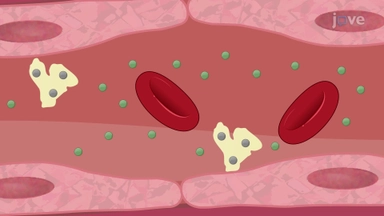
Drugs predominantly attach to plasma proteins, with only a small percentage remaining unbound. The unbound portion can be calculated as one minus the bound fraction. Acidic drugs form large, inactive complexes by reversibly binding to plasma albumin, which prevents them from diffusing across biological barriers. These drug-protein complexes act as reservoirs for the drugs. As the concentration of unbound drugs decreases, these complexes quickly dissociate to release the free drug, maintaining the unbound fraction. The quantity of protein-bound drugs relies on various factors, including the concentrations of free drug and protein, the number of binding sites, and their affinity for the drug. Due to the abundance of binding sites and indiscriminate binding, various drugs or endogenous substances may engage in competitive binding with plasma proteins. For instance, when sulfonamide competitively binds to plasma proteins, it reduces albumin's affinity for bilirubin, releasing free bilirubin and increasing the risk of bilirubin encephalopathy in newborns. In situations like exercise or infection, where free fatty acid concentrations in plasma are elevated, drugs bound to albumin may be displaced, raising the concentration of unbound drugs.
From Chapter 3:
Now Playing
3.12 : Drug Distribution: Plasma Protein Binding
Pharmacokinetics
4.8K Views
3.1 : Pharmacokinetics: Overview
Pharmacokinetics
5.4K Views
3.2 : Drug Absorption Mechanism: Passive Membrane Transport
Pharmacokinetics
3.6K Views

3.3 : Drug Absorption Mechanism: Carrier-Mediated Membrane Transport
Pharmacokinetics
3.5K Views
3.4 : Drug Absorption: Factors Affecting GI Absorption
Pharmacokinetics
3.8K Views
3.5 : Bioavailability: Overview
Pharmacokinetics
2.7K Views
3.6 : Factors Influencing Bioavailability: First-Pass Elimination
Pharmacokinetics
6.1K Views
3.7 : Bioequivalence: Overview
Pharmacokinetics
913 Views
3.8 : First Pass Effect
Pharmacokinetics
5.0K Views
3.9 : Time Course of Drug Effect
Pharmacokinetics
1.9K Views
3.10 : Drug Distribution: Tissue Binding
Pharmacokinetics
2.5K Views
3.11 : Physiological Barriers
Pharmacokinetics
3.4K Views
3.13 : Compartment Models: Single-Compartment Model
Pharmacokinetics
2.1K Views
3.14 : Compartment Models: Two-Compartment Model
Pharmacokinetics
5.2K Views
3.15 : Drug Distribution: Volume of Distribution
Pharmacokinetics
4.4K Views
See More

Copyright © 2025 MyJoVE Corporation. All rights reserved