Shearing stress, denoted by the Greek letter tau (τ), is stress caused by forces acting transversely on an object. These forces create internal ones within the entity in the plane where the external forces are applied. The resultant of these internal forces is the shear in the section.
The average shearing stress can be calculated by dividing the shear by the area of the cross-section.
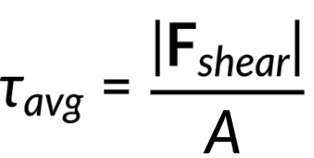
However, this is an average value as the distribution of shearing stress across a section varies. It can range from zero at the surface to a maximum far exceeding the average.
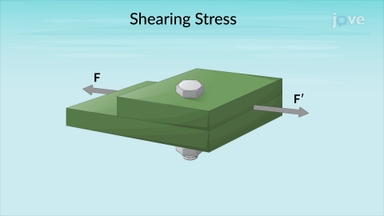
Elements like bolts, pins, and rivets, often used to connect machine components or structural members, frequently experience shearing stresses. For instance, tension forces exerted on two plates connected by a bolt may lead to shearing stresses in the bolt's section lying between the plates' surfaces, resulting in shear equal to the tension force.
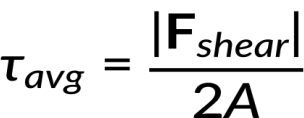
In complex scenarios, such as splice plates connecting other plates, shear occurs in two planes of each bolt, known as double shear. The average shearing stress in each plane is determined by dividing the applied force by twice the area.
From Chapter 17:
Now Playing
17.2 : Shearing Stress
Concept of Stress
440 Views
17.1 : Normal Stress
Concept of Stress
421 Views
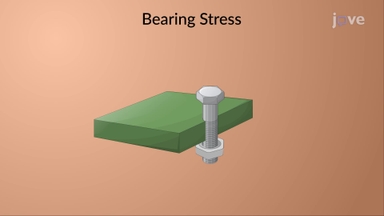
17.3 : Bearing Stress
Concept of Stress
621 Views
17.4 : Applications of Stress
Concept of Stress
210 Views
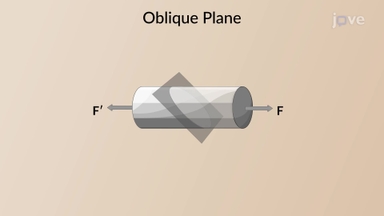
17.5 : Stress on an Oblique Plane
Concept of Stress
440 Views
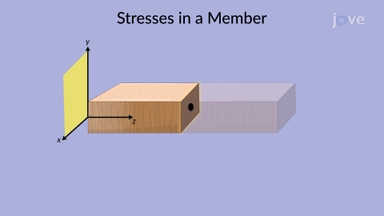
17.6 : Stress: General Loading Conditions
Concept of Stress
255 Views
17.7 : Components of Stress
Concept of Stress
181 Views
17.8 : Design Consideration
Concept of Stress
157 Views

Copyright © 2025 MyJoVE Corporation. All rights reserved