An electrocardiogram (ECG)graphically represents the heart's electrical activity on ECG paper or a monitor.
Components of the Electrocardiogram
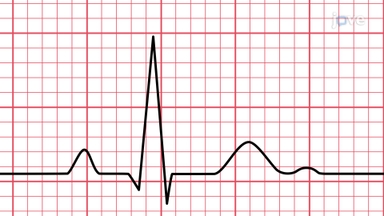
The primary components of a normal ECG waveform in Normal sinus rhythm(NSR) include the P wave, PR interval, QRS complex, ST segment, T wave, and occasionally a U wave.
ECG waveforms are divided by vertical and horizontal lines at standard intervals.
The horizontal axis measures time and rate, and the vertical axis measures amplitude or voltage. When the ECG waveform trends upward on the graph, this movement is called a positive deflection. When it moves toward the bottom, it is a negative deflection.
P Wave: A slight, positive deflection before the QRS complex, typically ≤2.5 mm height and ≤0.11 seconds.
PR Interval: Fluctuates from 0.12 to 0.20 seconds, covering the P wave and PR segment.
QRS Complex: Includes a Q wave (negative deflection), R wave (positive deflection), and S wave (negative deflection), taking <0.12 seconds to complete.
ST Segment: Links the QRS complex to the T wave, usually isoelectric, indicating early ventricular repolarization.
T Wave: A smooth, positive deflection following the QRS complex.
QT Interval: Stretches from the start of the QRS complex to the conclusion of the T wave and varies with heart rate.
U Wave: An optional wave that may follow the T wave.
TP Interval: Refers to the isoelectric segment between the end of the T wave and the onset of the following P wave.
PP Interval: Measures atrial rate and rhythm from one P wave start to the next.
RR Interval: Determines ventricular rate and rhythm, measured from one QRS complex to the next.
Calculating Heart Rate from an ECG
One method to determine heart rate from an ECG strip involves dividing 1500 by the count of small boxes between two R waves to get beats per minute. For instance, 1500/25 = 60 beats per minute.
From Chapter 14:
Now Playing
14.5 : ECG Interpretation of Rhythms
Cardiovascular Diagnostic Studies and Procedures
230 Views
14.1 : Blood Studies for Cardiovascular System I: Cardiac Biomarkers
Cardiovascular Diagnostic Studies and Procedures
59 Views
14.2 : Blood Studies for Cardiovascular System II: CRP, Hcy, and Cardiac Natriuretic Peptide Markers
Cardiovascular Diagnostic Studies and Procedures
36 Views
14.3 : Blood Studies for Cardiovascular System III: Serum Lipid Profile
Cardiovascular Diagnostic Studies and Procedures
88 Views
14.4 : Electrocardiogram Fundamentals
Cardiovascular Diagnostic Studies and Procedures
406 Views

14.6 : ECG Interpretation of Arrhythmias I: Sinus Arrhythmias
Cardiovascular Diagnostic Studies and Procedures
137 Views
14.7 : Exercise Stress Test
Cardiovascular Diagnostic Studies and Procedures
116 Views
14.8 : Imaging Studies for Cardiovascular System I:Echocardiography
Cardiovascular Diagnostic Studies and Procedures
254 Views
14.9 : Imaging Studies for Cardiovascular System II:Types of Echocardiography
Cardiovascular Diagnostic Studies and Procedures
195 Views
14.10 : Imaging Studies for Cardiovascular System III: X-Ray
Cardiovascular Diagnostic Studies and Procedures
99 Views

Copyright © 2025 MyJoVE Corporation. All rights reserved