
14.9 : Design Example: Deciding Thickness of Lubricating Fluid in a Shaft
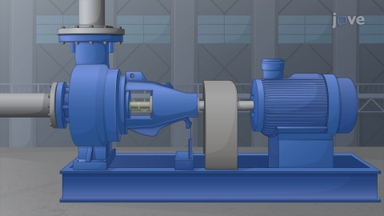
Effective lubrication between a rotating shaft and its bearing housing is essential in rotating machinery to minimize friction, wear, and energy loss. With carefully controlled thickness and viscosity, the lubricant layer prevents metal-to-metal contact, ensuring smooth operation.
To calculate the required thickness of the lubricant layer, the tangential velocity at the shaft's surface must first be determined. This velocity is calculated by converting the rotational speed to angular velocity and multiplying it by the shaft's radius.

The resulting tangential velocity v represents the shaft's linear speed relative to the stationary housing. The velocity gradient across the lubricant layer, which indicates how quickly velocity changes from the moving shaft to the stationary housing, is derived by dividing the tangential velocity by the lubricant thickness.
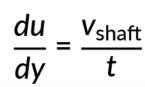
Shear stress within this fluid layer depends on the lubricant's viscosity and this velocity gradient, with higher viscosity providing greater resistance to flow and reducing metal-to-metal contact. To achieve the correct shear stress, the lubricant thickness must be calculated by rearranging the shear stress equation, expressing thickness in viscosity, tangential velocity, and the desired shear stress level. The necessary thickness t is obtained by dividing the tangential velocity by the product of viscosity and target shear stress.
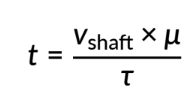
This optimal lubricant thickness ensures sufficient separation between the shaft and housing, allowing smooth operation and protecting the machinery components from excessive wear.
From Chapter 14:
Now Playing
14.9 : Design Example: Deciding Thickness of Lubricating Fluid in a Shaft
Fluid Properties
96 Views

14.1 : Characteristics of Fluids
Fluid Properties
273 Views
14.2 : Density, Specific Weight, Specific Gravity and Compressibility of Fluid
Fluid Properties
254 Views

14.3 : Viscosity of Fluid
Fluid Properties
345 Views

14.4 : Types of Fluids
Fluid Properties
199 Views

14.5 : Newtonian Fluid: Problem Solving
Fluid Properties
196 Views
14.6 : Vapor Pressure of Fluid
Fluid Properties
1.0K Views

14.7 : Surface Tension of Fluid
Fluid Properties
234 Views

14.8 : Capillarity in Fluid
Fluid Properties
146 Views

Copyright © 2025 MyJoVE Corporation. All rights reserved