
19.9 : Steady, Laminar Flow in Circular Tubes
Hagen-Poiseuille flow describes a viscous fluid's steady, incompressible flow through a cylindrical tube with a constant radius R. This flow profile is often applied to understand fluid transport in narrow channels, such as capillaries. It serves as a foundational example of laminar flow. In this model, cylindrical coordinates (r,θ,z) are used to describe the radial (r), angular (θ), and axial (z) dimensions within the tube. For Hagen-Poiseuille flow, the velocity profile is purely axial, meaning the velocity vector points only along the z-axis and varies solely with the radial distance r from the center of the tube.
The governing equations for fluid motion, the Navier-Stokes equations, simplify under these conditions. Without angular or radial velocity components, the axial velocity vz(r) emerges as a function of r alone. Solving the reduced Navier-Stokes equations yields a parabolic velocity profile:
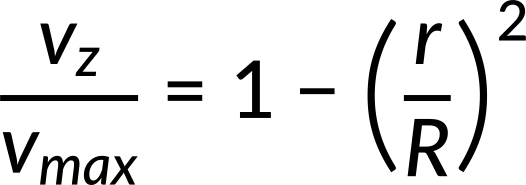
This profile demonstrates that viscous drag decreases the fluid velocity from the maximum at the center to zero at the tube wall. This zero velocity at the boundary, known as the no-slip condition, results from the friction between the fluid and the tube wall. Consequently, the flow is laminar, with fluid particles moving in parallel layers without lateral mixing.
Integrating the velocity profile over the cross-sectional area of the tube yields the volumetric flow rate Q, known as Poiseuille's law:
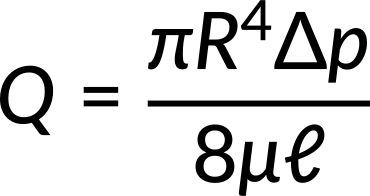
Where ΔP is the pressure difference across the length L of the tube, and μ is the fluid's dynamic viscosity. This relation shows that Q is highly sensitive to the tube's radius, increasing with the fourth power of R. It follows that even a slight increase in radius significantly boosts the flow rate, a principle critical in fluid transport applications.
From Poiseuille's law, the mean velocity V of the fluid can be expressed as:
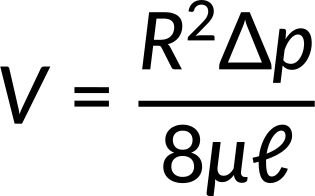
This average velocity is precisely half of the maximum velocity at the tube's center, confirming the parabolic velocity distribution and demonstrating the predictable, layered nature of laminar flow in a cylindrical tube.
From Chapter 19:
Now Playing
19.9 : Steady, Laminar Flow in Circular Tubes
Differential Analysis of Fluid Flow
98 Views
19.1 : Euler's Equations of Motion
Differential Analysis of Fluid Flow
217 Views
19.2 : Stream Function
Differential Analysis of Fluid Flow
878 Views
19.3 : Irrotational Flow
Differential Analysis of Fluid Flow
221 Views
19.4 : Velocity Potential
Differential Analysis of Fluid Flow
187 Views
19.5 : Plane Potential Flows
Differential Analysis of Fluid Flow
204 Views
19.6 : Navier–Stokes Equations
Differential Analysis of Fluid Flow
244 Views
19.7 : Steady, Laminar Flow Between Parallel Plates
Differential Analysis of Fluid Flow
92 Views
19.8 : Couette Flow
Differential Analysis of Fluid Flow
136 Views
19.10 : Design Example: Flow of Oil Through Circular Pipes
Differential Analysis of Fluid Flow
83 Views

Copyright © 2025 MyJoVE Corporation. All rights reserved