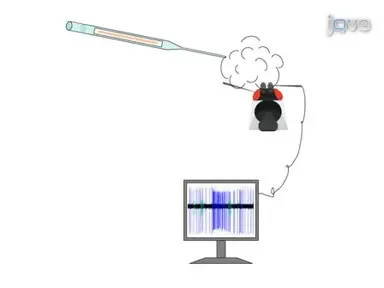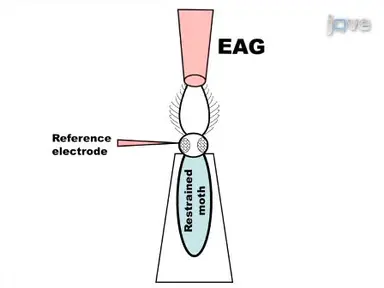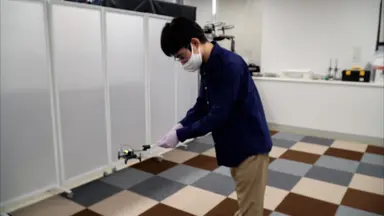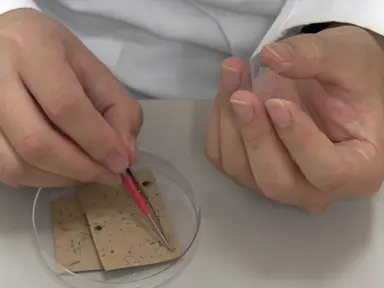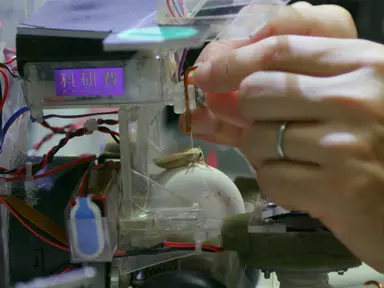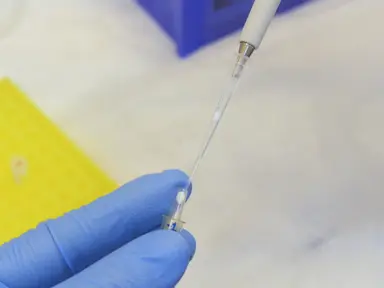
The overall goal of this procedure is to record electrograms or EEGs from a whole insect preparation and use insect antennae as biosensors in olfactory robots. This is accomplished by first tethering the animal in a styrofoam block. The second step is to place two EAG electrodes, a reference electrode into the neck of the insect, and a recording pipette at the tip of the antenna.
Next, the electrodes are connected to an electrophysiology board with adequate signal amplification and filtering. The final step is to mount the EAG preparation on a mobile robot. Ultimately, results can be obtained to show olfactory navigation towards an odor source by using identical sensors as in real animals.
This robotic platform provides a direct means for testing hypotheses about olfactory coating and olfactory navigation in insects. The advantage of the technique we are going to present today as compared to existing methods based on excise and antenna E, is that it allows stable recordings for a longer period of time. To record the EAG from a whole insect preparation first chlorinate two silver wires by immersion in concentrated bleach solution for 10 to 20 minutes and rinse afterwards.
This process prevents electrodes from polarizing Make glass electrodes from fire polished capillaries with an electrode polar fire polishing prevents scratching of the chlorinated silver wire with electrodes. Next, anesthetize a male moth with carbon dioxide and place it inside a styrofoam block with the head protruding from the top, tether the insect's head with painter's tape around the neck, insert a silver wire serving as the reference electrode into the neck. Under a stereo microscope, immobilize one of the antennae with thin strips of painter's tape on the tip and the base.
Cut out the distal two to three segments of the antenna with surgical scissors. Then position the glass electrode near the cut tip of the antenna with a micro manipulator. Cut out the extremity of the glass capillary with forceps to obtain a diameter slightly larger than the cut tip of the antenna.
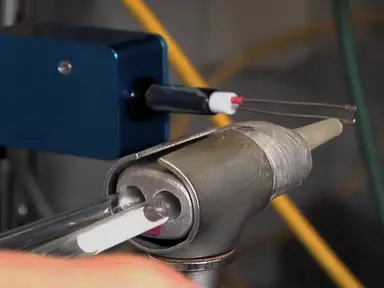
Fill the glass pipette with the buffer solution. Then insert the cut tip of the antenna into the glass capillary with the micro manipulator. Finally, slip the silver wire serving as the recording electrode into the largest extremity of the glass capillary mount the whole preparation.
That is the insect electrodes and micro manipulator onto a metal plate screwed on the top of the robot. Design a hardware interface to adapt the EAG output voltage to the range appropriate for the extension board of the robot as described in the text protocol. Briefly include a high input impedance amplifier, a low and high pass filter, and a second stage amplifier.
Next, connect the electrodes to the differential EAG inputs. Connect the recording electrode to the inverting input of the pre amplifier to obtain positive EEGs. A custom c plus plus software was developed to implement a graphical user interface and various functions for signal detection and for controlling the robot.
Signal detection can be performed by modeling the neural mechanisms that allow fast and reliable pheromone detection. In mths by mimicking biology in mths central neurons receiving input from the antenna respond to the pheromone with a stereotypical firing pattern of excitation inhibition To achieve signal detection, implement the neuron model as differential equations, which can be found in the text protocol. Detect the pheromone hits whenever a burst of excitation defined as three consecutive interspike intervals.
Smaller than 70 milliseconds is followed by inhibition defined by an interspike interval of greater than or equal to 350 milliseconds. EEGs in response to pheromone pulses are shown the measurement system can resolve pheromone pulses up to 10 hertz. The EAG was recorded periodically in response to pheromone stimulations to test the stability over time of the whole insect preparation.
As compared to the excised and antennae, the whole insect preparation shows good stability within a working day. In contrast, EEGs recorded on isolated antennae decrease rapidly over time so that the signal falls to one half of its initial value after only 1.5 hours. This time, dependence is described by an exponential decay with a lifetime two hours.
Finally, the ability of the EAG robotic platform to search for an odor source using a reactive search strategy was tested. The search strategy combines upwind surge every time the pheromone is detected with spiral casting. In the absence of detections without the odor source, the EAG remains around zero with very few or no detections, the robot performs spiral casting and generally leaves the search space before reaching the target location.
Conversely, with the odor source, the EAG presents bursts of activity from detections intertwined with periods of silence from no detections. Spiral casting mainly occurs at the plume contour and appears to be an efficient strategy for relocating the plume center line when the odor is lost. After watching this video, you should have a good understanding on how to record electron telegrams from a wall insect preparation, and using insect antenna on olfactory robots.