The overall goal of this procedure is to isolate the rare reprogramming intermediates from cultures of reprogramming mouse embryonic fibroblasts. This is accomplished by first deriving mouse embryonic fibroblasts from E 13.5 embryos of a reprogrammable mouse strain. In the second step, the low passage mouse embryonic fibroblasts are seeded in induced pluripotent stem or IPS cell media supplemented with doxycycline to initiate the reprogramming process.
Next, the cells are harvested at selected time points during reprogramming and labeled with antibodies against specific cell surface markers. Ultimately, the rare reprogramming intermediates can be isolated by facts for further experimental analysis. The main advantage of this technique of existing methods is that mechanistic studies can be performed on the rare reprogramming intermediates in the absence of cells refractory to the reprogramming process, which make up the bulk of the population To generate mouse embryonic, fibroblasts, or mes begin by transferring an embryonic day 13.5 uterine horn into a 10 centimeter tissue culture dish containing 10 milliliters of sterile PBS.
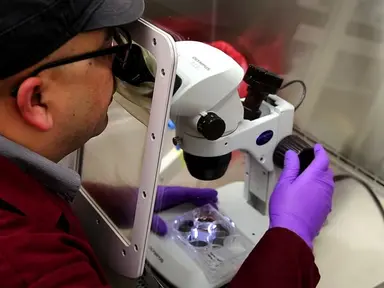
Then use sterilized surgical grade scissors to cut the horn into individual pieces each containing one embryo. Next, under a dissection microscope in a tissue culture hood, use sterilized forceps to carefully remove the uterine envelope and the extra embryonic membrane surrounding each embryo and transfer each denuded embryo into individual 10 centimeter dishes with 10 milliliters of fresh PBS. Then proceed by removing each embryo's head, limbs, tail, and internal organs with forceps.
Freeze the heads in individual 1.5 milliliter tubes for genotyping as necessary. Transfer each torso into new individual 10 centimeter plates and use two surgical blades to mince each embryo for two minutes. Digest the tissue pieces in 200 microliters of trypsin EDTA for three to five minutes at room temperature, followed by an additional two minutes of mincing.
Then inactivate the tryin with two milliliters of meth media and transfer the cell slurry to a 15 milliliter tube using a 1000 microliter pipette. Further mechanically dissociate the tissue with gentle pipetting and then transfer the cell solution to a gelatin coated 10 centimeter dish. Add an additional 10 milliliters of meth media to the culture.
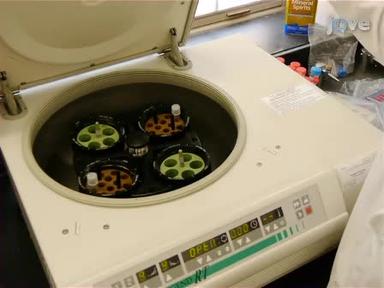
After 24 to 48 hours, the plate should be densely covered with MEFs to reprogram the MEFs first thaw a low passage frozen meth culture in a 37 degree Celsius water bath, and then transfer the contents into a tube containing 10 milliliters of prewarm meth media. After spinning down the cells, resuspend the pellet in 12 milliliters of fresh meth media and transfer the cell suspension into a gelatin coated T 75 culture vessel. After a 24 to 48 hour recovery period, wash the MEFs with PBS and then detach the cells with three milliliters of trypsin EDTA for three to five minutes at 37 degrees Celsius.
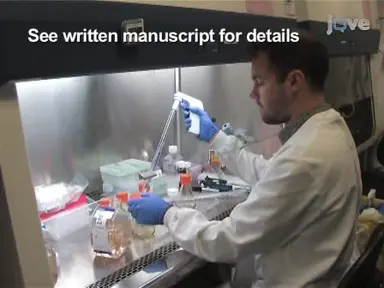
Then stop the enzymatic digestion with five milliliters of meth media and further dissociate the cells by gentle mixing with a 10 milliliter pipette. Next, reprogram the mets by seeding the cells onto new gelatin, coated T 75 flasks at 6.7 times 10 to the third cells per square centimeter in 12 milliliters of IPSC media containing two micrograms per milliliter of doxycycline for the first six days. Replace the media every other day with fresh doxycycline supplemented IPSE media harvesting the reprogramming intermediates at the required time points by trypsin EDTA detachment as just demonstrated for each harvested intermediate suspension.
Wash the cells in PBS. Then resus. Suspend the pellets in fax media for antibody labeling to establish fully reprogrammed IPSC cultures.
Grow the cells in doxycycline free IPSC media for a further four to seven days to label the reprogrammed cells. Label the harvested intermediates with the appropriate antibodies of interest. After 10 minutes, gently tap the tubes to resuspend the cells and then place the tubes on ice for an additional 10 minutes.
After the second incubation, wash the cells in 10 milliliters of cold PBS per tube. Then carefully aspirate the supernatant and resuspend the pellets in an appropriate volume of labeling media supplemented with strippin P size seven on ice. After 20 minutes, wash the cells in another 10 of cold PBS and resuspend the cell pellets in labeling media supplemented with propidium iodide.
Filter out any cell clumps by passing the suspension through a 70 micrometer strainer and then transfer the cells to the appropriate corresponding fax tubes on ice. For the compensation controls. Resus suspend a cryo vial of IPS cells maintained on irradiated mes in 800 microliters of labeling buffer.
Setting aside 200 microliters of cells for the unlabeled control control. Then split the remaining cell suspension between three 15 milliliter tubes for the single color controls and label the samples as just demonstrated to analyze the intermediates by flow cytometry. Begin by setting a gate in the forward by side scatterplot to exclude debris.
Then use the forward scatter height versus the forward scatter area to exclude the aggregates and the PI channel versus the forward scatter. To gate on the PI negative live cells. Use the unlabeled cells to adjust the voltages for the Pacific blue FITC and PSI seven channels.
Ideally positioning the cell population at the lower end of the respective channel. Next, set the gates with the unlabeled control cells to subfraction the reprogramming cultures into day three, six, and nine. Populations of SSEA one negative TH 1.2 positive cells SSEA one negative TH 1.2 negative cells and the reprogramming intermediates SSEA one positive TH 1.2 negative cells.
Then further subdivide the day nine SSEA one positive TH 1.2 negative fraction with the SSEA one versus EPAM plot. Using the unlabeled control draw gates around the EPAM positive cells and the EPAM negative cells as shown here. Finally, collect the cells in one to two milliliters of IPS cell media.
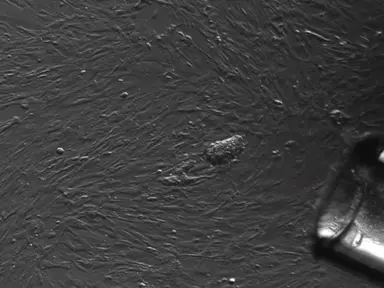
Upon doxycycline induction reprogramming myths undergo distinct morphological changes around day six. Early colony like patches start to emerge that continue to grow in size upon further culture. A good reprogramming experiment will result in greater than 500 colonies per T 75 initially seeded with five times 10 to the fifth cells and established IPS cultures will possess characteristic dome shaped colonies and be mostly devoid of differentiated cells.
Morphological and molecular changes during reprogramming are reflected in changes in the cell surface expression of thigh 1.2 SSEA one, and ultimately epca. While MES are predominantly positive for thigh 1.2 and negative for the other markers, by day three, a large proportion of cells have started to down regulate the expression of thigh 1.2, and a very small subset has become SSEA one positive. The actual reprogramming intermediate for this time point on days six and nine, an increased percentage of SSEA one positive cells, usually well above 10%can be detected by around day 12.
A subset of SSEA one positive cells can be detected that are also positive. For epca. Established bonafide IPS cell cultures will be strongly positive.
For SSEA one and EPCA While attempting this procedure, it is important to remember to only use low passage maps that have been properly genotyped beforehand.