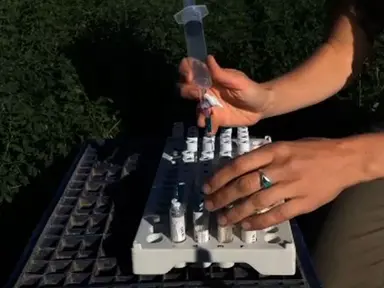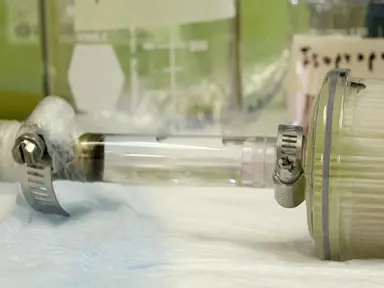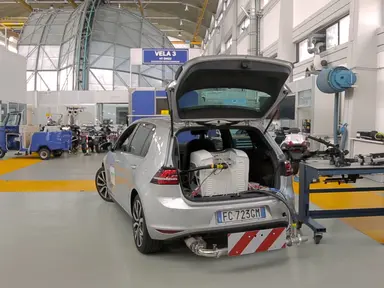
The overall goal of this procedure is to measure methane and carbon dioxide emissions from the breath of ruminant animals in T stalls. This is accomplished to buy first training the animals to use the automated head chamber system or a HCS with a tantalizing bait feed. The second step is to calibrate the system using gas standards and to standardize the feed delivery.
To take measurements. The system is positioned in front of the animal while feed is delivered for five minutes. To keep the animal's head in the feeding trough between measurements, the system is pulled away from the test animal for two minutes to sample the background air.
Ultimately, repeated samples from each animal are uploaded and analyzed on the green feed website. The main advantage of this technique over existing methods like the respiration chambers and sulfur hexa fluoride tracer gas method is that the automated head chamber system or green feed is simple to operate and does not require complicated and expensive analytical equipment. This method can help answer key questions in the methane mitigation field and describe the relatively inexpensive technique for measuring methane.
In ruminants, Though, this method can be used to quantitatively measure methane fluxes. Additional sensors can be added for carbon dioxide, molecular hydrogen, hydrogen sulfide, and oxygen. This saw demonstration of this method is critical as the five steps are difficult to learn because the animal cells should be continuously kept in the feeding trough.
For these experiments, use non cannulated intact cows. Cannulated cows have potential for room and gas leakage requiring additional equipment and measurement protocols. For a crossover experimental design use eight to 12 cows.
Depending on the number of treatments, a replicated design is utilized to balance residual effects. Each cow must be given an RFID tag compatible with ISO 1 1 7 8 4, or 1 1 7 8 5. The duration of randomized block design experiments is from eight to 12.
With the first two weeks being for adaptation to treatment, At least one week before the experiment begins, transfer the A HCS to where the cows are housed so they can see it. Let the cows acclimate to its presence for a few days. Before proceeding to entice the animals, use a pelleted feed containing molasses.
Introduce a handful of bait feed to each animal sprinkled on top of the regular feed. This is just to familiarize the animals with the bait feed. Next, very slowly move the A HCS to within 1.5 meters of the animals.
Then load a kilo of bait feed into a bucket and offer it to the animals. Gradually move the bucket towards the feeding trough of the A HCS. Dump some into the trough and slowly move the A HCS unit towards the cows.
The goal is to get the animals to stretch out to the trough for the bait feed. If the cows become apprehensive or scared, move the unit away and try again later on or not until the following day. Animals that aren't able to get used to the unit will need to be replaced.
One successful, repeat the process over the course of seven days. To customize the animals prepare gas standard bags and take them to the A HCS unit. Turn on some fans if the location is enclosed like a dairy barn.
After letting the unit warm up for 30 minutes or more, remove the stopper from the calibration tube in the inside front panel. Then connect the nitrogen gas bag to the calibration tube to zero. The unit unscrew the steel valve on the bag.
One full turn to open the airflow. Then switch the run calibrate knob to the calibrate position. When the air starts flowing, press and hold the calibrate button for 10 seconds.
The sample bag should deflate to about 10%of its capacity. Do not let it empty completely. Then switch the knob back to run.
Close the sample bag and deach it from the unit and connect the span gas mixture bag. Hold down the calibrate button for just three seconds. Then turn the run calibrate knob to run and disconnect the sample bag and replace the stopper into the calibration tube.
If the calibration was performed correctly, factor values will now appear on the data tab of the website integrated to the device. A carbon dioxide recovery test should be performed at least once before every gas measurement experiment. To run the test, close the valve perpendicular to the outlet nozzle, which is for carbon dioxide, and attach a new CO2 cylinder.
Once attached, confirm that gas flows from the tank using the system's valve. Now place the entire release system on the scale and record the initial mass. This is the zero point.
Next, attach the cylinder holder to the feeding trough. The animals need to be kept apart from the feeder. During this test, put the cylinder into its holder and direct the nozzle to the manifold.
While doing this, do not breathe into the feeder. Next, open the gas valve. Take note of the time and back away from the unit.
After three minutes, close the gas valve. Then without releasing any more gas, transfer the cylinder to a tub of warm water to warm the cylinder back to room temperature. This process only needs to be done if the temperature is below negative 10 degrees Celsius.
Once warmed up, wipe the cylinder off with a cloth and weigh again to know its final mass. After three minutes, the recovery test can be repeated. Repeat the recovery test at least three times.
After calibrating the system and letting it warm up for at least 30 minutes, position it so that airflow from the barn fans enters into the feeding trough For two minutes, let the unit sample this background airflow. After a couple of minutes, press the feed delivery button for three seconds. Visually confirm that about 50 grams of feed was delivered into the trough.
Then move the A HCS to a cow record, the time and animal id. Provide a bolus of feed every 50 seconds over a period of five minutes. If extra feed is needed, provide it and make note of it.
While feeding the device senses the cow's head position relative to the intake manifold. After five minutes, pull the unit away from the cow and position it so the fans blow air over the feed trough and wait two minutes before proceeding. Now, repeat the process on the next animal.
Over the course of three days, do this. A total eight times per animal in the study stagger out the feedings evenly. Over this time span, the gas emission data is supplied on the webpage associated with the unit using the described protocol, methane production was measured from dairy cows fed enriched diets.
Ad-lib methane production clearly increased. After such feedings, a crossover design trial was made using low grade cashew nut shell liquid as methane mitigating. Agent eight Holstein cows were tested for 21 days.
The cashew nut liquid tended to decrease methane production by about 5%After watching this video, you should have a good idea of how to quantitatively measure methane and carbon dioxide from the breath of ruminant animals. While attempting this procedure, it is important to remember that the animals must be trained by attractive bait in advance Following this procedure. Emissions fermentation gases such as hydrogen can also be measured.
There are currently some users who have systems modified to measure oxygen consumption and animal energetics as well. This technique allows to measure accurately and in a practical and non invasive way, and enteric methane and carbon dioxide emission from ruminant animals.