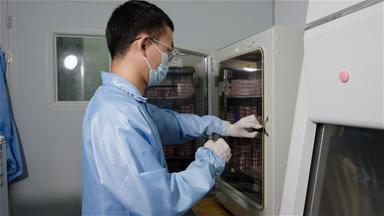
We focus on exploring active compounds derived from natural products and their potential in treating breast cancer. So specifically, we aim to alluded the pharmacological effects of cellular side and its molecular mechanisms in combating breast cancer. Currently, reliable experimental techniques are lacking to validate the salidroside molecular targets in treating breast cancer.
One significant finding in the field is a potential proliferation and migration of MCF-7 cells through the regulation of PI3K-AKT-HIF-1a-FoxO1 segmenting. The laboratory's future research directly is to explore the pathologic mechanisms underlying breast cancer onset, development, prognosis, and outcome. Additionally, we screen for actual small natural drugs derived from nature sources that may add in breast cancer prevention and treatment.
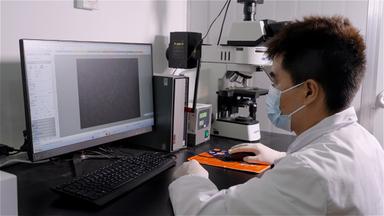
To begin, incubate two milliliters of the cultured MCF-7 cells in a six well plate until 90%confluency. In the grown cell monolayer, create a linear scratch wound down the center using a sterile pipette tip. Then capture the images with an optical microscope at different time intervals.
For the transwell assay, suspend MCF-7 cells in a serum-free medium. Then seed the cells in the upper transwell chamber, either pre-coated or non-coated with matrigel. Add DMEM complete medium at the bottom of the transwell chamber to act as a chemical inducer.
After 24 hours, remove the cells in the upper chamber and fix the remaining invasive and migrant cells using methanol. Stain the MCF-7 cells using crystal violet solution. Next, image the stained cells with an optical microscope.
A dose-dependent inhibitory effect of salidroside side on cell proliferation was observed, with a 50%decline in cell vitality at 40 micromolar. Further, salidroside could inhibit the vitality of MCF-7 cells over time, with a 50%decrease in MCF-7 cell vitality after 24 hours of co-incubation. The wound scratch assay showed an inhibitory effect for salidroside treatment on MCF-7 cells.
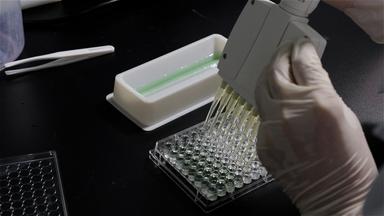
Further, salidroside treatment significantly reduced the undesirable migration and invasion of MCF-7 cells. Using a bicinchoninic acid kit, measure the protein concentration of lysed MCF-7 cells following the manufacturer's instructions. Add the lysed cell samples into the corresponding groups in a 96 well plate.
Then add the working solution and incubate a 37 degrees Celsius for five minutes. Finally, measure the optical density values at 636 nanometers in a functional microplate reader. Salidroside restricted the enzyme vitalities of sodium potassium ATPases and calcium ATPAs, indicating its potential role in promoting mitochondrial dysfunction.
To begin, harvest the trypsinized MCF-7 cells. Next, stain the PBS suspended cells with an XN5 FITC and propidium iodide for 20 minutes. Then determine the number of apoptotic cells using a flow cytometer.
For cell cycle analysis, mix the resuspended cells with propidium iodide solution in a fresh tube and incubate the mixture for 30 minutes. Then detect the sample using a flow cytometer. Salidroside increased the number of MCF-7 cells in the early and late episodic stages.
Meanwhile, compared with the control group, salidroside treatment also sharply increased the number of cells in the G0 G1 phase while reducing the proportion of S-phase cells. Add 10 micromolar of DCFH-DA's fluorescence probe to MCF-7 cells and incubate at 37 degrees Celsius for 20 minutes. After incubation, remove the excess DCFH-DA by washing the cells three times with PBS.
Next, test the fluorescence intensity using a fluorescence microscope and an excitation wavelength of 488 nanometers and an emission wavelength of 525 nanometers. Incubate the MCF-7 cells with a five micromolar Fluo-4 AM fluorescent probe solution for 45 minutes at 37 degrees Celsius. After washing the cells three times with PBS, determine the fluorescence intensity using a fluorescence microscope with excitation at 488 nanometers and emission at 516 nanometers.
Salidroside significantly enhanced ROS fluorescent signals shown by DCFH-DA immunofluorescent staining. Consistently, salidroside intervention also distinctly elevated calcium production evidenced by Fluo-4 AM immunofluorescent staining. Begin by adding two milliliters of MCF-7 cells containing different drugs into the wells of a six well plate.
Incubate the cell cultures for 24 hours at 37 degrees Celsius and 5%carbon dioxide. Harvest the cells by centrifugation at 560G for three minutes at four degrees Celsius. Then wash the cells twice with pre-cooled PBS, centrifuging at 560G for three minutes between the washes.
Add 50 microliters of lysis buffer to the washed cells, and place the sample in an ice bath for 15 minutes. Then centrifuge the sample at 8, 550G for 10 minutes at four degrees Celsius, and collect the supernatant protein sample. Combine the protein sample with the loading buffer in a four to one ratio.
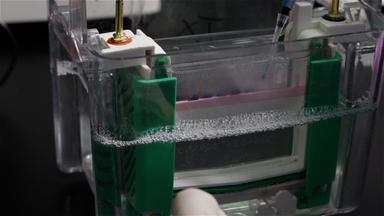
Next, denature the mixture at 100 degrees Celsius for 10 minutes in a metal bath. Then cool the mixture at room temperature. Separate the protein sample using 10%SDS polyacrylamide gel electrophoresis.
Transfer the proteins onto a 0.22 micrometer PVDF membrane. After blocking the membrane with 5%BSA, incubate it with the corresponding primary antibodies overnight at four degrees Celsius. The following day, incubate the membrane with goat anti-rabbit IgG secondary antibody at 37 degrees Celsius for two hours.
Then develop the membranes using an ECL chemoluminescence solution, and capture the images using a contactless quantitative western blot imaging system. Western blot showed that salidroside treatment promoted the protein expression of the pro-apoptotic factors CC9, CC7, CC3, Bim, and Bax, while it inhibited the protein expression of anti-apoptotic BCL2. Salidrosdie prominently limited the ratios of PPI3K to PI3K and PAKT to AKT.
Meanwhile, the protein expression of mTOR, HIF-1-alpha, and Fox01 was also notably suppressed. Harvest the MCF-7C cells by centrifugation at 560G for three minutes at four degrees Celsius. Add 500 microliters of buffered RL1 to five times 10 of the six cells, and mix thoroughly until no cell masses are visible.
Next, transfer the cell homogenates to a DNA cleaning column embedded in the collection tube. Centrifuge the samples at 8, 550G for two minutes at four degrees Celsius. After centrifuging, remove the DNA cleaning column, retaining the supernatant in the collection tube.
Add 800 microliters of buffer RL2 and 500 microliters of the supernatant and mix gently. Next, transfer 700 microliters of the mixture into an RNA only column embedded in the collection tube. Centrifuge the tube at 8, 550G for one minute at four degrees Celsius.
Then discard the flow-through in the collection tube. Wash the RNA only column first with 500 milliliters of buffer RW1, and then with 700 milliliters of buffer RW2 by centrifuging for one minute at 8, 550G and four degrees Celsius at each wash. After removing the residual RW tube by centrifuging again, transfer the RNA only column to a new collection tube.
Add 100 microliters of RNAse-free deionized water preheated at 65 degrees Celsius to the center of the membrane in the RNA only column and wait for two minutes. Then centrifuge at 8, 550G for one minute at four degrees Celsius to collect the RNA solution. Set up the reaction mixture for PCR and then set the PCR reaction conditions of the system.
Execute the qRT-PCR procedure. QRT-PCR showed that salidroside treatment promoted the gene expression of the pro-apoptotic factors CC9, CC7, CC3, Bim, and Bax, while it inhibited the gene expression of anti-apoptotic BCL2. Further, salidroside administration reduced the gene expression levels of PI3K, AKT, mTOR, HIF-1-alpha, and Fox01.