This protocol demonstrates the construction of lengthy and the intricate gene expression vector. When the full-length fragment cannot be obtained by a single PCR from a cDNA, or the full-length gene expression vector cannot be obtained by multiple insert homologous recombination in vitro, this method is applicable. Currently, multiple insert ligation Cloning is used to obtain full-length DNA fragment for cloning into a suitable vector.
This method can achieve deletion or mutation of target genes and efficiently join a large number of DNA fragments to the expression vector. To begin, open the software and select the option to create a new DNA file. Prepare the PRRSV gene sequence from NCBI and click OK to generate the sequence files.
Analyze the sequence and mark the fragment junctions. Identify all the junctions before designing the specific sequence primers for the fragments. Then, click on Primers and choose Add Primer.
Paste the specific sequence and add overlap sequences of the vector to the first five prime nucleotide of the primer. Name the forward primer and click on Add Primer to Template to incorporate the designed primer into the template. Then, mark the fragment junctions and design the reverse specific sequence primer of the fragments.
Again, navigate to Primers and select Add Primer. Input the specific sequence. Add the restriction site to the first five prime nucleotide.
Also, include 20 to 40 base pairs of vector overhang sequences to the first five prime nucleotide of the restriction site. Name the reverse primer and select Add Primer to Template. Next, set up six individual PCR reactions using the six fragments and designed primer pairs.
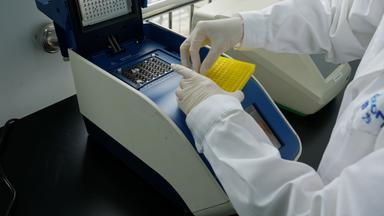
Run the PCR following a three-step protocol, as shown here. After PCR completion, pipette 1 microliter of 6x DNA loading buffer with 5 microliters of the PCR product. Mix and centrifuge briefly.
Analyze the samples using 1%agarose gel electrophoresis. To construct a full-length gene, insert fragments of PRRSV were amplified using six PCR reactions. The sizes of the fragments were confirmed by agarose gel electrophoresis.
Begin by linearizing the vector. Prepare the reaction mixture containing specific restriction enzymes at room temperature. Use a gel extraction kit to purify the linearized vectors, then incubate at 37 degrees Celsius for 60 minutes.
Then, assemble the ExonArt Seamless Cloning and Assembly reaction to subclone the PRRSV gene. Adjust the total reaction volume to 10 microliters with sterilized deionized water. Then, thoroughly mix.
Incubate the mixture in a thermocycler for 15 to 60 minutes at 50 degrees Celsius. Afterwards, store the samples on ice. After transforming the vector into competent cells, pick 8 colonies into 20 microliters of LB medium containing kanamycin.
Set up a colony PCR reaction to analyze the transformants. A full-length PRRSV over expression vector was obtained by introducing PRRSV fragment 1 into the pVAX1 vector, creating pVAX1-F1. Successive rounds of recombination using specific restriction enzymes resulted in incorporation of fragments 2 through 5, visualized by an increase in plasmid size.