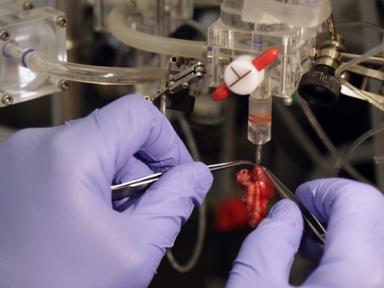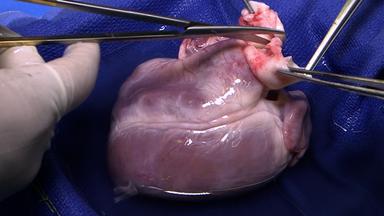
The scope of this research covers two important areas of cardiac ex vivo machine perfusion. First, it highlights the shortcomings of current clinically used assessment metrics in determining graft viability and transplantability. Second, it provides an alternative assessment technique capable of discerning between viable and unviable grafts, even when conventional metrics fail to do so.
Through this work, we developed a gravity-dependent loading reservoir that significantly simplifies and standardize the incorporation of loading capabilities into existing ex vivo machine perfusion systems. This, in combination with passive afterload, seems to significantly increase the predictive capabilities of the technique. The field has been in dire need of quantitative assessment metrics that eliminate the subjectivity of current practices.
This work offers a method to obtain quantitative objective metrics for assessing graft viability. This assessment method is expected to significantly improve the ability to draw conclusions from both experimental and clinical setups. To begin, start mounting the organ chamber on its stand, followed by the windkessel bag and the smaller reservoir.
Verify that all components are securely connected. Then attach one end of a quarter inch silicone tubing to the outflow port of the oxygenator and a Y connection at the distal end. To one side of the Y connector, attach another quarter inch silicone tubing with a lure connection and connect the other end to the bottom port on the windkessel bag.
After that, fix a three-way lure valve to the expander's lure connection for adenosine drip delivery. Place a Hoffman clamp on an additional piece of quarter inch silicone tubing. For loaded perfusion, attach one end of this line to the second end of the Y connector and the other end to the top of the smaller reservoir tubing to control reservoir filling.
Ensure that the clamp is fully engaged at this time. Then connect an overflow line from the top of the loading reservoir to the larger reservoir. Fit a quarter inch tube to the bottom of the loading reservoir and connect it to a port at the base of the organ chamber.
Ensure that the line has a one-way valve. Next, insert two three-way lure valves midway through the tubing for adenosine delivery and a one-way valve before reaching the organ chamber. Fit the second overflow port at the bottom of the windkessel bag with three by eight inch tubing, connecting it to any inflow port of the venous reservoir.
Afterward, close the Hoffman clamp completely during Langendorff mode and adjust it during loaded mode to modulate aortic pressures. Then connect a three-way lure valve to the overflow port at the top of the windkessel bag. Use a quarter inch tubing to connect the overflow port at the top windkessel bag to any inflow port in the venous reservoir.
Connect the third outflow port on the windkessel bag to the aortic port on the organ chamber, inserting a temperature probe in the lower three fourths of the tubing length. To begin, take the isolated pig's heart and cut the branches of the aortic arch to form a single outflow tract. Insert the aortic cannula through the tract.
And secure it using a zip tie and 4-0 silk suture. Then place a bipolar pacing wire on the posterior wall of the right ventricle. Create two per-string 4-0 Prolene sutures around the perimeter of the left atrium tract.
Secure the sutures with tourniquet snares, but do not tie them until loading. Lastly, close the left atrium appendage with a simple continuous 4-0 Prolene suture. Then record the initial heart weight.
To begin clamp the three by eight inch tubing right before the aortic port to stop perfusate flow. Position the prepared pig's heart with its posterior wall facing the operator, and angle the organ chamber at roughly 20 degrees. Then place the aortic cannula at a 90-degree angle from the aortic port and unclamp the aortic line slowly.
De-air the aortic cannula by allowing perfusate to flow into it gradually. Now slowly decrease the angle of the aortic cannula until it aligns with the aortic port. Then fully connect it to the aortic line.
Once fully connected, gently massage the heart intermittently to prevent distension due to left ventricular filling. Vent the left ventricle through the open left atrium during this period. Start data acquisition and initiate the adenosine drip at 333 microliters per minute.
Then connect the pacing wires to the pacing box and set it to 60 beats per minute for backup pacing. If fibrillation is present, defibrillate the heart using 30 joules paddles. Once an organized rhythm is present, discontinue manual venting and place EKG leads directly on the heart using hook needles.
Connect the right angle cannula to the atrial port of the organ chamber. Once connected, clamp the cannula and release the Hoffman clamp in the line between the oxygenator and the loading reservoir to allow fluid into the loading reservoir. Then fill the loading reservoir until the pressure reaches 15 to 20 millimeters of mercury.
Increase the pump output to maintain both aortic and atrial pressure. Next, insert half of the right angle metal tip into the left atrium with the tip pointing toward the appendage to promote mitral valve competence. Insert the pressure sensor inside the left ventricle to record left ventricular pressure.
After that, release the clamp on the cannula to allow the left atrium to fill. Once de-aired, use the previously placed sutures and tourniquet snares to close the left atrium opening completely. Adjust the cannula and snares as needed to minimize fluid leakage.
After securing the cannula in the left atrium, clamp the line from the oxygenator to the windkessel bag to completely stop retrograde perfusion to the aorta. Finally, move the adenosine drip from the line leading to the windkessel bag to the line between the loading reservoir and the atrial port. Vascular resistance, oxygen uptake rate, lactate accumulation, glucose consumption and potassium accumulation showed no statistical difference throughout the perfusion period.
Similarly, no difference was seen in the weight gained by the grafts. However, failing grafts heart rate steadily declined after two hours of loaded time, with the area under the curve showing no statistically significant difference until three hours of perfusion. Additionally, loading-dependent metrics suggested a loss of cardiac function as early as 30 minutes into loading time with the measure for contractility being the first metric to indicate a loss of function.
Like heart rate, left ventricular pulse pressure steadily declined after two hours of loaded perfusion, with statistically significant differences between grafts, pulse pressure and relaxation seen after 1.5 hours of perfusion.