11.7K Views
•
08:25 min
•
July 3rd, 2015
July 3rd, 2015
•The overall goal of this procedure is to grow thin films of vanadium tetra siano ethylene via chemical vapor deposition with optimal magnetic properties. This is accomplished by first synthesizing the tetraethyl ammonium hexa caril vanadate precursor. The second step is to synthesize vanadium hexa caril from tetraethyl ammonium hexa carone vanadate.
Next, the chemical vapor deposition reactor is assembled. The final step is to deposit films of vanadium tetra ciano ethylene via chemical vapor deposition from the tetra ciano ethylene and vanadium hexa caril. Ultimately, ferromagnetic resonance is used to show a spectrum with a single resonance feature with full width at half maximum line width of less than two GOs.
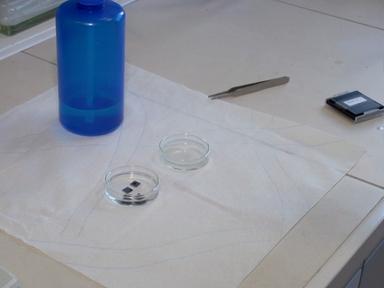
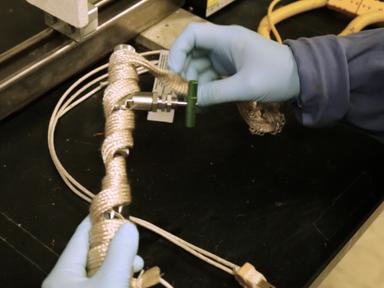
The main advantage of this technique of existing methods like solution processing is sym of material can be deposited on a variety of substrates for incorporation into electronic devices. Generally, individuals new to this method will struggle because there's a lot of optimization of different parameters required to grow good films. Prior to starting this procedure, prepare the tetraethyl ammonium hexa caril vanadate precursor as described in the text protocol Following this grease, the connection points for a vacuum adapter with stop cock a glass two-way connecting tube and a cold finger.
Place a cold finger in the center neck and a vacuum adapter with stop cock. In the third opening in an Argonne glove box, mix 100 milligrams of tetraethyl ammonium hexa caril vanadate with one gram of phosphoric acid in a round bottom flask containing a magnetic stirring bar. R connect the round bottom flask to a three neck round bottom flask via the glass two-way connecting tube in the glove box.
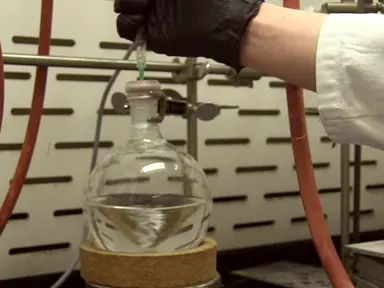
Following this, remove the sealed flask system from the glove box and set it up in a chemical hood, add methanol to the cold finger and stir with a spatula while adding liquid nitrogen until the methanol is frozen. Then pump down the system by opening the stop cock to a vacuum line until the pressure reaches approximately five times 10 to the minus two tor submerge the round bottom flask in an oil bath set to 45 degrees Celsius and turn on the magnetic stirring once the reaction starts. Observe the phosphoric acid melting and a black blue powder condensing on the cold finger.
When a black powder condenses on the round bottom, flask open the vacuum line, pump the system back to approximately five times 10 to the minus two tor before closing again. After rotating the reaction flask to mix all of the reactants, allow the reaction to continue until the remaining residue in the round bottom flask is white, gray and no longer bubbling. Following this, pour copper pellets into a cold, safe container and cool with liquid nitrogen.
Remove the methanol from the cold finger with a micro pipette. Then pour the chilled copper pellets into the cold finger to keep it cold. During transfer to the glove box, wipe the oil and condensed water off the flask system before transferring it into the Argonne glove box.
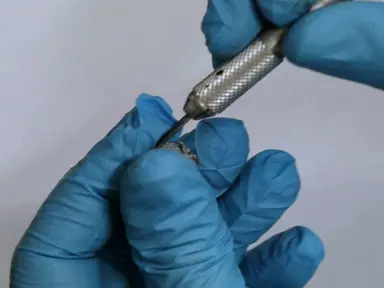
Inside the glove box, remove the cold finger from the flask system and use a spatula to scrape the black powder onto a piece of weighing paper. At this point, slide the preheated glass heater coil around the reactor. To begin the deposition, wrap a glass slide with polytetrafluoroethylene thread seal tape.
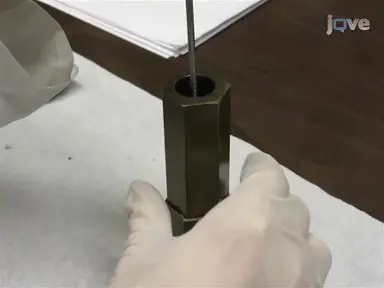
Arrange the samples on top of the covered slide within a two inch space. Then push the glass slide into the reactor so the samples are located in the reaction zone. Place an O ring on part B and slide it into the right side of the reactor.
Join the two pieces together with a clamp. Following this, attach a vacuum line to the bottom connection on the reactor and attach the gauge to the top connection. Add 50 milligrams of tetro siano ethylene or TCNE into the TCNE boat.
Slide the TCNE boat into part C near the end so that the TCNE will sit in the hottest part of the reactor, which should be about 75 degrees Celsius. Next, grease the connection of part C and slide it into the left side of the reactor. Then add five milligrams of vanadium hexa caril into the tbo, grease both sides of the tbo, and slide it into the right end of part B.Slide the flow line onto the right side of the tbo and left sides of part C and clamp in place.
After raising the oil bath to cover the entire bottom of the tbo, open the vacuum line to reach a pressure of 30 to five millimeters of mercury. Set the flow rate to 56 standard cubic centimeters per minute for the vanadium hexa caron and to 84 standard cubic centimeters per minute. For the TCNE opt optimized fields yield an extrapolated curie temperature or TC around 500 to 600 kelvin.
Due to film breakdown above room temperature, the TC is extracted from a magnetization versus temperature measurement, such as the one shown here. The presence of a large splitting of the zero field cooled and field cooled magnetization values at low temperature is evidence of isolation of local spin environments and is a larger presence in lower quality films in addition to characterizing the magnetic response to temperature. The magnetization as a function of applied field can also be measured, resulting in a hysteresis loop like the one displayed here.
The Pharaoh magnetic resonance spectrum of an ideal film at various angles of the applied microwave and DC fields rotating from in plane to out of plane at 300 kelvin with an applied microwave. Frequency of 9.85 gigahertz is shown here. The presence of a single feature with a line width of less than two gauss at all angles is evidence of an ideal growth.
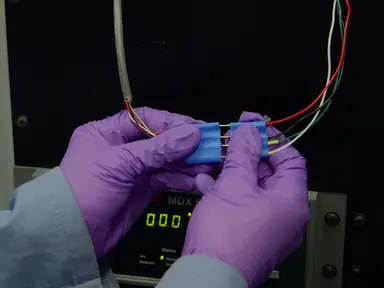
A schematic of a film deposited on glass with 30 nanometers of aluminum and 40 nanometers of gold top contacts created by thermal evaporation is displayed here. These measurements reveal omic IV characteristics at all temperatures with resistance that increases with decreasing temperature. As shown here, While attempting this procedure, it's important to remember that there are a lot of parameters that affect growth, including but not limited to temperature, oxygen level, and pressure After its development.
This technique paved the way for researchers in the field of organics to explore magnetism in thin films at room temperature.
我们提出的基于有机物的亚铁磁钒四氰的合成(Ⅴ[TCNE],则x〜2)通过低温化学气相沉积(CVD)。这种优化配方产生增加居里温度从400 K至600 K和磁共振性能的显着改善。
Chapters in this video
0:05
Title
1:29
Preparation of V(CO)6
4:10
Deposit V[TCNE]x~2 onto Substrates
6:15
Results: Magnetic and Electronic Properties of V[TCNE]x~2
7:50
Conclusion
Related Videos

15.5K Views

12.2K Views

11.1K Views

8.7K Views

13.4K Views

35.3K Views

12.2K Views

9.8K Views

3.3K Views

1.5K Views