The Gliding Actin Filament Assay: An In Vitro Motility Assay to Study Translocation of Actin Filaments on Immobilized Myosins
-- views • 6:01 min
Transcript
Myosin - a motor protein - interacts with another filamentous protein, actin, causing its translocation.
To analyze the gliding movement of actin, assemble a glass slide-based flow chamber such that the inner portion of the chamber-top is nitrocellulose-coated. Flow in the myosin proteins through the chamber, which immobilize over the nitrocellulose coating.
Supplement the chamber with unlabeled actin filaments - black actins - and add a motility buffer containing adenosine triphosphate or ATP molecules.
The actin filaments bind to immobilized active myosins along with inactive or dead myosins. ATP molecules interact with the active myosins, leading to their dissociation from black actins while the inactive myosins remain actin-bound.
Centrifuge to pelletize inactive myosins attached to black actins. Rinse with a buffer thoroughly to remove the inactive myosin pellet, free actin filaments, and unused ATPs. Flow in fluorescently-labeled actins that bind immobilized, active myosins.
Supplement the chamber with a final buffer containing a crowding agent - methylcellulose, and ATP. The crowding agent forces actin filaments to remain closer to the chamber surface.
Each active myosin hydrolyzes ATP leading to conformational change and binding to a new position along the filament, generating a power stroke that glides the actin over myosin.
Observe the chamber under a fluorescence microscope to record the motion of labeled actin filaments gliding smoothly over the immobilized myosin heads, confirming successful translocation.
To begin, prepare a 1% nitrocellulose solution in amyl acetate, and place a circular filter paper with a 125-millimeter diameter on the bottom of a tissue culture plate.
Load 8 square coverslips onto a rack, and thoroughly wash them with approximately 2 to 5 milliliters of 200-proof ethanol, followed by 2 to 5 milliliters of distilled water. Then, dry the coverslips completely using a filtered air-line or nitrogen-line.
Slowly pipette 10 microliters of 1% nitrocellulose solution along one edge of one coverslip. Smear it across the rest of the coverslip using the side of a 200-microliter pipette tip in 1 smooth motion. Then, place this coverslip on the tissue culture dish with the nitrocellulose side up. Repeat this for the remaining coverslips, and allow them to dry.
Wipe a microscope slide with an optical lens paper to clean off large debris. Cut two pieces of double-sided tape approximately 2 centimeters in length, and place one piece along the middle of the long edge of the microscope slide. Place the second piece of tape roughly 2 millimeters below the first piece of tape, such that the two are parallel, creating a flow chamber that can hold approximately 10 microliters of solution.
Carefully stick one of the nitrocellulose coverslips onto the tape, so that the side coated with nitrocellulose is making direct contact with the tape.
Using a pipette tip, gently press down on the slide-tape interface to ensure that the coverslip has properly adhered to the slide. Then, cut the excess tape hanging over the edge of the slide, with a razor blade.
Prepare the solutions for Myosin-5a, and keep them on ice. Flow in 10 microliters of the Myosin-5a through the slide flow chamber, and wait for 1 minute. Then, flow in 10 microliters of 1 milligram per milliliter BSA in motility buffer with DTT. Repeat this twice, and wait a minute after the third wash.
Use the corner of a tissue paper or filter paper to wick the solution through the channel, by gently placing the corner of the paper at the flow chamber exit. Then, wash with 10 microliters of motility buffer with DTT.
Pipette the black actin solution with a 1-milliliter syringe and a 27-gauge needle to shear the actin filaments, before introducing the solution to the chamber. Add the black actin to the chamber in the presence of 1 millimolar ATP in 50 millimolar MB with 1 millimolar DTT.
Next, flow in 50 microliters of motility buffer with DTT and 1 millimolar ATP to deplete the chamber of free actin filaments. Wash with 10 microliters of motility buffer with DTT three times to deplete the chamber of any ATP.
Flow in 10 microliters of 20 nanomolar Rh-actin solution containing motility buffer with DTT, and wait for 1 minute to allow rigor binding of actin filaments to the myosin-5a attached to the surface of the coverslip.
Wash with 10 microliters of 50 millimolar motility buffer with the DTT twice to remove unbound Rh-actin filaments. Flow in 30 microliters of final buffer.
Record images on a fluorescence microscope using an excitation wavelength of 561 nanometers to visualize the Rh-actin.
Imaging di fluorescenza con One nanometri Precisione (FIONA)
Related Videos
18.2K Views
Adattamento semi-alto/throughput del saggio ATPase accoppiato NADH per lo screening degli inibitori delle piccole molecole
Related Videos
10.3K Views
Sondare la meccanica dell'ensemble di miosina in fasci di filamenti di actina usando pinzette ottiche
Related Videos
2.6K Views
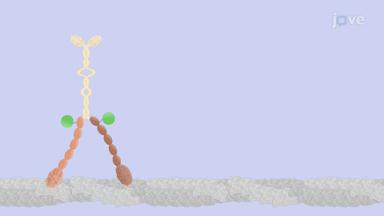
Saggio di motilità invertita: una tecnica in vitro per visualizzare il movimento della miosina su filamenti di actina immobilizzati
Related Videos
794 Views
Adattamenti specifici della miosina dei saggi di motilità basati sulla microscopia a fluorescenza in vitro
Related Videos
6.5K Views
Un saggio a base di spettroscopia a fluorescenza efficiente in termini di tempo per valutare lo stato di polimerizzazione dell'actina nei tessuti cerebrali dei roditori e umani
Related Videos
4.6K Views
Utilizzo della microscopia a microfluidica e fluorescenza per studiare la dinamica di assemblaggio di singoli filamenti e fasci di actina
Related Videos
3.1K Views
Ricostituzione di cortecce di actina minima legate alla membrana su doppi strati lipidici supportati
Related Videos
2.8K Views
Visualizzazione delle dinamiche di accoppiamento di actina e microtubuli in vitro mediante microscopia a fluorescenza a riflessione interna totale (TIRF)
Related Videos
3.9K Views
Ricostituzione e caratterizzazione di compositi actina-microtubuli con dinamica e meccanica azionata da motori sintonizzabili
Related Videos
3.8K Views