Alkenes react with water in the presence of an acid to form an alcohol. In the absence of acid, hydration of alkenes does not occur at a significant rate, and the acid is not consumed in the reaction. Therefore, alkene hydration is an acid-catalyzed reaction.

Strong acids, such as sulfuric acid, dissociate completely in an aqueous solution, and the acid participating in the reaction is the hydronium ion.

The first step is the slow protonation of an alkene at the less-substituted end to form the more-substituted carbocation.

The second step is the nucleophilic attack by water at the carbocation to give an oxonium ion.
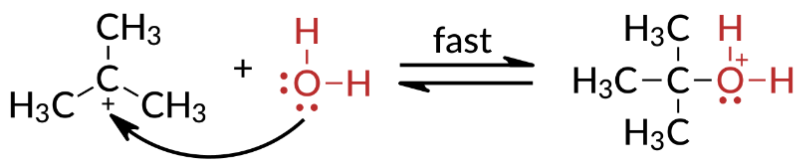
In the last step, water, with a pKa of 15.7, acts as a base and deprotonates the acidic oxonium ion (protonated alcohol), which has a pKa of approximately –2, to yield the final product.

The two processes, hydration of alkenes to form alcohols and the dehydration of alcohols to form alkenes, are in equilibrium with each other. The control over this equilibrium can be explained by Le Chatelier’s principle, which states that a system at equilibrium will adjust to minimize any stress placed on the system.
In the hydration of 2-methylpropene, water is on the left side of the reaction. When the amount of water increases, the equilibrium shifts towards the right, producing more alcohol. In contrast, eliminating water from the system shifts the equilibrium to produce more alkene. Thus, the presence of dilute acids favors the formation of alcohols from alkenes, while the reverse occurs in the presence of concentrated acids that contain very little water.
Addition reactions are temperature-dependent. The enthalpy term for these reactions is negative as new bonds are formed during the process. In contrast, the entropy term is positive as the two reactant molecules give one molecule of product.
At low temperatures, the entropy term is small and the enthalpy term dominates. Thus, the Gibbs free energy is negative, and the equilibrium constant being greater than one promotes the formation of product over reactants.

However, at high temperatures, the large entropy term dominates the enthalpy term and the Gibbs free energy is positive. The equilibrium constant being less than one reverses the reaction, implying that reactants will be favored over products.

From Chapter 8:
Now Playing
8.5 : Acid-Catalyzed Hydration of Alkenes
Reactions of Alkenes
12.9K Views
8.1 : Regioselectivity of Electrophilic Additions-Peroxide Effect
Reactions of Alkenes
8.0K Views
8.2 : Free-Radical Chain Reaction and Polymerization of Alkenes
Reactions of Alkenes
7.3K Views
8.3 : Halogenation of Alkenes
Reactions of Alkenes
14.8K Views
8.4 : Formation of Halohydrin from Alkenes
Reactions of Alkenes
12.4K Views
8.6 : Regioselectivity and Stereochemistry of Acid-Catalyzed Hydration
Reactions of Alkenes
8.2K Views
8.7 : Oxymercuration-Reduction of Alkenes
Reactions of Alkenes
7.1K Views
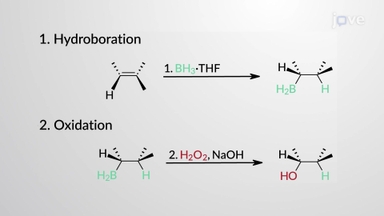
8.8 : Hydroboration-Oxidation of Alkenes
Reactions of Alkenes
7.3K Views
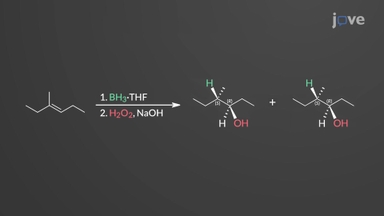
8.9 : Regioselectivity and Stereochemistry of Hydroboration
Reactions of Alkenes
7.9K Views
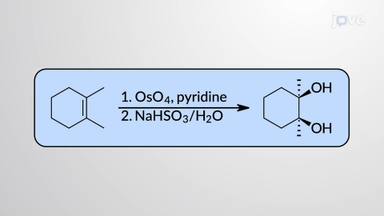
8.10 : Oxidation of Alkenes: Syn Dihydroxylation with Osmium Tetraoxide
Reactions of Alkenes
9.5K Views
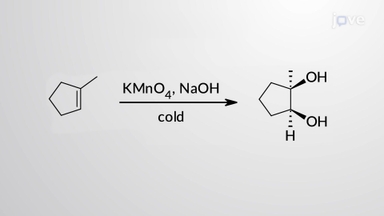
8.11 : Oxidation of Alkenes: Syn Dihydroxylation with Potassium Permanganate
Reactions of Alkenes
10.1K Views
8.12 : Oxidation of Alkenes: Anti Dihydroxylation with Peroxy Acids
Reactions of Alkenes
5.2K Views
8.13 : Oxidative Cleavage of Alkenes: Ozonolysis
Reactions of Alkenes
9.4K Views
8.14 : Reduction of Alkenes: Catalytic Hydrogenation
Reactions of Alkenes
11.5K Views
8.15 : Reduction of Alkenes: Asymmetric Catalytic Hydrogenation
Reactions of Alkenes
3.2K Views

Copyright © 2025 MyJoVE Corporation. All rights reserved