
8.13 : Oxidative Cleavage of Alkenes: Ozonolysis
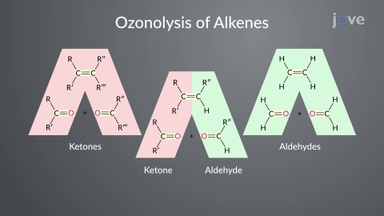
In ozonolysis, ozone is used to cleave a carbon–carbon double bond to form aldehydes and ketones, or carboxylic acids, depending on the work-up.
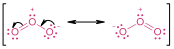
Ozone is a symmetrical bent molecule stabilized by a resonance structure.
Ozonolysis proceeds through an oxidative cleavage reaction. The first step is the electrophilic addition of ozone across the alkene double bond, forming an unstable molozonide intermediate, which reacts further to form a carbonyl and a carbonyl oxide. These intermediates rearrange to form an ozonide.
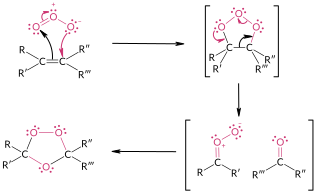
The ozonide is treated with a mild reducing agent such as dimethyl sulfide or zinc to yield the carbonyl compounds as the final product.

Ozonolysis with Different Substituted Alkenes
The conversion of ozonide to aldehydes, ketones, or carboxylic acids depends on the structure of the alkene starting material and different reaction conditions.
When a reductive work-up is used, ozonolysis of monosubstituted alkenes such as 1-butene yields a mixture of aldehydes.

Trisubstituted alkenes, such as 2-methyl-2-butene, on the other hand, form an aldehyde and a ketone.

When an oxidative work-up is used, the reaction yields a ketone and an aldehyde that is further oxidized to the corresponding carboxylic acid.

Tags
From Chapter 8:
Now Playing
8.13 : Oxidative Cleavage of Alkenes: Ozonolysis
Reactions of Alkenes
9.9K Views
8.1 : Regioselectivity of Electrophilic Additions-Peroxide Effect
Reactions of Alkenes
8.4K Views
8.2 : Free-Radical Chain Reaction and Polymerization of Alkenes
Reactions of Alkenes
7.7K Views
8.3 : Halogenation of Alkenes
Reactions of Alkenes
15.3K Views
8.4 : Formation of Halohydrin from Alkenes
Reactions of Alkenes
12.7K Views
8.5 : Acid-Catalyzed Hydration of Alkenes
Reactions of Alkenes
13.6K Views
8.6 : Regioselectivity and Stereochemistry of Acid-Catalyzed Hydration
Reactions of Alkenes
8.3K Views
8.7 : Oxymercuration-Reduction of Alkenes
Reactions of Alkenes
7.4K Views
8.8 : Hydroboration-Oxidation of Alkenes
Reactions of Alkenes
7.8K Views
8.9 : Regioselectivity and Stereochemistry of Hydroboration
Reactions of Alkenes
8.0K Views
8.10 : Oxidation of Alkenes: Syn Dihydroxylation with Osmium Tetraoxide
Reactions of Alkenes
9.8K Views
8.11 : Oxidation of Alkenes: Syn Dihydroxylation with Potassium Permanganate
Reactions of Alkenes
10.8K Views
8.12 : Oxidation of Alkenes: Anti Dihydroxylation with Peroxy Acids
Reactions of Alkenes
5.6K Views

8.14 : Reduction of Alkenes: Catalytic Hydrogenation
Reactions of Alkenes
11.8K Views
8.15 : Reduction of Alkenes: Asymmetric Catalytic Hydrogenation
Reactions of Alkenes
3.2K Views

Copyright © 2025 MyJoVE Corporation. All rights reserved