
19.3 : Van der Waals Equation
The ideal gas law is an approximation that works well at high temperatures and low pressures. The van der Waals equation of state (named after the Dutch physicist Johannes van der Waals, 1837−1923) improves it by considering two factors.
First, the attractive forces between molecules, which are stronger at higher densities and reduce the pressure, are considered by adding to the pressure a term equal to the square of the molar density multiplied by a positive coefficient a. Second, the volume of the molecules is represented by a positive constant b, which can be thought of as the volume of a mole of molecules. This is subtracted from the total volume to give the remaining volume that the molecules can move in. The constants a and b are determined experimentally for each gas. The resulting equation is

For carbon dioxide gas with the van der Waals equation, constant a is 0.364 J·m3/mol2 and constant b is 4.27 x 10⁻⁵ m3/mol. If 1 mole of this gas is confined in a volume of 300 cm3 at 300 K, then the pressure of the gas can be calculated using the van der Waals equation. Rearranging the van der Waals equation for pressure,
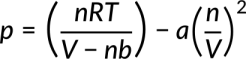
and substituting the known quantities in it,

gives the pressure of carbon dioxide gas

In the low-density limit (small n), the a and b terms are negligible, and the van der Waals equation reduces to the ideal gas law. On the other hand, if the second term from the van der Waals equation is small, meaning that the molecules are very close together, then the pressure must be higher to give the same nRT, as expected in the situation of a highly compressed gas. However, the increase in pressure is less than that argument would suggest because, at high densities, the pressure correction term from the van der Waals equation is significant. Since the pressure correction term is positive, it requires a lower pressure to give the same nRT. The van der Waals equation of state works well for most gases under various conditions, such as for predicting liquid-gas phase transitions.
From Chapter 19:
Now Playing
19.3 : Van der Waals Equation
The Kinetic Theory of Gases
4.0K Views
19.1 : Equation of State
The Kinetic Theory of Gases
1.7K Views
19.2 : Ideal Gas Equation
The Kinetic Theory of Gases
6.7K Views
19.4 : pV-Diagrams
The Kinetic Theory of Gases
4.0K Views
19.5 : Kinetic Theory of an Ideal Gas
The Kinetic Theory of Gases
3.5K Views
19.6 : Molecular Kinetic Energy
The Kinetic Theory of Gases
5.0K Views
19.7 : Distribution of Molecular Speeds
The Kinetic Theory of Gases
3.9K Views
19.8 : Maxwell-Boltzmann Distribution: Problem Solving
The Kinetic Theory of Gases
1.4K Views
19.9 : Phase Diagram
The Kinetic Theory of Gases
5.8K Views
19.10 : Mean free path and Mean free time
The Kinetic Theory of Gases
3.4K Views
19.11 : Heat Capacity: Problem-Solving
The Kinetic Theory of Gases
492 Views
19.12 : Dalton's Law of Partial Pressure
The Kinetic Theory of Gases
1.3K Views
19.13 : Escape Velocities of Gases
The Kinetic Theory of Gases
890 Views

Copyright © 2025 MyJoVE Corporation. All rights reserved