
3.13 : Compartment Models: Single-Compartment Model
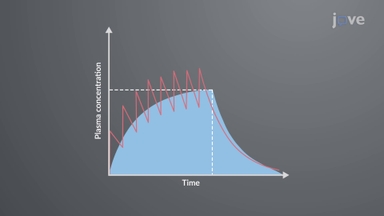
The single-compartment model serves as a simplified representation of the human body. This model assumes that the body functions as a single, well-mixed open compartment. When a drug is administered intravenously, it enters the body and quickly distributes uniformly. The drug then undergoes biotransformation and elimination, ultimately leaving the body. The volume of this compartment is referred to as the apparent volume of distribution into which the drug can uniformly distribute. In this model, drug clearance from the body follows first-order kinetics, meaning that the elimination rate is directly proportional to the drug concentration in the body. With time, the drug plasma concentration declines exponentially, leading to a similar decline in tissue drug concentration. When a continuous infusion of a drug occurs, a steady-state value is reached exponentially. However, if the infusion stops, the concentration of the drug in the body falls exponentially. On the other hand, when a drug is administered in multiple equal doses, the average steady-state concentration and the time required to reach this steady state are comparable to those achieved with continuous infusion.
From Chapter 3:
Now Playing
3.13 : Compartment Models: Single-Compartment Model
Pharmacokinetics
2.2K Views
3.1 : Pharmacokinetics: Overview
Pharmacokinetics
5.6K Views
3.2 : Drug Absorption Mechanism: Passive Membrane Transport
Pharmacokinetics
3.6K Views

3.3 : Drug Absorption Mechanism: Carrier-Mediated Membrane Transport
Pharmacokinetics
3.5K Views
3.4 : Drug Absorption: Factors Affecting GI Absorption
Pharmacokinetics
3.8K Views
3.5 : Bioavailability: Overview
Pharmacokinetics
2.7K Views
3.6 : Factors Influencing Bioavailability: First-Pass Elimination
Pharmacokinetics
6.1K Views
3.7 : Bioequivalence: Overview
Pharmacokinetics
926 Views
3.8 : First Pass Effect
Pharmacokinetics
5.2K Views
3.9 : Time Course of Drug Effect
Pharmacokinetics
2.0K Views
3.10 : Drug Distribution: Tissue Binding
Pharmacokinetics
2.6K Views
3.11 : Physiological Barriers
Pharmacokinetics
3.4K Views
3.12 : Drug Distribution: Plasma Protein Binding
Pharmacokinetics
4.9K Views
3.14 : Compartment Models: Two-Compartment Model
Pharmacokinetics
5.2K Views
3.15 : Drug Distribution: Volume of Distribution
Pharmacokinetics
4.5K Views
See More

Copyright © 2025 MyJoVE Corporation. All rights reserved