
4.8 : Strength of Cement
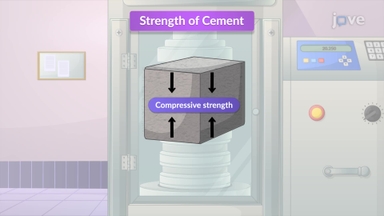
Strength tests for cement are not performed directly on neat cement paste due to difficulty in obtaining consistent, reliable specimens. Instead, cement is typically tested in the form of cement-sand mortar.
For compressive strength tests, ASTM C 109-05 standards prescribe a cement-sand mix ratio of 1:2.75 and a water/cement ratio of 0.485 for making 2-inch cubes. These cubes are mixed, cast, and cured in saturated lime water at 23°C until testing. Flexural strength testing, outlined in ASTM C 348-02, uses prisms measuring 1.5 x 1.57 x 6.3 inches that are simply supported and loaded at mid-span. Another method to determine the compressive strength of cement is the modified cube test, detailed in ASTM C 349-02. This test uses sections of failed flexural prisms to test compression.
ASTM C150 specifies minimum compressive strength values for various types of cement at different stages of aging. The British Standard BS EN 196-1: 2005 categorizes cement into strength classes, such as N for normal and R for rapid hardening properties.
From Chapter 4:
Now Playing
4.8 : Strength of Cement
Introduction to Concrete
118 Views
4.1 : Concrete
Introduction to Concrete
301 Views
4.2 : Portland Cement
Introduction to Concrete
188 Views

4.3 : Hydration of Cement
Introduction to Concrete
185 Views
4.4 : Strength and Heat of Hydration
Introduction to Concrete
201 Views
4.5 : Fineness of Cement
Introduction to Concrete
114 Views
4.6 : Setting Time of Cement
Introduction to Concrete
136 Views

4.7 : Soundness of Cement
Introduction to Concrete
134 Views

4.9 : Types of Cement I
Introduction to Concrete
94 Views
4.10 : Types of Cement II
Introduction to Concrete
87 Views
4.11 : Pozzolans
Introduction to Concrete
92 Views

Copyright © 2025 MyJoVE Corporation. All rights reserved