The overall goal of the following experiment is to prepare and characterize SD F1 Alpha Chias and dextran sulfate nanoparticles. The preparation of the nanoparticles is achieved by first mixing the stem cell homing factor stromal cell derived factor one alpha or S df one alpha with dextran sulfate to allow binding to the negatively charged glycan. As a second step ozan, a positively charged glycan is added to the mixture forming a poly electrolyte complex with dextran sulfate.
Next zinc sulfate is added in order to stabilize the complexes with zinc bridges. The resulting particle has a dense core surrounded by a negatively charged shell. The particles are subsequently measured for their size and zeta potential, as well as the content and activity of S df one alpha in the nanoparticles Main advantage of the SDF one alpha glycan nanoparticles is that the incorporated SDF one alpha is fully active without being released from the particles.
Therefore, the particles could be useful to serve as a stationary hermine signal in stem cell therapy. To begin prepare stock solutions as described in the text protocol and sterilize them through 0.22 micron filter membranes. Assess endotoxin levels in the prepared solution with ulu amoeba cyte lysate gel clot assay.
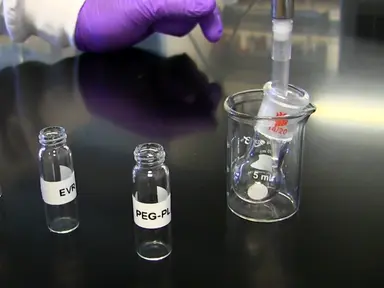
Ensure that the levels are less than 0.06 endotoxin units per milliliter. Next at 0.18 milliliters of ultrapure water to a 1.5 milliliter glass vial containing a magnetic stir bar. Set the stir speed at 800 RPM, then add 0.1 milliliters of 1%dextran sulfate and stir after two minutes.
Add 0.08 milligrams of SD F1 alpha and stir for 20 minutes. Dropwise add 0.33 milliliters of 0.1%tizen and stir for five minutes. Change the stir speed to the maximum and slowly add 0.1 milliliters of zinc sulfate with a gas tight syringe.
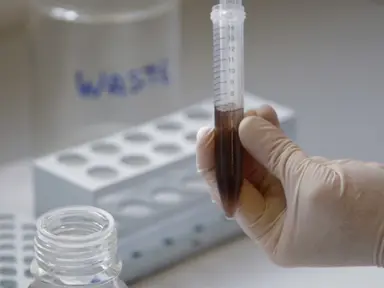
Return the stir speed to 800 RPM and stir for 30 minutes. Then add 0.4 milliliters of 15%mannitol and stir after five minutes. Transfer the reaction mixture to a 1.5 milliliter fuge tube and centrifuge at 16, 000 Gs and four degrees Celsius for 10 minutes.
Following centrifugation, aspirate the supernatant and use a pipette to remove the last drop of liquid. Slowly add 0.2 milliliters of 5%mannitol and suspend the pellet with a 0.5 milliliter 29 gauge needle syringe. Then add an additional one milliliter of 5%manitol before centrifuging.
A second time at 16, 000 GS for 15 minutes. After repeating the Resus suspension centrifugation process aspirate the supernatant and resuspend the pellet in 0.2 milliliters of 5%mannitol. The particle size and zeta potential are analyzed by dynamic light scattering and electrophoretic light scattering respectively.
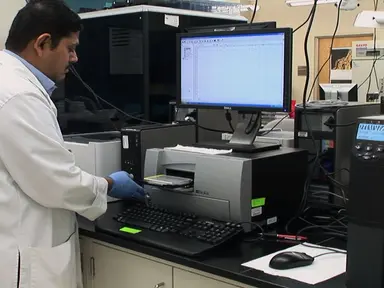
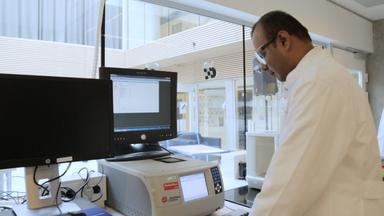
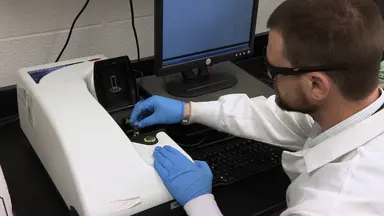
To begin, select an operation procedure from the SOP list, which contains parameters for particle size measurement through dynamic light scattering. As listed in the text protocol, dilute the SD F1 alpha particle sample with water. Then load 100 microliters of the sample to a disposable UV Q Vet such as an Einor Q Vet.
Insert the Q vet into the cell holder and wait for the intensity adjustment to reach optimum before starting data acquisition. After the measurement is complete, record the cumul results of diameter and poly dispersity index. Average the results obtained from each of the four repeated readings and calculate the standard deviation for measurement of zeta potential through electrophoretic light scattering.
Load 500 microliters of the tenfold diluted particle sample to the flow cell. Select an operation procedure from the Zeta potential SOP listing, which contains parameters for the measurement as listed in the text protocol. Record the results of the zeta potential.
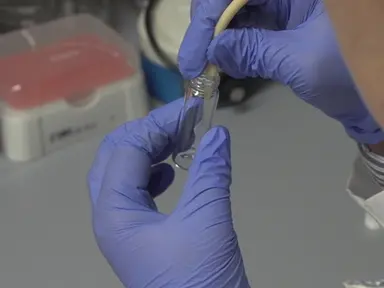
Then average the results obtained from each of the five repeated readings and calculate the standard deviation. Heat the diluted samples of free and particle bound SD F1 alpha in laly sample buffer at 100 degrees Celsius for 10 minutes. Vortex the samples twice during the 10 minute heating in order to dissociate the particles completely after cooling down the samples to room temperature for two minutes, centrifuge had 10, 000 Gs for 0.5 to one minute to bring down the water condensate vortex again to mix well.
At this point, the sample solution should be clear with no visible precipitate present. Then load 10 microliters of sample per well to a four to 20%sodium ESAL sulfate or SDS gel. Run electrophoresis at 200 volts for 20 minutes before staining the gel with kumasi blue protein stain.
Examine the protein band density of SD F1 alpha using a molecular imager and densitometry analysis software. Calculate the quantity of S DF one alpha in the particles against a standard curve constructed with free SDF one alpha standards to perform the in vitro release assay mix SD F1 alpha glycan particles with docos phosphate buffer saline without calcium and magnesium or DPBS at a one-to-one ratio. Divide the particle suspension into 0.05 milliliter aliquots in 1.5 milliliter tubes.
Load the samples to the bottom of the tubes. Avoid introducing air bubbles or disturbing the surface of the liquid. Seal the top of the tubes with paraform.
Then rotate the tubes at 37 degrees Celsius on a rotating micro tube mixer. Remove aliquots from the tubes at the designated times and immediately centrifuge the samples at 16, 000 Gs for 10 minutes at four degrees Celsius following centrifugation. Separate the supernatants and pellets.
Then reconstitute the pellet with 0.05 milliliters of DPBS. After all the samples are collected, examine the supernatants and pellets on an SDS gel. As before, this assay measures the chemotactic activity of S df.
One alpha interaction of S df one alpha with its receptor causes migration of the cell towards the SD F1 alpha gradient. To begin dilute free or particle bound form SD F1 alpha with migration buffer in a threefold serial dilution to the final concentrations listed in the text protocol. Add 0.6 milliliters of the diluted SD F1 alpha solution to a well in the 24 well plate for the negative control.
Do the same for migration buffer only then add 0.57 milliliters of migration buffer to a well for the input cell control. Incubate the plate at 37 degrees Celsius for 30 minutes. Then place a permeable cell culture insert such as transwell on top of the lower well load 0.1 milliliters of jerk hat cells into the transwell insert.
Then load 0.03 milliliters of cells directly to the input cell control. Well incubate the plate at 37 degrees Celsius for two hours in a 5%carbon dioxide incubator. Following incubation, remove the cell culture inserts.
Transfer the cells that have migrated to the lower wells to a four milliliter polystyrene tube. Count the migrated cells with a flow cytometer. Finally calculate migration as a percentage of the input cell number after subtraction of the numbers in the negative controls.
Shown here is the analysis of the SD F1 alpha dextran sulfate ozan particle size measurement. The CUMUL result shows the hydrodynamic diameter of the particle is 671 nanometers and the poly dispersity is 0.24. This screenshot shows one of the five repeated measurements of the zeta potential of the SD F1 alpha DExT strand sulfate ozan particles.
The zeta potential is minus 24.7 millivolts. The amount of S df one alpha in the S df one alpha dextran sulfate ozan particles is estimated by SDS gel Electrophoresis. Shown here is a kumasi stained SDS gel with SD F1 alpha standards dextran sulfate kaizan control nanoparticle and SD F1 alpha dextran sulfate kaizan nanoparticle samples loaded.
A standard curve is constructed from the density analysis of the SD F1 Alpha Standard bands calculation from the standard curve indicates that the S DF one alpha concentration in the SDF one alpha nanoparticle sample is 0.03 milligrams per milliliter. To determine the in vitro release rate of S DF one alpha from the nanoparticles, the amount of released S DF one alpha in the supernat and the amount of particle bound sdf one alpha in the pellets was determined by kumasi staining of an SDS gel followed by cytometry analysis. The activity of the particle bound S DF one alpha is measured by a migration assay and compared to that, a free SDF one alpha as shown here.
The particle bound SDF one alpha induced the same extent of migration as that a free s DF one alpha at all concentrations measured. While attempting this procedure, it's important to remember that the formulation of the glycan protein particles can be altered. Depending on the specific application, other proteins can be incorporated and different formulations can be used to vary the particle size.
We hope this video is demonstrated the basic techniques in preparation of collecting nanoparticles and then functional analysis of the incorporated SDF one alpha.