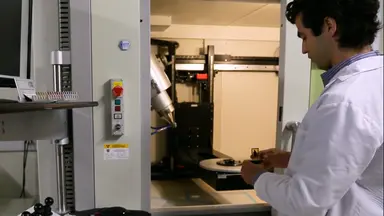
The overall goal of this experiment is to test the resolution limits of structural MRI in order to resolve and compare subcortical structures in both the postmortem and living human brain. Research in our lab has involved studying the small subcortical nuclei within patient populations. Given their small size and duplication within the brain, they are difficult to study.
We developed a protocol that resolves these subcortical structures in both postmortem and living human brains. The advantage of this technique is the reduction in scan duration, which is useful in clinical applications. MRI resolution is limited by noise, so we wanted to determine what the ultimate resolution would be.
In the absence of the largest sources of noise, namely subject head motion, pulse, and respiration Acquire all imaging described in this protocol with a three TMRI scanner equipped with a 32 channel head coil. In this video, steps are demonstrated using a Siemens MAGOME TRIO three TMRI scanner for study participant imaging sessions. Be sure to first perform an MRI safety screening.
Then review the details of the neuroimaging protocol and have them sign a patient consent form while setting up the participant for scanning. Earplugs are inserted in the participant's ears. Then secure their head with pads to minimize head motion.
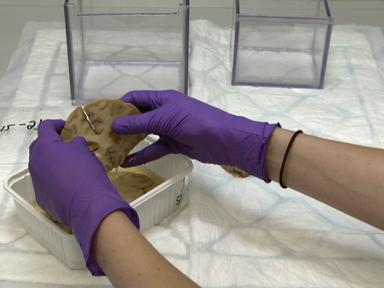
During imaging when acquiring scans with a postmortem brain, make sure the brain is fixed prior to neuro imaging and is contained within a watertight bag or container that fits within the MRI head coil. Place the brain in the head coil with its Z axis aligned with the bore of the scanner with the brainstem facing towards the foot of the scanner bed. Also place vacuum cushions around the brain for additional support.
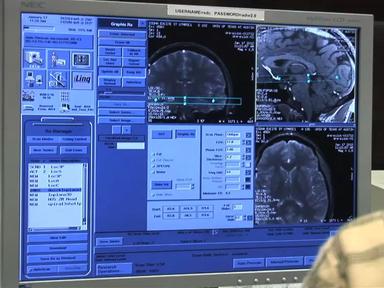
Before scanning, select the patient tab in the upper left hand corner. Use the register tab to fill in the appropriate subject information. Then click on the exam tab in the exam explorer tab.
Begin by first creating a new LOCALIZER scan protocol In the setup window, use the routine contrast and resolutions tab to enter the parameters as seen on screen here. Next, create a new protocol that will be used for obtaining the high resolution proton density weighted scans. Set this up in the coronal orientation using the parameters seen on screen here.
Reduce the bandwidth to the minimum possible to maximize the signal to noise ratio. To reduce scan duration, choose 18 slices each one millimeter thick with a 160 millimeter field of view. Next, overlay the slice selection box for acquiring the proton density images over the localizer.
Being sure to cover the subcortical nuclei within the thalamus as well as surrounding structures. Then start the scan for reliable identification of subcortical structures. Acquire five runs with these parameters.
When performing postmortem brain imaging, reliable identification of subcortical structures can be observed in just one scan with a total duration of approximately three minutes following the same scanning protocol. To analyze the data, use the freely available FSL software. Begin by opening a terminal window.
Then convert the raw DICOM files from the scanner for each proton density volume to a nifty format. In the command line, type the command scene here, DCM to NII, followed by the directory of each image.Run. Next, obtain the parameters of the original proton density scan.
Then create a high resolution blank image target volume with half the voxel size of these parameters. To do this in any text editor program, first, define the transformation using an identity matrix as seen here and save as a text file named identity dot matt. Next, use the flirt command to apply the transformation up, sampling each original run to double the total resolution.
This results in a 10 24 matrix and halves the voxel size in each dimension. Now move all the high resolution images to a new folder. Then for each participant, concatenate all the UPS sampled proton density images into a single four D file.
Using the FSL merge command motion, correct these concatenated files. Using the URT command, select a four stage correction, which utilizes sync interpolation as a further optimization pass for greater accuracy. Next, create the 3D mean image using FSL maths.
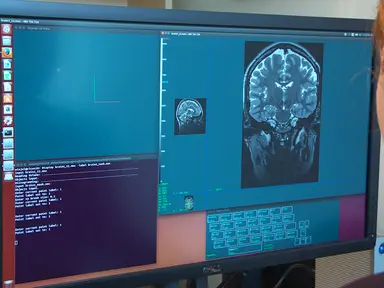
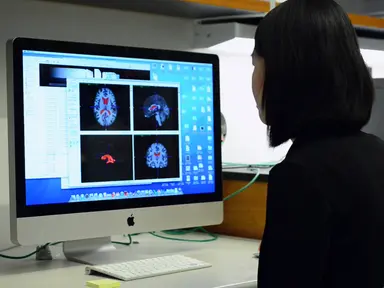
Then visualize the final outcome, 3D high resolution image using the FSL view command. Now create regions of interest, also called ROIs. Using FSL view, load the high resolution image.
Then in the tools tab, select single image tab to enlarge the view for drawing ROIs. Next, click the file tab followed by create mask, draw a line in the ROI and save. Finally, use AF acne's 3D mask dump command to extract the image, intensities and location of the ROI masks that were just created.
Results will be output as a text file, which can be used for further analysis. This series of images compares volume averages in in vivo and postmortem brains. Note the postmortem brain shows clear demarcation of subcortical structures in one proton density weighted volume, whereas a minimum of five averaged images are required for the in vivo brain To provide this detail, this coronal slice in an in vivo brain image shows clear delineation of the LGN and other subcortical structures, and here we see another slice of the same brain averaged in 40 proton density volumes in the same session with the same imaging parameters.
This postmortem brain slice was acquired in one proton density volume scan and provides clear delineation of subcortical structures, including the right and left LGN. This slice shows a postmortem brain averaged in 100 proton density volumes with the same slice prescription. The zoomed view shows clear demarcation of subcortical structures.
Here we see line intensity profiles for in vivo left and right, LGN as well as the postmortem left and right, LGN. These lines are for 40 maximum averages in vivo and 100 averages postmortem. In the postmortem brain, there was no variation in intensity that can be ascribed to layers in the in vivo brain.
There was variation in intensity that can be ascribed to layers. After watching this video, you should have a good understanding of how to follow this optimized protocol in obtaining high risk solution, proton density images of subcortical regions once followed this method can be applied in clinical settings to reduce scan durations to less than 15 minutes in living humans and less than three minutes in postmortem brains when applied Properly.