The overall goal is to introduce cortical micro infarcts as a new imaging marker of microvascular brain pathology on MRI. We first identified micro infarcts on in vivo seven Tesla MRI scans. We performed post-mortem MRI to confirm the pathology of these lesions.
Here we demonstrate our postmortem MRI protocol and we also propose rating criteria for micro infarcts on seven Tesla MRI scans and how best to identify them on three Tesla Postmortem, MRI. If human brain tissue is a powerful tool to bridge the gap between neuropathology at one hand and in FIFO MRI. At the other hand, this is particularly valuable in small vessel disease, which involves a large number of different brain lesion types.
Prior to postmortem scanning, select 10 millimeter thick, formal and fixed coronal brain slabs. In this example, three slabs are taken from the frontal temporal, parietal, and occipital regions of the brain. Take photographs of the brain slabs on both sides, or take careful notes of the orientation of the slabs in the container and in the scanner.
For the purpose of colocalization of histology, with MRI fill a container that fits within the Mr.Head coil with 10%fresh formin at room temperature. Use a flow cabinet when handling the formin. Avoid air bubbles when placing the brain slabs in the container.
Remove the majority of air bubbles by gently shaking the tissue by hand. Place a smaller container inside the larger container to limit the amount of needed fluid as well as to ensure that the slabs do not move within the larger container. Optionally, remove additional air bubbles by placing the container in an ultrasound bath.
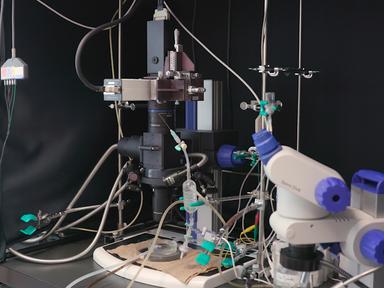
Next, cover the container with paraform to preventive aberration and to protect the Mr.Head coil from potential contamination, use a whole body seven TMRI scanner with a 32 channel head coil to scan the brain slabs. Wrap the container in a surgical underpad when placing it in the head coil to prevent the potential spilling of fluid. Ensure that the container cannot move and that the slabs remain in a horizontal position.
Run a survey scan and correct B zero in homogeneity by using an appropriate shimming tool. Calibrate the RF power to obtain the correct flip angles. Next, plan the high resolution acquisition on the survey scan To ensure the brain slabs are fully within the field of view.
Scan the brain slabs overnight using a high resolution acquisition protocol That includes 3D flare T two and T one weighted images with an isotropic resolution of 0.4 millimeters and a T two star weighted image with an isotropic resolution of 0.18 millimeters. Use a VPN connection to monitor the scanner overnight for any popups or automatic software processes that may interrupt scanning. Return the following morning after a total scan time of approximately 12 hours and remove the brain slabs from the MRI finally store the brain slabs in formin.
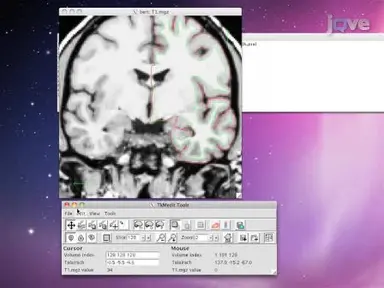
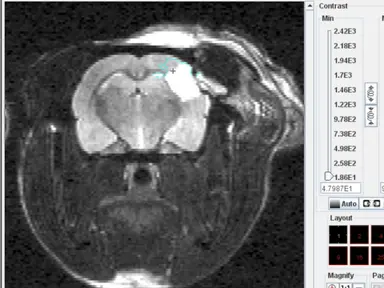
Assess cortical cerebral micro infarct on in vivo 70 T MR images according to the following seven T rating criteria, cortical micro infarcts are hyperintense on flare hyperintense on T two hyperintense on T one, detectable on at least two views of the brain restricted to the cortex distinct from perivascular spaces and they have a dimension less than or equal to four millimeters simultaneously. View flare T one and T two images to place markers on possible lesion locations. Assess one hemisphere on flare in sagittal view and screen the whole cortex for focal hyperintense lesions.
Place markers on any hyperintense lesions less than or equal to four millimeters as they could be possible micro infarct repeat for the other hemisphere. Then verify all marked locations on T one and T two. Discard a location if it is not hyperintense on T one or not hyperintense on T two.
Finally, assess the transversal view on flare T one and T two. Discard a location if no lesion is visible. Save all markers.
Assess cortical micro infarct on in vivo three TMR images according to the following three T rating criteria. Cortical micro infarcts are hypo intense on T one with the greatest dimension, less than or equal to four millimeters restricted to the cortex and distinct from perivascular spaces. Explore the location of a hypo intense cortical lesion found on T one on flare and T two weighted images.
Rate the lesion as a probable cortical micro infarct if the location is hyperintense or ISO intense on flare and T two. Discard the lesion if the same location is hyperintense on T two. First assess one hemisphere on T one in sagittal view.
Screen the whole cortex for focal hypo intense place markers on any hypo intense lesion less than or equal to four millimeters. Repeat for the other hemisphere. Assess the transversal view on T one and simultaneously verify all marked locations on transversal flare and T two.
Regard the location as a micro infarct if it is hyperintense or ISO intense on flare and T two. Discard a location if it is hypo intense on T two or an anatomical variation. Finally, it is recommended to discard possible cortical micro infarct in tissue with close proximity to a larger cortical infarct.
Save the markers. This is an example of an ex vivo seven Tesla 0.4 millimeter isotropic T two weighted image of a case with severe cerebral amyloid angiopathy. Here in another case, a possible micro infarct was identified on flare T two and T one.
After microscopic examination of the histological sections, this micro infarct proved to be a chronic glio micro infarct with cavitation. This is a cortical micro infarct on in vivo seven Tesla MR images where it is hyperintense on flare and T two and hyperintense on T one cortical micro infarct on three Tesla MRI can be best identified on three DT one weighted images. Here a cortical micro infarct is identified as a hypo intense lesion.
On T one. The corresponding location is hyperintense on flare and T two. After proper training, it will take someone approximately half an hour on average to rate micro infarct on a three Tesla MRI scan.
We would also like to stress that our proposed rating criteria may need to be adjusted depending on available dataset. We strongly encourage others to assess micro infarct in their own data sets as this will help to rapidly increase our understanding of the clinical significance of these lesions. We are therefore setting up a module to train other investigators in micro infarct rating.