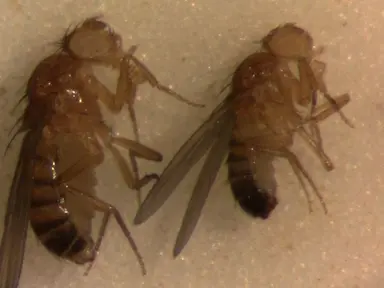
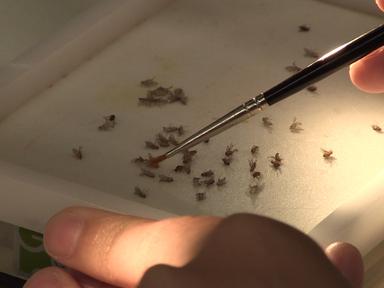
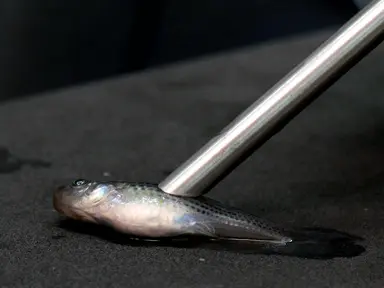
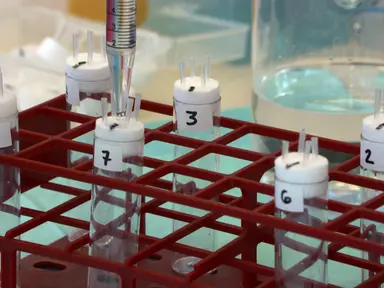
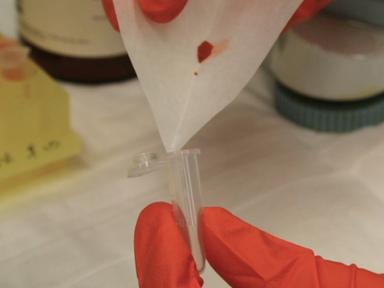
The overall goal of this procedure is to make insects visibly distinct from one another in a non-invasive manner for their identification in behavioral experiments. This is accomplished by first visibly staining the surface of normal drosophila food in a standard fly vial with a few drops of food coloring. Next, the flies are added to the vial for three hours, at which point the drosophila should exhibit a strong coloring of the abdomen.
Mating experiments can be performed, for example, to observe if females find males dyed a specific color more attractive. Ultimately, this dye technique is a quick, simple, and non-invasive way to label insects for easy experimental identification. The main advantage of using this technique over existing methods, such as removing part of the fly's wing, is that it's quicker, less invasive, and less likely to impact on subsequent behavior.
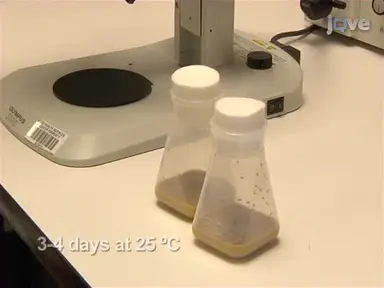
This method can be useful in a wide variety of experiments where it's important to identify individuals or classes of flies. It's also easy enough to be used in simple experiments in schools or colleges. Demonstrating this technique will be Rudy Verse Bo and Chloe Hayes, both PhD students here at the University of Liverpool After the food has been called and solidified, begin by adding 0.5 to one milliliter of blue food coloring on top of the food, spread the dye over the whole surface of the vial.
Then store the food at four degrees Celsius for two days to allow the diet to be absorbed by the top layer of food. Next, transfer flies onto the food according to the needs of the experiment. Within one day, the diet flies can easily be distinguished from the non dyed flies to perform a mating trial with the dyed flies.
Use an aspirator to transfer individual virgin males into standard 75 by 20 millimeter plastic vials containing 20 milliliters of food. If performing a two male mating trial, place half of the males in each treatment group in vials with colored food. Next, transfer, newly emerged females into fresh food vials in groups of 10.
Now allow both sexes to mature to the mating age at the appropriate temperature for the species. When the drosophila are ready, expose the experimental males to the desired treatment. For example, the other flies are being anesthetized with carbon dioxide and label the vials to identify both the treatment and color status of the flies on the day before the trial.
Move the females into individual vials containing 20 milliliters of food to acclimatize the flies to the mating vial, and label the vials with neutral labels to blind the experiment. Then add one or two male flies to each mating vial containing a single female fly. As appropriate.
Begin the mating trial to coincide with the lights coming on in the incubator for two male mating trials. Take care that each male is from a different treatment and that one fly exhibits abdominal staining. Record the treatment and coloring of each male fly.
If copulation occurs within two hours, record the dice status of the male that mates for single male mating trials. Record the time the mating starts and stops. Then calculate the mating success latency and duration data for the trial.
The best model found to explain the variation in the effect of carbon dioxide. Anesthesia contains species as a factor. For example, in these representative experiments, carbon dioxide anesthesia exhibited no significant effect on the mating success of drosophila.
Pseudo obscure and drosophila sub obscure flies in two male trials for drosophila melanogaster, however, a significantly lower mating success was observed for males exposed to carbon dioxide anesthesia with an even greater effect when drosophila melanogaster were exposed to gas at collection or one day before the trials. No significant differences in mating were observed in food colored flies for any of the three species, nor did including the treatment in the analysis or to the mating status of the insects in single mating trials. No difference in mating.
Latency was observed for any of the three species when carbon dioxide anesthesia was used to collect recently emerged adults. An effect on mating duration was exhibited only by drosophila sub obscure flies when exposed to carbon dioxide two days before the mating trials. After watching this video, you should have a good idea of how to use intestinal dyeing as a non-invasive technique for labeling your flies during your experiments.
While attempting this procedure, it's important to test any impact of the dye of interest on your focal species. Some dyes may be toxic and some colors can directly affect mating success. For example, red food coloring may be preferential in some species.
Here we have used this dye technique to distinguish between flies in competitive mating trials. However, it can also be used in a variety of other experiments in which flies need to be individually identified, such as assays to evaluate aggression, territorial defense, food preference activity, or social behaviors.