
6.16 : Cost Minimization Point
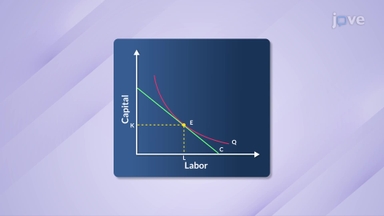
The cost minimization point is where a firm produces a given output at the lowest possible cost, given input prices. It occurs where an isoquant curve is tangent to the lowest achievable isocost line).
To illustrate, consider a firm that aims to produce 100 units of output using labor and capital. The isoquant for 100 units shows all efficient combinations of L and K that can produce this output level. Meanwhile, the isocost line reflects all combinations of these inputs that the firm can afford, given their prices— $10 per hour for labor and $20 per unit for capital.
The cost-minimization point is identified by equating the slopes of the isoquant and the isocost line. The slope of the isoquant is the Marginal Rate of Technical Substitution (MRTS), which indicates the rate at which labor can be substituted for capital without changing the output. The slope of the isocost line is the ratio of the prices of labor and capital (w/r). Cost minimization is achieved when MRTS equals the input price ratio (w/r). This condition ensures that the last dollar spent on each input contributes equally to production, optimizing input use and minimizing costs.
For example, suppose the optimal combination involves using 40 hours of labor and 30 units of capital to produce the desired output of 100 units. At the input prices given, this results in a total cost of $1,000. This point of tangency between the isoquant and the isocost line confirms that the firm is producing at the lowest possible cost. Any deviation from this input mix would either fail to meet the output requirement or increase the total cost, indicating that this allocation is indeed cost-efficient.
This condition, known as the "equal marginal principle," states that at the cost minimization point, the marginal product per dollar spent should be equal for all inputs. Mathematically, this means the Marginal Product of Labor (MPL) divided by the wage rate (w) must equal the Marginal Product of Capital (MPK) divided by the rental rate (r), or MPL/w=MPK/r.
Economic interpretation:
- If MPL/w > MPK/r, the firm should use more labor and less capital.
- MPL/w < MPK/r, the firm should use more capital and less labor.
- Cost minimization is achieved only when MPL/w=MPK/r, ensuring the optimal allocation of resources for the given output level.
Do Capítulo 6:
Now Playing
6.16 : Cost Minimization Point
Producer Behavior
164 Visualizações

6.1 : Assumptions on Producer Behavior
Producer Behavior
159 Visualizações

6.2 : Production Function
Producer Behavior
131 Visualizações

6.3 : Short run
Producer Behavior
64 Visualizações
6.4 : Marginal Product I
Producer Behavior
111 Visualizações

6.5 : Marginal Product II
Producer Behavior
98 Visualizações
6.6 : Total Product and Average Product
Producer Behavior
114 Visualizações
6.7 : Relation between Total Product, Marginal Product and Average Product
Producer Behavior
188 Visualizações

6.8 : Long Run
Producer Behavior
61 Visualizações

6.9 : Isoquants
Producer Behavior
60 Visualizações
6.10 : Features of Isoquants
Producer Behavior
106 Visualizações
6.11 : Marginal Rate of Technical Substitution I
Producer Behavior
147 Visualizações

6.12 : Marginal Rate of Technical Substitution II
Producer Behavior
60 Visualizações
6.13 : Types of Isoquants
Producer Behavior
183 Visualizações
6.14 : Isocost Line I
Producer Behavior
95 Visualizações
See More

Copyright © 2025 MyJoVE Corporation. Todos os direitos reservados