
Ophthalmoscopic Examination
Overview
Source: Richard Glickman-Simon, MD, Assistant Professor, Department of Public Health and Community Medicine, Tufts University School of Medicine, MA
The simplest ophthalmoscopes consist of an aperture to look through, a diopter indicator, and a disc for selecting lenses. The ophthalmoscope is primarily used to examine the fundus, or the inner wall of the posterior eye, which consists of the choroid, retina, fovea, macula, optic disc, and retinal vessels (Figure 1). The spherical eyeball collects and focuses light on the neurosensory cells of the retina. Light is refracted as it passes sequentially through the cornea, the lens, and the vitreous body.
The first landmark observed during the funduscopic exam is the optic disc, which is where the optic nerve and retinal vessels enter the back of the eye (Figure 2). The disc usually contains a central whitish physiologic cup where the vessels enter; it normally occupies less than half the diameter of the entire disc. Just lateral and slightly inferior is the fovea, a darkened circular area that demarcates the point of central vision. Around this is the macula. A blind spot approximately 15° temporal to the line of gaze results from a lack of photoreceptor cells at the optic disc.
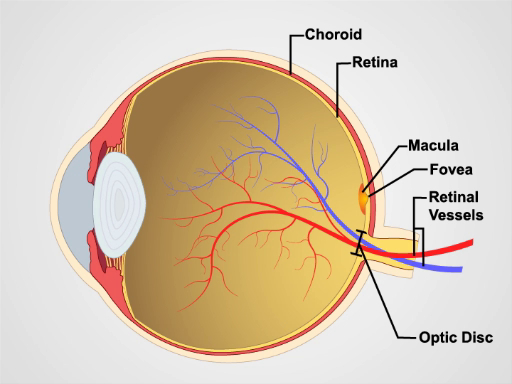
Figure 1. Anatomy of the eye. A diagram showing a sagittal view of the human eye with the structures labeled.

Figure 2: Normal retina. A photograph showing an ophthalmoscopic view on the normal retina.
Procedure
Since mydriatic eye drops are typically not used in general practice, the view of the fundus is limited to only a section of the posterior retina. Be familiar with these features before attempting to examine the patient.
- Unless the patient's refractive errors make it difficult to focus on the retina, it is usually best to remove your own eyeglasses for the exam.
- After darkening the room, turn on the ophthalmoscope and shine the light on your hand or on the wall.
- Turn the lens disc until the largest white
Application and Summary
The ophthalmologic exam is probably the most challenging for students to master. With time, however, it becomes routine. It is also one of the most productive parts of the physical exam, as it not only offers a window into the condition of the eye, but also provides evidence of disease elsewhere in the body. Elevated intracranial pressure from a variety of causes may lead to swelling of the optic nerve, which appears as papilledema on a funduscopic exam. In papilledema, the optic disc is swollen, its margins are blurred,
Skip to...
Videos from this collection:
Now Playing
Ophthalmoscopic Examination
Physical Examinations II
67.5K Views
Eye Exam
Physical Examinations II
76.8K Views
Ear Exam
Physical Examinations II
54.7K Views
Nose, Sinuses, Oral Cavity and Pharynx Exam
Physical Examinations II
65.4K Views
Thyroid Exam
Physical Examinations II
104.6K Views
Lymph Node Exam
Physical Examinations II
386.0K Views
Abdominal Exam I: Inspection and Auscultation
Physical Examinations II
202.3K Views
Abdominal Exam II: Percussion
Physical Examinations II
247.8K Views
Abdominal Exam III: Palpation
Physical Examinations II
138.4K Views
Abdominal Exam IV: Acute Abdominal Pain Assessment
Physical Examinations II
67.2K Views
Male Rectal Exam
Physical Examinations II
114.1K Views
Comprehensive Breast Exam
Physical Examinations II
87.1K Views
Pelvic Exam I: Assessment of the External Genitalia
Physical Examinations II
305.5K Views
Pelvic Exam II: Speculum Exam
Physical Examinations II
149.9K Views

Pelvic Exam III: Bimanual and Rectovaginal Exam
Physical Examinations II
147.3K Views

Copyright © 2025 MyJoVE Corporation. All rights reserved