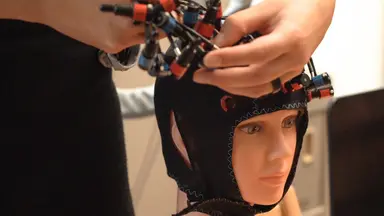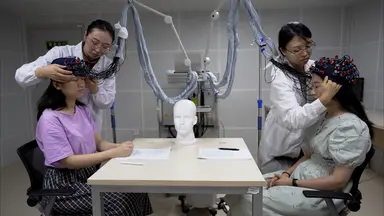
Hyperscanning is a promising method to describe the relationship between individuals and that in this study finds neural synchronization between individuals. And the most important question is to identify who is synchronizing with who. And the method we propose here is to identify the direction of the information flow between individuals.
Compared to other methods, the most significant advantage of this method is to remove the various confounding factors from the neural synchronization. For example, the autocorrelation in every signal. And meanwhile, we can maintain the high spatial anatomical resolution of every signal.
Start the data pre-processing by exporting the hemoglobin concentration changes data files from the equipment and transmitting the files to MATLAB readable format. Then, remove the first and last 15 seconds of the data for each session to avoid transient responses and use the MATLAB decimate built-in function to downsample the data from 55.6 hertz to 11.1 hertz. To correct motion artifacts, apply the discrete wavelet transform filter method with the appropriate filtering function.
Use the PCA built-in function to remove global physiological noise. Then, remove the top 80%of the variance from the signals. After removing the initial two seconds of data from women and the last two seconds of data from men, calculate the women-led two second-lagged INS WTC value with the equation.
Similarly, after removing the initial two seconds of data from men and the last two seconds of data from women, calculate the men-led two second-lagged INS WTC value. Repeat the procedure with different time lags, N, like N equals to four or six or eight seconds, across the potential 676 CH pairs and calculate the strength of women and men-led time-lagged INS WTC with the equation as described before. Calculate INS pWTC using pWTC in the same way using the equation.
Generate the time-lagged time series of the fNIRS signals between men and women and calculate the values of the time-lagged WTC at different time lags. Generate autocorrelated time series of men's fNIRS signals by removing the first two seconds and the last two seconds of the data from the men. Then, calculate the two seconds autocorrelated value for men.
Then, evaluate the autocorrelated WTC values at different time lags. In the same way, create a time-aligned time series of the fNIRS signals by removing the first two seconds of data from the men and the women. Then, calculate the two seconds time-aligned WTC.
Then, evaluate the time-aligned WTC values at different time lags. Enter the time-aligned WTC, time-lagged WTC, and autocorrelated WTC values at different time lag into the equations of pWTC, generating INS pWTC. In the second-level fNIRS data processing, remove physiological noise and frequency bands of each signal above 0.7 hertz.
Then, remove frequency bands of each signal below 0.01 hertz and within 0.15 to 0.3 hertz to filter out very low frequency fluctuations. Transform INS with Fisher Z-transformation and then average INS at the temporal dimension. For the averaged INS at each time lag, conduct a paired two sample t-test on each CH pair across the frequency range.
Then, identify all significant frequency clusters. Reassign dyadic relationships by randomly assigning the participants to new, two member pairs, like the participants of a diad that had never communicated with one another. Conduct a cluster based permutation test to establish a threshold for the results.
Recalculate the INS in each time lag. Perform paired t-tests in the new sample and identify significant frequency clusters. Then, select the cluster with the largest summed T value before repeating the procedures 1, 000 times to generate a null distribution of the maximum false positive T values.
Compare the summed T value of each identified frequency cluster in the original sample with the null distribution to obtain significant statistical results. A simulation analysis was conducted in the study. The representative analysis illustrates that the time-lagged INS WTC with autocorrelation was significantly higher than the time-lagged INS WTC without autocorrelation and time-lagged INS pWTC.
Additionally, there was no significant difference between the time-lagged INS WTC without autocorrelation and INS pWTC, indicating the efficiency of pWTC in removing the impact of the autocorrelation effect on INS. A marginal significant context effect was observed within 0.4 to 0.6 hertz, which of men lagged that of women by four seconds. In contrast, for INS pWTC, only significant context effect within 0.4 to 0.6 hertz when the sensor and motor cortex activity of men lagged that of women by four seconds was observed.
The directional INS from women to men was significantly higher in the conflict contexts than in the supportive contexts. The results of INS pWTC were validated with the Granger causality method. The results showed that INS GC exhibited a similar pattern to INS pWTC.
The directional INS calculated by the Granger causality analysis from women to men was significantly higher in the conflict contexts than in the supportive contexts. After calculating the neural synchronization using this method, it's also possible to conduct a lot of other methods. For example, we can compare this directional information flow between different social connection context and the social connection in different social relationship.
And also, it is possible to understand the contribution of different communication behaviors to the neural synchronization. For example, whether it is verbal communication or nonverbal communication play more a important role in the neural synchronization.