We developed a fluorescent assay that can quickly and inexpensively confirm the ability of novel compounds to chelate iron. Iron chelators are a promising class of compound that can be used to target cancers. Chelators'disruption of cancer's metabolic adaptions may lead to a new therapeutic strategy in cancer treatment.
There is a research focus on the development of iron chelators to disrupt the metabolic adaptions of cancers. However, there are no inexpensive and simple screening techniques for the observation of a novel molecule's ability to chelate iron. There is an unmet need for a simple, inexpensive assay for screening novel iron chelators.
This assay will allow cancer biologists to observe the chelation ability of novel compounds before investing time and resource into cellular screens of biological activity. Using this assay, we were able to observe the iron chelation ability of newly developed iron chelators. We have then focused on the question of how these chelators disrupt metabolism in cancer cells and how these cells respond to this disruption.
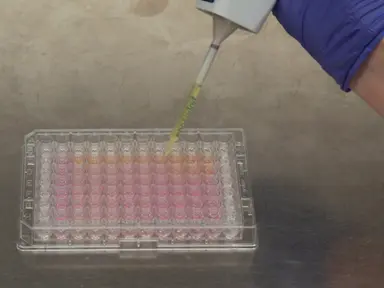
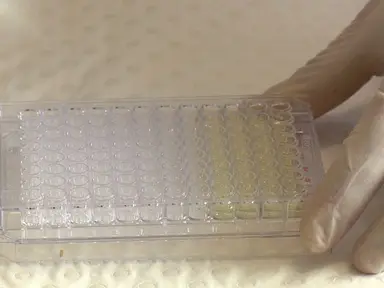
We are fascinated with how cancer cells respond to the metabolic disruptions created by the treatment with iron chelators. Understanding iron metabolism in cancers is fundamental to the development of novel therapeutics and new treatment regimes. To begin, use a multichannel pipette to distribute 50 microliters of PBS into columns 2 to 10 of rows A to E on a 96-well plate.
Pipette 100 microliters of two millimolar ferric ammonium sulfate stock solution into column 11. With a multichannel pipette transfer 50 microliters of the ferric ammonium sulfate stock from column 11 into column 10. Pipette the solutions multiple times to mix well.
Perform stepwise double dilution across the columns from 9 to 2 and rows A to 2. Now pipette out 50 microliters of the solution from column 2 to discard. After adding PBS into all the wells, pipette 10 microliters of 10 micromolar calcein stock into each well.
For the standalone PBS control, pipette 100 microliters of PBS into row F of columns 1 to 5. Then add 100 microliters of two millimolar ferric ammonium sulfate to row F of columns 6 to 10 for the FAS control. Incubate the plate at room temperature in the dark for 10 minutes.
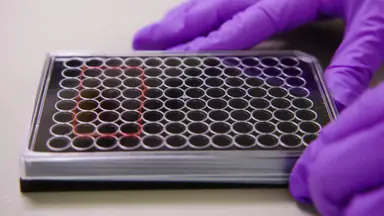
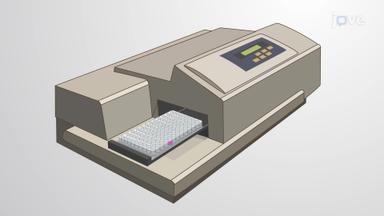
Analyze the fluorescence with a microplate reader. Pipette 50 microliters of PBS to columns 2 to 10 of row A to E of a 96-well plate. To column 11, add 100 microliters of two micromolar stock solution of the iron chelator solution.
With a multichannel manual pipette, remove 50 microliters of the iron chelator solution from column 11, then transfer it into the PBS in column 10 from rows A to E.Pipette up and down to mix the solution well. Continue to dilute the chelator solution across the remaining columns. Discard 50 microliters of the solution from the wells of column 2, then pipette 30 microliters of PBS into all wells.
Using a multichannel pipette, add 10 microliters of 100 micromolar ferric ammonium sulfate stock into columns 2 to 12 of rows A to E.Add 10 microliters of 10 micromolar calcein stock into the same wells. Next, for the positive control, pipette PBS, calcein stock, and ferric ammonium sulfate stock into column 1 of rows A two E.Mix the samples well by pipetting the solutions up and down, then add 100 microliters of PBS into row F of columns 1 to 5 to create the PBS negative control. Pipette the same volume of the iron chelator solution to row F from column 6 to 10 to create the standalone chelator control.
Place the well plate at room temperature for 10 minutes in the dark. Then analyze on a multimodal microplate reader as before. The addition of ferrous ions to calcein resulted in a linear decrease in calcein fluorescence.
The iron chelator outcompeted calcein for the ferrous ions. The chelator increased the calcein fluorescence up to a peak.