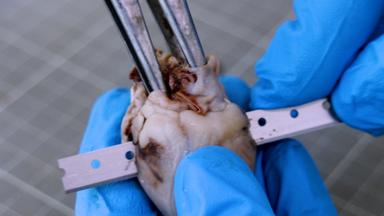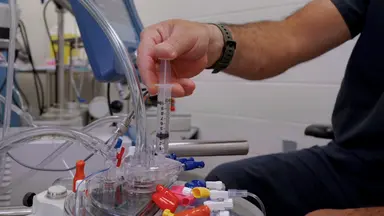
The overall goal of this procedure is to measure the cardiac function of large animals on an ex vivo circuit. This is accomplished by first assembling the working heart apparatus. In the second step, the blood is washed, reconstituted with normal saline, and the electrolytes are optimized in the final step.
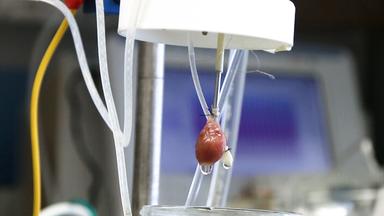
The heart is attached replicating in vivo hemodynamic parameters. Ultimately, a conductance catheter inserted into the ventricle can be used to obtain quantitative measurements of the ventricular function. The main advantage of this technique over existing methods like using small animal models, is that it produces clinically relevant data while avoiding immunological confounders that are seen with large animal transplantation.
To build the langor apparatus begin by connecting the heart reservoir to the blood reservoir with three eighths inch tubing, ensuring that the tubing goes through a roller pump. Next, connect the blood reservoir to the heater oxygenator with more three eighths inch tubing, and then connect the heater oxygenator to a Y connector. Connect one arm of the Y connector to the centrifugal pump.
Then connect the centrifugal pump to a second Y connector to create a bubble trap and a means of inserting the pressure transducer. Attach a piece of three eighths inch tubing to secure a hemostasis valve to the upward facing arm. Then attach a piece of three eighths inch tubing to the downward arm and connect the other arm of the Y connector to the inflow of the preload chamber.
Ensuring that this tubing goes through the second roller pump. Attach the preload line first to the outflow portion of the preload chamber. This will eventually connect to the left atrium.
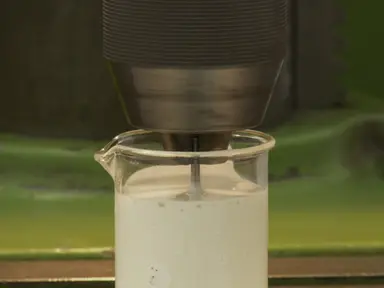
Connect the excess three eighth inch tubing to the outflow of this chamber, and then connect the oxygen tank and heating apparatus to the heater oxygenator. Finally, clamp the line going from the Y connector to the preload chamber, as this line will not be used until the heart is put into working mode. Now, turn on the oxygen tank heating apparatus, roller pump, connecting the two reservoirs and centrifugal pump, wash the blood according to manufacturer's instructions.
Next, reconstitute the washed red blood cells with normal saline to the desired hematocrit concentration. Add the diluted blood to the langor apparatus and check the hematocrit. Adjust the speeds of the two pumps to begin blood flow through the system, excluding the preload chamber.
Check the pH and electrolytes of the blood mixture and adjust until physiologic for the species used to prevent deleterious calcium influx upon reperfusion. Keep the calcium level on the languor apparatus initially at 0.3 to 0.5 millimole per liter. After calibrating the languor apparatus, quickly remove a properly rested heart from the storage container.
Pour out any storage solution from the ventricles. Blot the tissue dry and weigh it. Then return the heart to the storage container and orient it so that the aorta is facing upwards to help maintain a cold myocardial temperature.
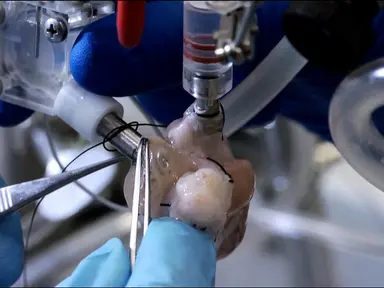
Next, insert a three eighth inch cannula into the aorta and secure it with a zip tie. Decrease the centrifugal pump to a slow trickle and drip the blood into the aorta until it is filled and completely deed When the aorta is full of blood. Carefully attach the aortic cannula to the aortic tubing on the L endorf making note of the attachment time.
Then insert the calibrated pressure transducer through the hemostasis valve into the native aorta. Begin the pressure measurements and adjust the centrifugal pump speed until the desired reperfusion pressure is achieved. Monitor the aortic pressure closely, especially during initial reperfusion and incrementally increase the temperature on the warming unit until the intra myocardial temperature reaches 37 degrees Celsius.
Obtain a baseline times zero sample from the venous blood reservoir to measure the pH electrolytes and other biochemical measurements. Then insert a temperature probe into the septum and monitor the myocardial temperature. Take blood samples every 15 minutes, adjusting the physiological parameters as desired for the experiment, and adding approximately one millimole of calcium to the blood solution every five minutes.
Ensuring that ionic calcium is greater than 0.8 millimoles per liter prior to the initiation of the working mode. After putting the heart into working mode, use a three zero polypropylene suture to place a purse string suture at the left ventricular apex. Then uses 16 gauge needle to make a stab incision within the purse string.
Insert the pressure volume conductance catheter into the apical incision. Look at the data output to determine how many volume segments are active. If all the segments are not active, adjust the catheter position until they are slight twisting of the catheter may be necessary to optimize the loop morphology.
Then using a properly calibrated catheter, obtain at least 30 seconds of baseline pressure volume data to determine the volume dependent measurements of cardiac function. Once sufficient loops are obtained, use a tubing clamp to slowly occlude the preload tube. The pressure volume loops should begin to become smaller and shift down and to the left.
This is called the walk down. After obtaining 10 to 15 seconds of walk down data, release the tubing clamp to allow the preload to reenter the left atrium and to obtain the volume independent measurements of cardiac function. Finally, click the stop button to stop the data collection to obtain replicate measurements.
After five minutes, repeat the procedure. Starting at the occlusion step, changes in the coronary resistance can cause fluctuations in the perfusion pressure. These variations can be minor and gradual correcting themselves over time.
However, in some cases, these variations can be abrupt and require adjustment of the flow through the centrifugal pump to maintain the desired reperfusion pressure. In this experiment, upon the initial introduction of the pressure volume catheter into a porcine heart that had been stored at four degrees Celsius for two hours, the loops were of poor quality with multiple areas of crossover and no discernible cardiac cycle components. However, with minimal manipulation of the catheter within the ventricle, the loop morphology improved dramatically, allowing for measurements to be obtained despite optimization of the catheter position.
The loops acquired on the ex vivo circuit may have a different morphology than the in vivo loops likely do to the different orientation of the heart on the circuit compared to in a supine animal, as well as to the lack of the anatomical attachments found within a live animal. Furthermore, the use of pacing wires to help regulate the heart rate introduces an external electrical current leading to the spike seen in the bottom right portion of the ex vivo loops. However, as long as these loops still feature the cardiac cycle components, they can still yield interpretable data.
Following this procedure. Other methods like electrocardiography and echocardiography can be performed to examine other physical properties of the heart, including conduction.