The overall goal of the following experiment is to estimate the number of functional motor units innervating the tricep Siri muscles in the mouse in vivo. This is achieved by first measuring the maximal cmap amplitude from the tricep Siri muscles. As a second step 10 sub maximal incremental responses are obtained, which are then average to give the average single motor unit action potential amplitude.
Next, the cmap amplitude is divided by the average SUP amplitude. In order to calculate muni, the results provide an in vivo estimation of the number of functional motor units innervating the tricep sury hin limb muscles. The electrophysiological motor unit number estimation technique or muni can be used to investigate preclinical therapies for disorders or injuries of the peripheral nervous system.
We first had the idea for this method when examining the Delta seven mouse model of spinal muscular atrophy. In this model, it presents with a severe phenotype, and therefore we had to examine the neonatal mouse. As such, this technique can be used both in neonatal mice and in adult mice.
Visual demonstration of this method is critical in order to obtain reproducible incremental responses to allow for an accurate estimation of the number of functional motor units. The main advantage of this technique over other methods of muni measurements and mice, such as those that rely on incremental force measurements, is that this technique is minimally invasive and can be repeated over time. The ability to perform clinically relevant, reliable, and repeated assessments of motor unit integrity in models of motor neuron disease and peripheral nerve injury increases the translational potential of these models and increases our understanding of the determinants of motor unit maintenance and health.
To perform cmap and muni recordings, place the active ring electrode on the skin, overlying the proximal portion of the hind limb, gastro muscle of an anesthetized mouse. Then place the reference ring electrode on the skin over the mid metatarsal portion of the foot in order to reduce impedance, coat the skin and residual hair underlying the ring electrodes with gel to maximize electrode skin contact. Avoid excessive application of electrode gel as this may cause an electrical bridge between electrodes and prevent accurate recording for stimulation of the sciatic nerve.
Insert an insulated 28 gauge monopolar needle as cathode in the proximal hind limb. Avoid inserting the stimulating electrodes overly close to the sciatic nerve or two deep as it could injure the sciatic nerve or other structure. Insert another insulated 28 gauge monopolar needle as anode, more proximally in the subcutaneous tissue overlying the sacrum After that, place a disposable surface electrode as ground electrode on the contralateral hind limb or tail.
In this procedure, obtain the sciatic cmap responses by stimulating the sciatic nerve with square wave pulses of 0.1 milliseconds.Duration. Acquire cmap responses with increasing stimulus intensity from one to 10 milliamps until the amplitude of the response no longer increases. In order to ensure super maximal stimulation, increase the stimulation to about 120%of the stimulus intensity utilized to obtain a maximal response and an additional response.
If there is no further increase in the cmap size, record this response as the maximal cmap. Then record baseline to peak and peak to peak cmap amplitudes in millivolts. To determine the average SUP size, use the incremental stimulation technique by delivering the sub maximal stimulation while increasing the intensity in 0.03 milliamp increments to obtain the minimal all or none responses.
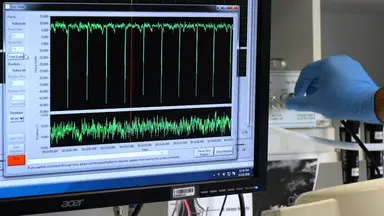
If the initial response does not occur with the stimulus intensity between 0.21 milliamps and 0.70 milliamps, adjust the stimulating cathode position either closer or farther away from the position of the sciatic nerve in the proximal thigh. Obtain the initial incremental response shown here. Ensure that the latency of the negative peak of the incremental response is roughly aligned with the negative peak of the previously obtained maximal cmap response.
Ensure that the response is stable and without fractionation by observing three consistent incremental responses in real time and ensure that the amplitude is at least 25 microvolts. Next, obtain the second incremental, ensuring the increment is stable and without fractionation by super imposing three incremental responses in real time. The second increment should be visually distinct and at least 25 microvolts larger than the preceding response.
Then obtain the third incremental response ensuring that the increment is stable and without fractionation. Similar to the second incremental response previously shown, the third increment should be visually distinct and at least 25 microvolts in amplitude greater than the second response. Continue to acquire incremental responses in this manner until a total of 10 incremental responses have been recorded.
Assess the increments to ensure the amplitude of each individual incremental response is smaller than one third of the sum of all 10 increments. Next, use the 10 incremental values to give the average SUP amplitude. The calculated values for the 10 incremental responses are shown.
The average SUP size is determined by averaging the 10 increments or simply dividing the final increment by 10. Then calculate muni by dividing the maximum peak to peak cmap amplitude by the average SM amplitude. To illustrate an application of these techniques, we have investigated the effect of sciatic nerve crush on motor unit function.
In this figure responses in an adult control mouse and an adult mouse 11 weeks following sciatic nerve crush are compared no differences in sensitivity between recordings. Following sciatic nerve crush muni is severely reduced at 50 estimated functional motor units compared with a normal finding of 278 functional motor units in the control mouse. In contrast, the cmap amplitude in the crushed animal shows only mild reduction compared to the control due to collateral sprouting.
After watching this video, you should have a good understanding of how to perform motor unit number estimation in mouse hind limb, muscles and vivo Once mastered, this technique can usually be done in less than 20 minutes if performed properly. We are hopeful that this visual demonstration of the protocol will lead to widespread adoption of this important technique, which we believe will lead to improved inter laboratory reliability and the effective translation of discoveries in the lab to effective therapies in the clinic.