My research focuses on the efficient development of exosomes. The development of the microneedle strategy can increase exome stability, and it provides more possibility for the clinical application of exosomes. We'll successfully develop the cell row, once the microneedle delivery systems.
Those include self-healing pearls, micro needles for sustained drug delivery, ultra sterling microneedle device for rapid loading and delivery of drugs, and collateral micro needles for delivery living cell and sugar micro needles for delivery exomes. We use microneedle to pierce the biological barrier and then deliver exosomes directly to the vector area efficiently. By throwing them dry, we have their stability, making the process easy, and convenient for both clinical and home use.
My lab, we focused on key technologies for developing the advanced, microneedle based delivery systems and that can load and delivery various therapeutics, includes mRNA small molecular drug antibodies, latent cell, and exomes. We are also investigators of their chemical and physical properties and therapeutic efficacy in different biomedical applications. To begin, take cultured mouse ovarian epithelial cancer cells.
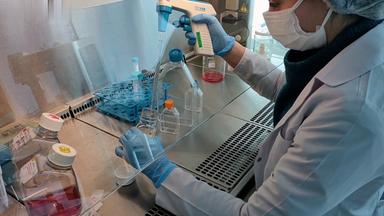
Remove the culture medium from the Petri dishes and wash twice with DPBS. Add 20 milliliters of dobecos modified eagle medium without FBS and penicillin streptomycin solution. Incubate at 37 degrees Celsius and 5%carbon dioxide for 48 hours.
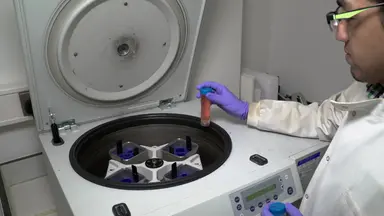
Then collect the cell culture supernatant from 20 Petri dishes of 15 centimeter diameter. Centrifuge at 300 G for 10 minutes at four degrees Celsius, and collect the supernatant. Centrifuge the supernatant at 2, 000 G for 10 minutes at four degrees Celsius, and collect the supernatant to remove cellular debris.
Now turn on the vacuum pump and connect it to the air inlet of the vacuum filtration system. Filter the supernatant through the 0.22 micron polyether cellphone membrane to remove vesicles or impurities larger than 0.22 microns. Add 15 milliliters of the filtered supernatant to the inner tube of the 100 kilodalton ultra filtration tube.
Centrifuge at 3, 500 G for 10 minutes at four degrees Celsius. Then remove the liquid from the outer tube. Next, collect the liquid from the inner tube.
Add one milliliter of DPBS in the inner tube pipette repeatedly to re-suspend exosomes, and then collect them. Centrifuge the liquid at 10, 000 G for 60 minutes at four degrees Celsius. Transfer the supernatant to a six milliliter quick snap centrifuge tube and seal it with a heat sealer.
Cut open the tube after ultracentrifuging the supernatant for two hours. Once the supernatant is removed, re-suspend the pellet in 100 microliters of DPBS to obtain the exosome solution. To begin, mixed components A and B of polydimethylsiloxane, or PDMS, in a ratio of 10 to one.
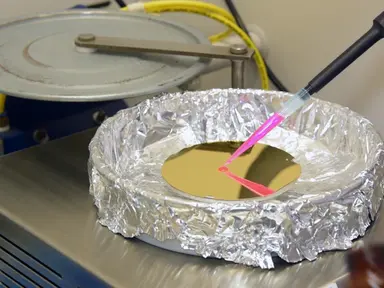
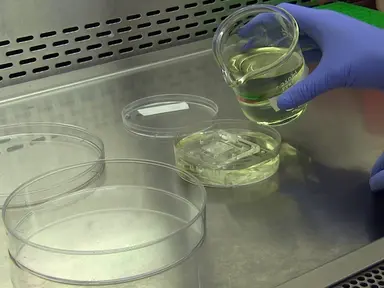
After stirring the mixture well, pour the mixture into a master mold. Place the PDMS mold under a pressure of one pound per square inch for 15 minutes to remove air bubbles. Cure the PDMS mold at 60 degrees Celsius for two hours.
Demold to obtain the production mold of the microneedle, then clean the production mold with ultrapure water before use. Quantify the protein content of the prepared exosome solution, using a BCA assay kit. Add an appropriate amount of DPBS to the exosome solution.
Now prepare a solution of 200 milligrams per milliliter of trehalose, using DPBS as the solvent. Stir for 20 minutes to ensure full dissolution. Next, prepare a solution of hyaluronic acid and polyvinyl perone, or PVP, using DPBS and ethanol as the solvent, respectively.
Stir overnight to ensure full dissolution. Mix the exosome solution and trehalose solution in an equal ratio. Add an equal volume of hyaluronic acid solution and mix thoroughly to obtain the tip solution.
Using a plasma cleaner, process the surface of the PDMS mold for 30 seconds at a low grade to enhance its hydrophilicity. Add 40 microliters of the tip solution to the PDMS mold. Centrifuge at 3, 000 G for three minutes at room temperature to ensure the liquid fills the needle layer of the mold.
Remove excess from the mold and dry at room temperature in a vacuum drying oven for one day. Then add 200 microliters of PVP solution to the PDMS mold. Centrifuge at 3, 000 G for three minutes at room temperature to ensure the liquid fills the mold's backing layer.
After drying the mold for one day, demold to obtain the exosome loaded microneedles patch. To begin, prepare the exosome loaded microneedle patch and paste its backing onto a 45 degree incline surface. Position the patch under a stereo microscope.
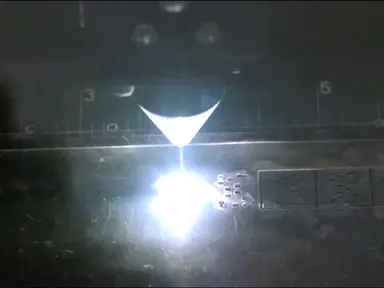
Turn on the illuminator and capture the morphology of the patch, using a four times objective lens. For mechanical testing, cut out a three by three array from the patch and place it with the tips facing upwards on the rigid platform of a tensile meter. Adjust the height of the probe to bring it close to the needle tips without touching them.
Set the parameters to stop automatically when the pressure reaches 20 Newton. Compress the needle tips vertically at a 0.5 millimeter per minute speed before recording the load versus displacement profile. The tips in the exosome loaded microneedle patch, exhibited a conical shape arranged in a 10 by 10 array with sharp and intact needle tips.
The tip of the microneedle can withstand the force of two Newtons, allowing it to penetrate through the skin barrier.