The overall goal of the following experiment is to demonstrate a method for surface modification of multi wall carbon nanotubes, along with laboratory scale column experiments for transport, retention, and re mobilization of the surface modified carbon nanotubes. Functionalization of commercially available carbon nanotubes is achieved by adding carbocyclic and hydroxyl functional groups to the nanoparticle surfaces. As a second step, a stable solution of carbon nanotubes is prepared for flow through column experiments.
Next column experiments are performed using acid washed silica sand and functionalized carbon nanotubes. After the sand is carefully packed into the column, the stable solution of nanotubes is injected, followed by injection of the background solution and then deionized water. The results show that the functionalization process has a large impact on the overall retention of multi wall carbon nanotubes in the selected sand types.
The demonstration of this method provides a guideline for surface modification of carbon nanotubes and an understanding of the impact of transport and retention of these nanoparticles in soil.Pos. Visual demonstration of this method is important because some of the procedures such as a nanoparticle functionalization may otherwise be difficult to reproduce. A systematic approach Using well controlled laboratory experiments is essential to understand and differentiate between different effects.
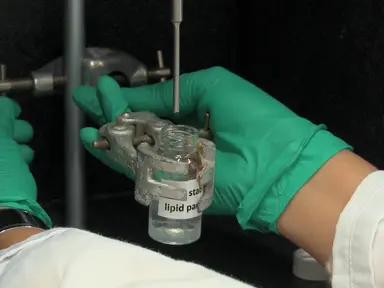
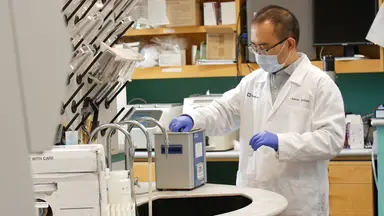
On the nanoparticle transport behavior, Part of the experimental procedure is being done by a student in the laboratory. Maria ti Inside a fume hood with appropriate personal protective equipment transfer 24 milliliters of concentrated sulfuric acid and eight milliliters of nitric acid to a beaker on aluminum foil. Weigh out 32 milligrams of untreated multi wall carbon nanotubes and add them to the acid solution.
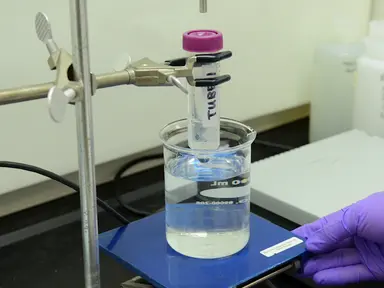
Sonicate the nano tube and acid mixture for two hours at room temperature. Then heat and stir the solution for five hours at 90 degrees Celsius. Filter about one fourth of the nano tube suspension through a 0.2 micron.
Pour diameter PTFE filter membrane with the aid of a vacuum. Bring the pH of the mixture to above five by adding boiling water during the filtration process. Then repeat with a fresh filter until all of the material is filtered.
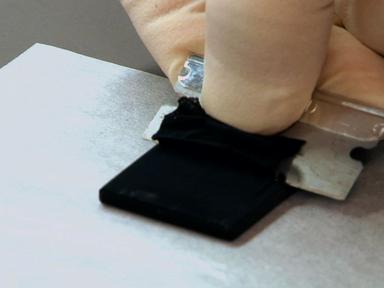
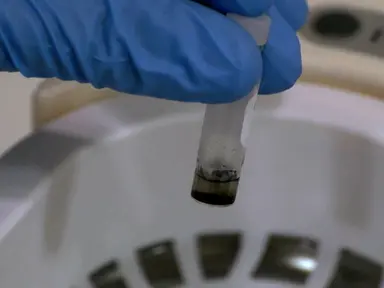
Collect the filter membranes and place them in a desiccate under vacuum for about 24 hours. After the membranes are completely dried, scrape the nanotubes from the membranes and collect the resulting powder for future experiments. To prepare the porous medium first, take eight milliliters of 37%hydrochloric acid and add it to one liter of deionized water to make a 0.1 molar solution in three portions.
Mix approximately one kilogram of sand into the acid solution. Allow the mixture to sit for 30 minutes. Then decant the acidic solution and rinse the sand with deionized water a minimum of eight times.
Next, add 700 milliliters of deionized water followed by 40 milliliters of 30%hydrogen peroxide to the flask of sand. Shake the flask twice to mix the solution with the sand. Add an additional 40 milliliters of 30%hydrogen peroxide to the flask.
Three more times mixing. After each addition, stir the mixture every 10 minutes For a total of 40 minutes, decant the solution and rinse the sand with deionized water at least eight times. Dry the sand in an oven at 105 degrees for 24 hours, and then allow it to cool at room temperature for two hours before wet.
Packing the column, prepare the background solution with sodium chloride and adjust the pH with 0.1 molar hydrochloric acid and 0.1 molar sodium hydroxide. Obtain a glass column of 2.5 centimeters in diameter and 15 centimeters in length with 0.2 millimeters. Steel mesh filters at both ends.
Flush and fill the tubing first with tracer up to the valve and then with DI water removing trapped air from the tubing. Next, calibrate the peristaltic pump to a flow rate of two milliliters per minute. Start the pump to fill the column from the bottom with the background solution.
As the water level rises, add about 12 grams of sand at a time for a total of 124 grams. Cap the column with the mesh filter when filling is complete. Switch the three-way valve to the tracer solution.
Then inject the solution for 4.32 po volumes and collect outflow samples at two minute intervals corresponding to four milliliters per sample. Then switch the valve to deionized water for another 4.32 pour volumes. To prepare for the transport experiment, add 15 milligrams of functionalized nanotubes to a beaker containing 200 milliliters of the background solution, and sonicate the mixture with an ultrasonic homogenizer probe for 15 minutes.
Then add an additional 800 milliliters of solution and mix flow background solution through the sand packed column. Then begin phase one of the experiment by switching the three-way valve to the nano tube solution. Inject the solution and collect the outflow samples at two minute intervals for 4.32 pour volumes.
Next, flow the background solution for another 4.32 po volumes. Continuing to collect samples every two minutes. For the final stage of the experiment, change the injection tube to deionized water and flow for another 4.32 po volumes.
Again, collecting samples every two minutes, stop the pump. At the end of this phase, prepare a UV vis spectrophotometer for sample analysis. Scan all of the collected tracer solution samples at the appropriate wavelength here.
333 nanometers and all of the nano tube solution samples at 400 nanometers. Plot the data as absorbent against time to better understand nano tube transport and retention. Experiments were performed with fully and less functionalized multi wall carbon nanotubes.
The maximum concentration of fully functionalized nanotubes in the collected samples was higher, indicating that they were more mobile than less functionalized nanotubes. Next three grain sizes of quartz sand were assessed theoretically as grain size decreases maximum absorption capacity increases, which implies more deposition. In agreement with this, less nanotubes were alluded from finer grain sand than from the medium or coarse grain sand.
Finally, three experiments were performed to investigate the effect of flow rate on nano tube retention. At lower velocities, nano tube concentrations increased slowly, and a steady concentration was not achieved in the outflow within 4.32 poor volumes. This is consistent with previous literature indicating that spherical nanoparticles are often less mobile and slower fluids After its development.
This technique has allowed researchers to carefully investigate the different physical and chemical factors controlling the mobility of nanoparticles, such as carbon nanotubes in soil and groundwater systems. Therefore, their potential to spread in environment under different conditions can be assessed. After watching this video, you should have a good understanding of how to perform surface modifications of carbon nanotubes.
You have also seen how to perform a series of column experiments investigating the transport, retention, and re mobilization of carbon nanotubes in saturated forest media.