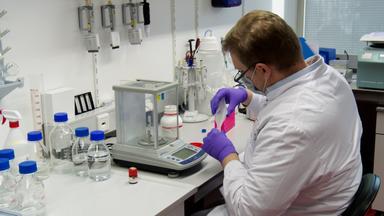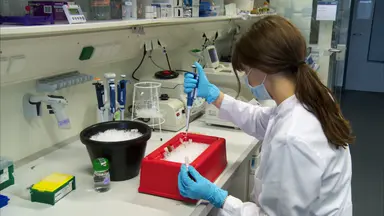
The overall goal of the following experiment is to visualize the activity of de ubiquitinated enzymes in cells. This is achieved by culturing cells to high co fluency and harvesting them to facilitate the production of a concentrated lysate as a second step. Gentle mechanical lysis is used to produce a lysate that maintains a metabolic picture of the cell's cytoplasm.
Next, the enzymes are incubated with hemagglutinin derived probes in order to label the de ubiquitin enzymes by reacting with the active site cysteine residue, the results show the activity profiles of many de ubiquitin enzymes based on Western blotting and subsequent chemiluminescent detection. The main advantage of this technique over existing methods like regular western blotting, is that it allows the user to visualize the activities of multiple enzymes. In one experiment, Prepare cell culture media by Ali, quoting 30 milliliters of dobe docos, modified eagles medium, or DMEM plus 10%fetal bovine serum into a 50 milliliter conical tube to culture.
The cells for the experiment transfer frozen M 17 or he A cells from liquid nitrogen storage to a small beaker with lukewarm water. Then transfer the cells to the 50 milliliter conical tube containing 30 milliliters of media. Next, add some media to the cell vial and transfer the resuspended cells within five seconds of thawing.
Centrifuge the cell suspension at 450 Gs for five minutes to obtain a cell pellet. Then add 20 milliliters of media into a T 75 flask. Remove the media from the cells using suction.
Add five milliliters of fresh media to the cell pellet and resus Suspend. Transfer the five milliliters of cell suspension to the 20 milliliters of media in the T 75 flask and incubated 37 degrees Celsius. Changing the media every three days to harvest the cells.
Remove the media via suction, being careful not to touch the cells. Wash the cells with five milliliters of phosphate buffered saline or PBS. Remove PBS using suction.
Next, add three milliliters of tripsin EDTA to the T 75 flask and incubate at 37 degrees Celsius for three minutes. Following incubation, add six milliliters of fresh media to the flask and resus. Suspend the cells.
Transfer the suspension to a 15 milliliter conical tube and centrifuge at 290 Gs for five minutes, remove the supernatant and add five milliliters of PBS. Gently tap the bottom of the tube to break up the pellet before centrifusion at 290 Gs for five minutes. After repeating the PBS wash three times, remove the old PBS and resuspend the cells in one milliliter of fresh PBS.
Then transfer the cells to an einor tube and spin at 290 GS for five minutes. To perform cell lysis, measure the approximate volume of the pellet using a pipette and weigh out glass beads and a mass to volume ratio of one-to-one. Add lysis buffer to the pellet at twice the volume of the pellet.
Then add the glass beads to the pellet and lysis. Buffer ly the cells in the einor tube at maximum agitation for 30 minutes at four degrees Celsius by vortexing in a cold room. Centrifuge briefly at 200 GS for 30 seconds.
To settle the beads and collect the supernatant. Add the same volume of glass beads as before to the supernatant vortex, once again at maximum agitation for 30 minutes at four degrees Celsius after centrifusion briefly at 200 Gs for 30 seconds. To settle the glass beads, collect the supernatant.
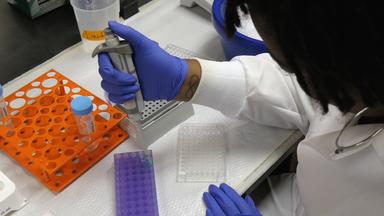
Finally centrifuge at 5, 030 GS for five minutes. To remove the nuclei, membranes and unbroken cells, collect the supernatant, which is the cell lysate for tissue derivitization, performed by Cinco nimic acid, or BCA analysis. In a 96 well plate to determine the protein concentration of the lysate using a chole metric 96 well plate reader as specified by the BCA protein assay kit protocol.
After determining the protein concentration, bring an aliquot corresponding to 20 micrograms of total protein to 50 microliters using deionized water. Then add two microliters of 1.35 micromolar of HAUB vinyl cell phone to the solution. The result is 20 micrograms of lysate to 50 nano molar of probe in the final reaction mixture.
This is in large molar excess. To ensure tagging of functional de ubiquitin enzymes or dubs, leave the solution to incubate for one hour at 37 degrees Celsius. Next, add laly sample buffer to the solution.
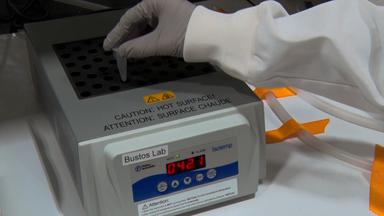
For a 52 microliter reaction volume use 26 microliters of two x sample buffer, 13 microliters of four x sample buffer, or 8.87 microliters of six x sample buffer. Incubate the sample for five minutes at 95 degrees Celsius. Cool on ice.
Before loading the gel to perform the western blot first load a 12, well four to 20%tris glycine gel with 40 microliters of the prepared sample. Run the gel at 95 volts until the ion front reaches the bottom. Then carry out an overnight transfer of the gel onto a poly vine DI fluoride or PVDF membrane following.
Transfer First, incubate the membrane in the AMDO black stain and scan the membrane to obtain an image showing the amount of protein in each lane. Then detain the membrane and incubate in 5%milk in PBS for one hour to block. Next, incubate the membrane in the primary anti HA antibody at a concentration of one to 10, 000 in 5%milk in PBS, either overnight at four degrees Celsius or for four hours at room temperature.
After incubation, perform three washes for five minutes each in PBS with 0.1%tween 20 detergent. Then incubate the membrane in mouse horseradish peroxidase at a concentration of one to 10, 000 in 5%milk in PBS for at least two hours. Perform three washes as before, followed by one wash for five minutes in PBS.
Finally incubate the membrane in a chemiluminescent detection reagent for 10 minutes and detect using a luminescent detector. Use the automatic exposure setting on the detector. The protein loading was checked using the AM mito black stain.
This control step ensures that the differences in activity are due to actual cellular processes and not unequal protein loading. The lanes shown here indicate equal protein amounts were used in the first experiment. In the second experiment, unequal protein amounts were loaded due to the expected differences in the activity profiles of the differences cell lines.
This was done to ensure the detection of an activity profile for the M 17 cell. Lysates incubated with ethyl maide, which is a cystine inhibitor and should lead to a reduced signal on the Western blot. The membranes were incubated in anti HA primary antibody.
A mouse horse radish peroxidase, and then detected using chemiluminescent imaging. Successful tagging of the dubs using the probes results in a profile in each lane of the membrane. The intensity of the bands at different molecular weights corresponds to the activity level of the dub enzyme.
The differences in activity levels of various dubs across cell lines become evident when similar proteins such as U CHL one are compared in the he a and M 17 cells. After this procedure. Other methods like subcellular fractionation can be performed in order to answer questions like, how do pathological processes affect the ubiquitin enzyme activity in membrane bound organelles?
After watching this video, you should have a good understanding of how to measure de ubiquitinated enzyme activity using active site directed probes.