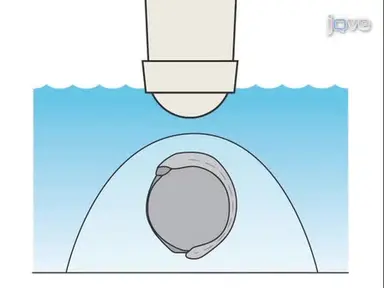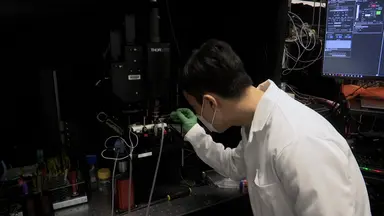
The fish forebrain hosts areas suspected to be homologous to mammalian brain regions involved in complex behavior. These include the hippocampus, the cortex and the amygdala. We are currently trying to understand the effect of sensory information on the activity of these brain regions.
Current research in zebrafish neuroscience uses two-photon calcium imaging of immobilized larvae combined with virtual reality-based behavior assays to study sensory motor processing in the brain. Most research on the zebrafish brain is done on larvae, however, some complex behaviors in fish do not fully develop until adulthood. Our protocol allows the study of brain activity in the adult during behavior.
This protocol reduced surgery time by 50%compared to the previous method. It's a more efficient approach for restraining head of the zebrafish for brain image. This head restraint protocol opened out opportunity to perform in vivo experiment on the adult zebrafish brain.
In addition to the two-photo calcium image, head restraint potentially allowed the optogenetic manipulation, electrophysiologic and even ultrasound image in live fish. To begin, prepare a semi-hexagonal tank, a base plate and a head stage. Place the semi-hexagonal tank on the experimental platform of the microscope.
Aim the 810-nanometer infrared light and the camera to the head stage for behavioral recording. Then set up an 875-nanometer short-pass filter and a 700-nanometer long-pass filter in front of the camera to prevent the two-photon laser and the visual stimulus from interfering with behavioral recording. To present the visual stimulus, attach back projection films to the inner side of the three walls of the semi-hexagonal tank.
Aim the three projectors at the three surfaces of the tank. To prepare an omega-shaped head bar for the zebrafish head restraint, attach a piece of oil-based modeling clay to a three-axis micromanipulator. Then insert an arm of the head bar into the clay and orient the head bar horizontally.
Prepare the cannon for holding the fish's body in place during surgery. To remove excess skin and water from the skull's attachment sites, prepare four tissue swabs by cutting a paper towel into a three-centimeter square. Then fold the paper squares along their diagonal to produce a tube-like structure and twist the end of the tube into a fine point.
After anesthetizing the fish with 0.03%TMS, perform syringe perfusion with 0.01%TMS to maintain sedation throughout the procedure. Wrap the fish in moist paper tissue, starting from the tip of the tail to around one-millimeter coddle to the gill. Then wrap a soft plastic tubing with a longitudinal slit around the paper tissue, covering the fish from the end of the tail to around two-millimeter coddle to the gill.
Wrap the paper towel around the tubing. Then wrap a soft plastic tube cut from the bulb of a plastic transfer pipette around the paper towel. Load the wrapped fish into the cannon.
Next, using a scalpel, remove the skin covering the attachment sites, two triangular areas of the skull rostrolateral to the cerebellum and above the gills. Then use tissue swabs to dry the attachment sites and clear any remaining skin. Using a 10-microliter pipette tip, apply a drop of tissue glue at the center of each attachment site.
Place the fish body in an upright position and position the head bar slightly above and coddle to the attachment sites. Next, prepare dental cement by mixing one small spoon of polymer with four drops of quick monomer and one drop of catalyst five. Stir the mixture evenly for 15 seconds.
Immediately after mixing, use a micropipette and a 10-microliter pipette tip to apply the cement onto the attachment sites and the region between the sites. Then, using a micromanipulator, gently press the head bar onto the cement. Cover the head bar with the remaining cement and wait for 12 minutes to allow the curing of the cement.
Next, to improve optical access to the forebrain for calcium imaging, use a scalpel to remove the skin above the telencephalon. After curing, remove the clay from the head bar. Next, prepare a fish-loading module for the micromanipulator, then transfer the entire capsule from the cannon to the pitch adjuster in the fish-loading module.
Using the micromanipulator, position the fish with the head bar placed on top of the metal posts of the head stage. Slightly increase the pitch angle of the fish. Apply ultraviolet curable glue to secure the head bar to the metal posts.
Then pull out the fish from the capsule and lock the head stage onto the base plate within the semi-hexagonal tank. After surgery, immerse the animal in fish tank water to recover from anesthesia. Turn on the laser and wait for 30 minutes for the power to stabilize.
Set the wavelength to 920 nanometers and power to approximately 50 milliwatts at the sample. Place the recording chamber with the head-restrained zebrafish on the experimental platform. Position the objective lens close to the forebrain surface.
For behavior recording, turn on the 810-nanometer infrared lights on both sides of the tank. Select the input source for VR display and start recording data. Then open the laser shutter and enable the photo multiplier tube.
Gradually elevate the objective lens until the dorsal forebrain is revealed. Use a piezo actuator to acquire images at multiple depths to increase the number of neurons recorded. Two-photon calcium imaging records individual neuron activity in the dorsal forebrain up to 200 microns deep through intact skulls.
The imaging range includes the pallial areas Dm, cDc, rDc, and part of the Dl, covering 30%of the adult zebrafish forebrain. Simultaneous behavioral recording performed during brain imaging enables the identification of neuronal correlates of motor outputs. During imaging, tail movements should not cause visible motion artifacts.