We are working on the mechanism and treatment strategies of age-related macular degeneration, a prevalent condition causing severe vision loss in older individuals. Particularly, we're developing new treatments to tackle the issue of drug resistance to the current treatment of choroidal neovascularization, which is the wet type of AMD. Our lab recently developed new treatment to ameliorate anti VEGF resistance in CNV.
This is achieved by using mouse CNV model. Our research has shown that old mice with laser induced CNV develop arteriola CNV, which is resistant to anti VEGF treatment. In contrast, young mice with capillary CNV are responsive to the treatment.
In AMD research, CNV is almost exclusively studied by fluorescein angiography to reveal leakage patterns in animal models. However, FA does not show CNV vascular morphology, and thus, it is not suitable to study anti-VEGF resistance in a AMD. The current FA method used for CNV imaging lacks vital information regarding the vascular morphology of CNV lesions, such as capillary or arteriolar CNV.
However, by combining ICGA and FA, this protocol can evaluate both CNV leakage and vascular morphology. By assessing both leakage and CNV lesion morphology, it is possible to study the underlying molecule mechanism, leading to arviola CNV, and therefore provide opportunities to find new targets to treat anti-VGF resistance for AMD patients. After anesthetizing the mouse, gently pinch one of the mouse's paws to check whether the mouse is adequately anesthetized.
Administer 1%tropicamide ophthalmic solution drops to dilate the mouse's eyes and wait for 30 seconds. Then, to reduce eye movement and blinking, apply 0.5%proparacaine hydrochloride drops to both eyes, followed by lubricant iGel drops and position the mouse on a heating water pad. Prepare a dye mix containing an equal volume of indocyanine green, or ICG, and fluorescein dye.
Inject 250 microliters of the mixture through an intraperitoneal injection into the lower left quadrant, near the hind legs of the mouse, positioning it parallel to the skin to prevent organ perforation. Carefully retract the plunger, ensuring no blood has entered the syringe cap. Proceed by gradually injecting the dye at a steady pace.
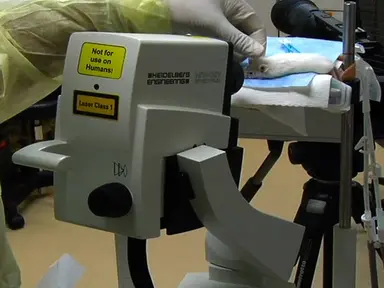
Next, place the mouse on the heating pad of the imaging platform. Adjust the positioning of the mouse's body at a 45 degree angle relative to the camera and gently angle the head is slightly downwards. Delicately wipe the eye to be imaged using a cotton swab to remove the layer of lubricant eyedrops or gels.
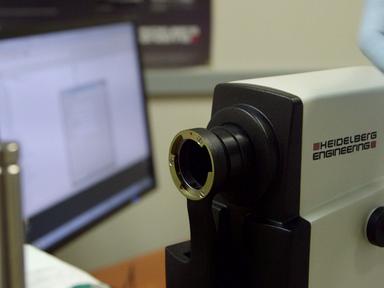
Transition the camera towards the mouse's eye and select the FA channel from the acquisition module. Arrange the mouse's head so the optic nerve is centered on the screen, avoiding the need to tilt the laser scanning ophthalmoscope. Now switch to the ICGA channel on the acquisition module.
Once the eye occupies the entire screen on the imaging software, rotate the round black button on the acquisition module for image sensitivity adjustments. Use the ophthalmoscopes knob to fine tune the focus. Next, press the round black button on the acquisition module to normalize the image.
After normalization, click the acquire button on the touchscreen panel to save the image. Switch to the FA channel using the acquisition module and adjust both the sensitivity and focus of each image as shown earlier to capture the leakage of the choroidal neovascularization, or CNV lesion. Then capture images for the early phase of ICGA and FA three to four minutes after injection.
Once all the necessary images are captured, apply a gel lubricant or ointment to the eye of the mouse. Capillary CNV dominates the CNV lesions in young mice. In contrast, old mice exhibit arteriolar CNV, characterized by large caliber vessels, vascular loops, and anastomotic connections.
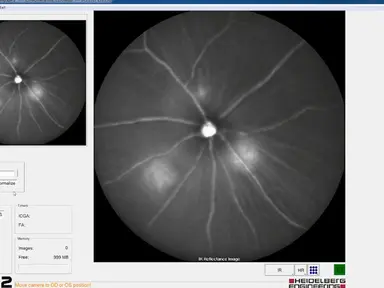
Both young and old mice show clear visibility of the retinal vasculature in FA.in the ICGA images of young mice, the retinal vasculature is not visible and the choroidal vessels appear faded. In the ICGA images of old mice, partial retinal vasculature can be observed while the choroidal vessels appear faded. Arteriolar CNV in old mice exhibits a larger CNV size and significantly more leakage compared to capillary CNV in young mice.