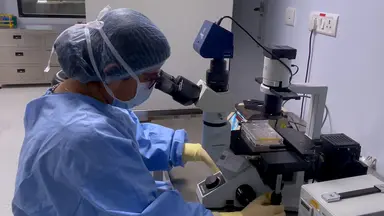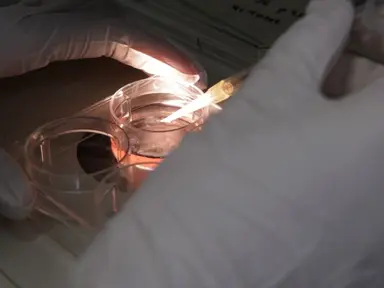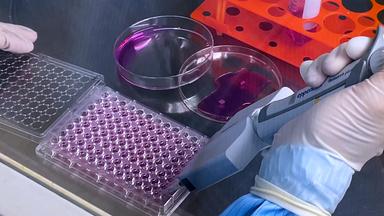
Our group focuses on understanding the pathogenesis and the treatment of human retinal diseases. Our protocol describes an optimized induction technique to generate a neural retina that significantly reduce the probability of escalation and fusion to increase the success rate of retina production until death 60. The modified method is simpler and more efficient in generating neural retina, which can prove to be a better disease model for drug screening and cell therapy.
In the future, we aim to study the effects of physical chemical factors on retinal development and underlying mechanisms using our retinal organoid model. To begin, add one milliliter of 1%extracellular matrix to each well of a 6-well plate. Incubate the plate at 37 degrees Celsius in a 5%carbon dioxide atmosphere.
After one hour, add two milliliters of pre-warmed maintenance medium, containing 0.4 micromolar Y-27632 to each well. To thaw the H9 embryonic stem cells, shake the cryovial stock in a 37 degree Celsius water bath for 30 seconds. Carefully sterilize the cryovial with a 75%disinfectant alcohol spray.
Then, transfer the thawed cells to a 15 milliliter tube containing the maintenance medium and Y-27632. Centrifuge the tube at 190 G for five minutes at room temperature. Then, carefully remove most of the supernatant and resuspend the cells in one milliliter of maintenance medium, containing Y-27632.
Dispense 0.5 milliliters of the cell suspension to each well of the extracellular matrix coated plate containing maintenance medium. Shake the plate laterally and incubate the plate at 37 degrees Celsius under 5%carbon dioxide for at least 24 hours. Change the medium every day.
Once the clone density reaches 70%remove the spent medium. After two DPBS washes, incubate the cells with one milliliter of EDTA for four to seven minutes at room temperature and discard EDTA completely. Add one milliliter of maintenance medium to the cells and tap the plate gently.
Then transfer the dislodged cells to a 15 milliliter tube and mix them three to five times. Add 20 to 100 microliters of cell suspension to each well of a previously prepared ECM-coated dish and mix well. Using a microscope, confirm the cell density and incubate the cells at 37 degrees Celsius under 5%carbon dioxide.
To begin, thaw and culture H9-embryonic stem cells in maintenance medium containing Y-27632. On day zero, once the colonies become 70%confluent, wash them with two milliliters of DPBS. Then, incubate the cells with 0.5 milliliters of cell dissociation solution, containing 20 micromoles per liter Y-27632.
To abort the digestion, add three milliliters of maintenance medium containing 20 micromoles per liter Y-27632. To develop the cells, centrifuge the tube at 190 G for five minutes and discard the supernatant. Resuspend the pellet in one milliliter of growth factor-free chemically defined medium with Y-27632.
After counting the cells, add 1.2 million cells to 10 milliliters of growth factor-free chemically defined medium and mix well. Then dispense 100 microliters of cell suspension to each well of a 96-well conical bottom plate. Incubate in a humidified 5%carbon dioxide atmosphere.
To induce retina formation on day six, add medium-containing BMP4 to each well of a 96-well V-bottom plate and incubate again on day 9, 12 and 15. Replace half of the spent medium with fresh medium without BMP4. On day 18, carefully transfer the formed embryoid bodies to a 15 milliliter centrifuge tube.
After the natural precipitation of the embryoid bodies, gently remove the supernatant and rinse them with the neural retina differentiation medium. Then place the embryo bodies in a low absorption 6-welled plate and incubate the plate again. On day 21, bright-field images showed continuous neuro epithelial structure in the neural retina generated using this method.
The retinal induction success rate was significantly higher and retinal organoids generated using this protocol were similar in size and morphology compared to other methods.