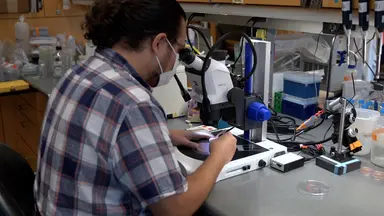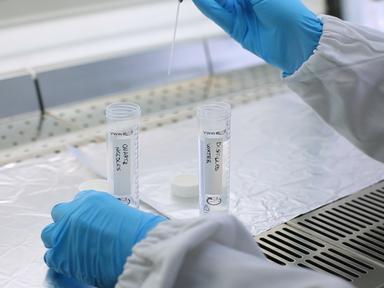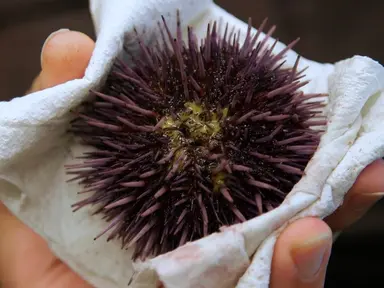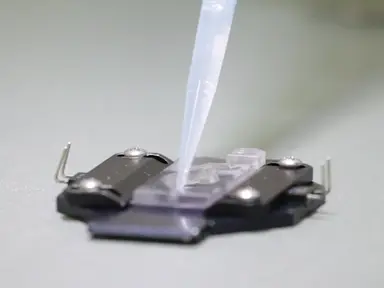
The insect transformation facility. We are a university service facility that helps clients make genetically modified insects. The research ranges from neuroscience in which they are doing research on mosquito olfaction to public health research in which they are making vaccines to malaria, to expressing novel proteins within the black soldier fly.
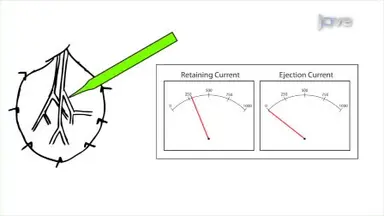
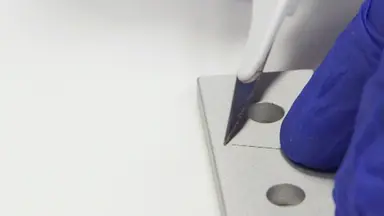
Traditionally, needles have been opened by pulling the needles and then brushing them against something in order to open that needle, and that can produce needles which are either perfect for microinjection or unusable. And so this method allows us to open the needle in a concise fashion in which we get sharp needles each time. This protocol gives feedback on the opening size of the needle.
Once that needle is open, you can dial back the pressure that is being delivered to the tip of the needle, and the higher the pressure at which air bubbles stop flowing, the smaller the opening size of that needle. Prepare the grinding assembly as per the manufacturer's guidelines, which includes setting up the abrasive plate and attaching the retaining ring equipped with magnets. Then apply 10 drops of pedestal oil onto the pedestals'optically flat surface.
Place the grinding assembly on the pedestal and initiate the grinding operation. Activate the light source to illuminate the work area, ensuring the light is behind the beveled edge, shining at an angle of 45 degrees to the abrasive plate and needle. Rotate the microscope head in place at 90X magnification.
Briefly halt the spinning of the abrasive plate to focus the microscope on the surface of the plate. Add 1%wetting agent to the wick until the wick is completely wet. Then add 1%wetting agent to the surface of the abrasive plate, ensuring it covers the surface without leaking onto the black retaining ring.
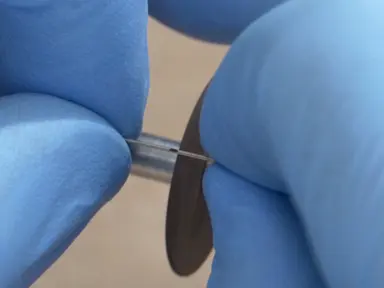
Place the pre-wet wick onto the surface of the abrasive plate while it is spinning, ensuring the wick is on the left side of the plate while looking down from the top and stretches from 11 o'clock to 6 o'clock position with the plate as a clock face. Make sure the wick does not ride on the black portion of the retaining ring. To begin beveling the bora silicate needle after preparing the grinding assembly, insert the needle into the needle holder and tighten the retaining ring to secure the needle in place.
Open the regulator and increase the pressure to 24 pounds per square inch. Rotate the course adjustment knob enough to raise the needle holder till the needle is raised higher than the surface of the rotating abrasive plate. Rotate the entire manipulator so the needle swings into place above the rotating plate.
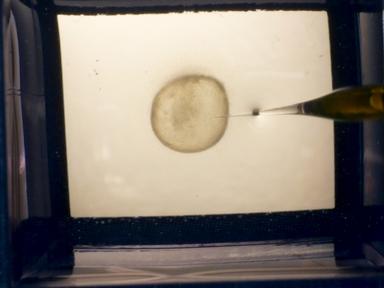
Position the needle on the plate such that the rotation of the plate moves it away from the needle tip. Watching from the side, use the coarse adjustment knob to lower the needle toward the abrasive plate surface and stop when the needle is almost touching the surface of the liquid. Adjust the needle position so that it is in the center of the field of view.
Once in the center, slowly increase the magnification, making slight adjustments to keep the needle tip in the center of view. At maximum magnification, stop the grinding plate and focus the microscope on the surface of the abrasive plate. Once the surface is in focus, immediately restart the plate rotation.
Using the manipulator course adjustment knob, lower the needle toward the abrasive plate. In the field of view, observe the needle and the shadow of the needle. When the two are close to touching, switch to the fine adjustment knob.
Continue lowering the needle until it touches its shadow. At this point, read the caliper and note the reading. This reading indicates the abrasive plate surface is at or below this caliper measurement.
Allow the needle to remain at this caliper reading for 5 to 10 seconds. Using the manipulator fine adjustment knob, raise the needle while ensuring it stays underneath the surface of the wetting agent. Stop the rotation of the abrasive plate briefly to observe whether bubbles escape from the needle tip.
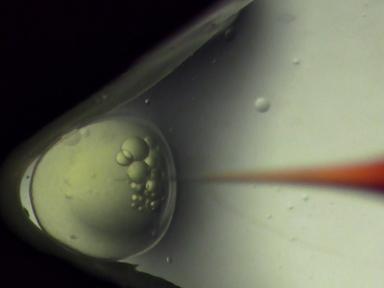
If bubbles are not present, move the needle back to the previous caliber reading, lower its slightly, take a new caliber reading and repeat the steps as demonstrated previously. If bubbles are seen, restart the abrasive plate to observe if bubble formation occurs while the plate is rotating. Once bubbles are observed with the abrasive plate not rotating, slowly decrease the air pressure by rotating the regulator adjustment knob.
When the bubbles stop flowing from the tip of the needle, note the pressure, then increase the air pressure until bubbles start flowing again from the needle tip. Once the beveling is over, raise the needle above the abrasive plate, ensuring it is high enough not to hit anything as the entire manipulator is rotated away from the plate and microscope. Once the needle is in a position where it can be safely removed, lower the air pressure to zero.
Remove the needle and place it in a needle storage box like a Petri dish until it is used.