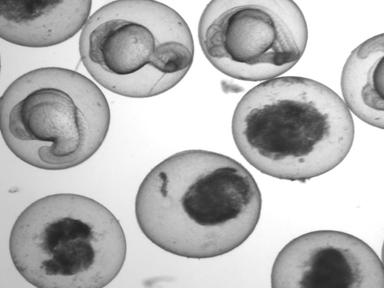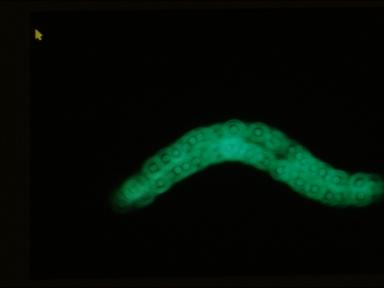
The overall goal of the Evans Blue Dye and Fitzy Dextrin common cardinal vein injection is to observe skeletal muscle membrane integrity in live zebrafish to help characterize disease causing mechanisms related to various subtypes of muscular dystrophy. Evan's blue dye injection can help uncover biological mechanisms that contribute to disease pathology when characterizing animal models on muscular dystrophy, it can also contribute to our understanding of potential therapeutic mechanisms for disease treatment. The main advantage of this technique is that it can be carried out and analyzed using live zebrafish.
Additionally, the co injection of Fitz Dextrin demonstrates a quality control for successful injection, which improves rigor and quantification. The implications of this technique relate to the utility in validation of zebrafish models of muscle disease. They also enhance the understanding of how certain mutations lead to muscle disease phenotypes, such as muscular dystrophy, which is critical for finding treatments and cures.
To prepare agar injection plates boil two to 3%aros in E three medium and allow the solution to cool slightly on the bench. Pour about 35 milliliters of the cooled agros into each 100 millimeter dish. Then place one end of a preferred injection mold into the solution before laying the remainder of the mold onto the agro solution.
Allow the agro solution to solidify either at room temperature or at four degree Celsius for about 30 minutes. Then use a spatula to separate one end of the mold from the solid agros and slowly remove the remainder of the mold. Make a 1%stock of Evan's Blue Dye or EBD in one x ringer solution.
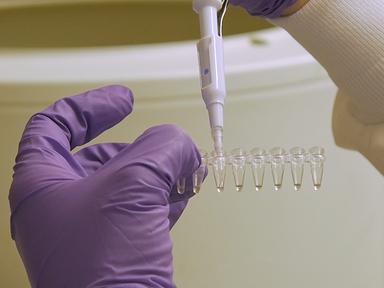
Then prepare a stock solution of Fitzy Dextrin in one x ringer solution and store at negative 20 degree Celsius. To make an injection mix dilute EBD to 0.1%directly in Fitz Dextrin stock solution thoroughly vortex the injection mix and keep out of direct light by using aluminum foil to wrap the tube prior to injecting. Prewarm the injection plate to room temperature.
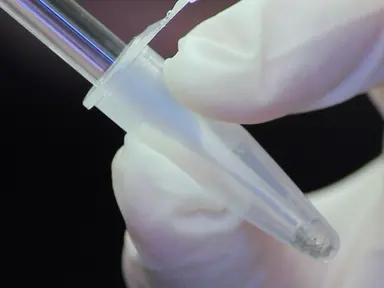
Arrange the micro manipulator on a metal plate and stand next to the injection microscope. Turn on the air driven micro injection controller. Then with approximately two to four microliters of EBD mix, backfill the injection needle.
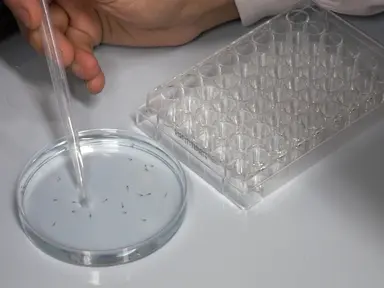
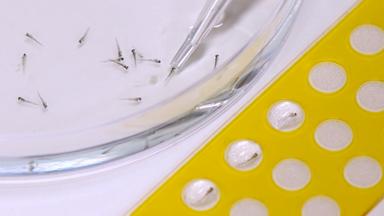
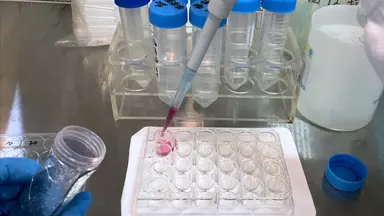
Next, calibrate the injection volume with about five nanoliters of EBD mix. Then use one x ringer solution to wet the injection plate and remove excess solution from the wells pretreat the larvae with 0.04%trica diluted in one x ringer solution to completely immobilize the larvae prior to injecting with a glass pipette. Place the anesthetized larvae into wells of the auger injection plates, ensuring that the larvae are completely in the wells lying on their sides.
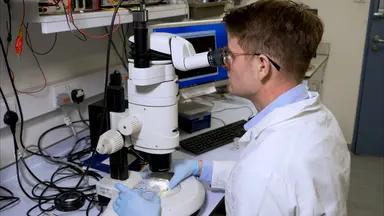
Remove the excess trica solution to minimize larvae movement within the well, but leave enough to prevent dehydration. Place the injection plate of larvae on a dissecting scope and position the injection pipette needle containing the EBD. Mix over a zebrafish larvae near the heart and about 45 degrees from the anterior posterior axis.
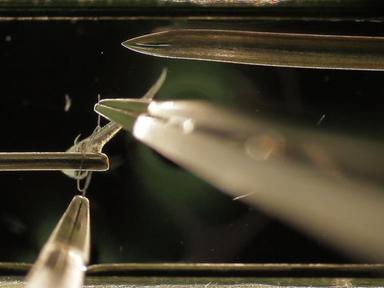
Insert the injection needle into the common cardinal vein or CCV near the anterior portion of the yolk where the vein initially turns in the dorsal direction. Next, inject five nanoliters of EBD mix and keep the injection needle in position for five to eight seconds. To minimize immediate leakage of EBD mix, a good injection will show dye in the heart chambers, and it can be repeated.
If EB DMX is not seen in the heart immediately after a successful injection, the embryo will accumulate Fitz Dextrin in the vasculature as shown here. After the desired number of larvae have been injected, return the larvae to one x ringer solution without trica in 100 millimeter dishes to increase survival rate and maintain signal strength. Keep the dishes wrapped in aluminum foil.
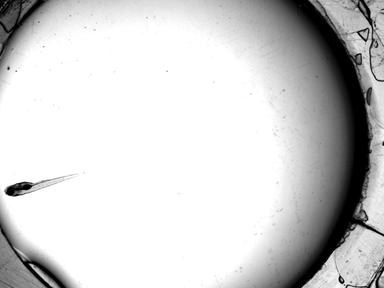
Incubate the larvae at 28.5 degrees Celsius for four to six hours to ensure efficient EBD uptake. To visualize EBD in the muscle use 0.04%trica to anesthetize the larvae before viewing the larvae under red fluorescence. EBD was injected into the CCV of Sapia homogeneous mutants and wild type siblings at 3D PF injections that filled the heart chambers as shown here, were then analyzed for successful die perfusion by visualizing fitzy dextrin in the vasculature under green fluorescence.
After a four hour incubation period, EBD uptake was examined at the so mite level as shown in this figure. Wild type siblings exhibited no EBD fluorescence within any visible muscle fibers, whereas the sapia homozygous mutants showed EBD uptake indicating damage to the muscle membrane. Once proficient Evans blue dye injection into the common cardinal vein of zebrafish, larvae can be completed within 30 to 60 minutes depending on the number of larvae being injected.
Additionally, experimental results can be obtained in a single day To ensure proficiency. It's important to remember to carefully aim for the cardinal vein in order to produce consistent and interpretable results. This can be challenging and will likely take practice Following this procedure.
Other methods can be performed such as chemical and genetic screens in order to determine molecular mechanisms responsible for the membrane damage associated with muscular dystrophies. These experiments can help establish new therapeutic strategies for muscle disease After its development. This technique paved the way for researchers in the field of muscle disease research to explore membrane integrity in zebrafish models of muscular dystrophy.
After watching this video, you should have a thorough understanding of how to inject Evan's blue dye into the common cardinal vein of zebrafish larvae. You should also understand how to identify muscle fibers with membrane damage due to the presence of Evan's blue dye within the fibers.