
19.4 : Properties of the z-Transform II
The property of Accumulation in signal processing is derived by analyzing the accumulated sum of a discrete-time signal and using the time-shifting property to determine its z-transform. This principle reveals that the z-transform of the summed signal is related to the z-transform of the original signal by a multiplicative factor.
Moreover, the convolution property indicates that the convolution of two signals in the time domain corresponds to the product of their z-transforms in the frequency domain. This property is valid for both causal and noncausal signals. The convolution property can be confirmed by applying the time-shifting property to the corresponding time-domain equation.
The initial value theorem establishes a connection between the initial value of a signal and its z-transform. For a given signal, the initial value can be obtained by evaluating the z-transform as the variable approaches zero. This theorem is particularly useful for determining the starting conditions of a system from its z-transform.
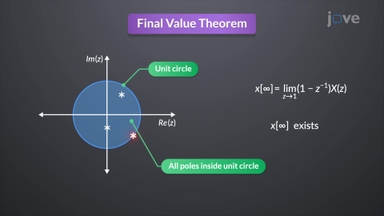
Conversely, the final value theorem determines the final value of a signal by examining its z-transform as the variable approaches one. This theorem is applicable only if the signal continues to exist at infinity and all the poles of the z-transform are within the unit circle, except at the point where the variable equals one.
These properties are crucial for analyzing and designing discrete-time systems. By utilizing the accumulation, convolution, initial value, and final value theorems, the behavior of discrete-time signals, and systems in the z-domain can be studied effectively. Mastery of these properties allows for the manipulation and transformation of signals, aiding in the creation of filters and control systems that function within the discrete-time domain.
From Chapter 19:
Now Playing
19.4 : Properties of the z-Transform II
z-Transform
94 Views
19.1 : Definition of z-Transform
z-Transform
257 Views
19.2 : Region of Convergence
z-Transform
345 Views
19.3 : Properties of the z-Transform I
z-Transform
138 Views
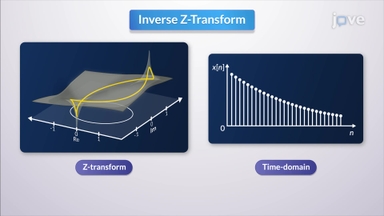
19.5 : Inverse z-Transform by Partial Fraction Expansion
z-Transform
253 Views

19.6 : Difference Equation Solution using z-Transform
z-Transform
226 Views
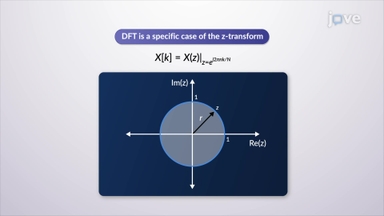
19.7 : Relation of DFT to z-Transform
z-Transform
333 Views

Copyright © 2025 MyJoVE Corporation. All rights reserved