Pore transport and ion-pair formation are critical mechanisms for the absorption and distribution of drugs in the body.
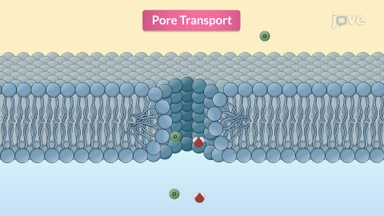
Pore transport, also known as convective transport, is a process where small molecules like urea, water, and sugars rapidly cross cell membranes as though there were channels or pores in the membrane. Although direct microscopic evidence is limited but the concept of pores or channels is widely accepted based on physiological evidence. Despite the lack of direct microscopic evidence of such pores, this model explains renal drug excretion and hepatic drug uptake. Transport proteins may form an open channel across the cell's lipid membrane, facilitating faster diffusion of small molecules, including drugs, compared to other parts of the membrane.
On the other hand, ion-pair formation involves the binding of oppositely charged ions to form a neutral complex. The strong electrolyte drugs maintain their charge at all physiological pH values and penetrate membranes poorly. However, when paired with an oppositely charged ion, a neutral ion pair forms, which diffuses more easily across the membrane. Examples include propranolol, which forms an ion pair with oleic acid, and quinine, which pairs with hexyl salicylate.
The use of ion pairs has intriguing applications, such as the complexation of amphotericin B and DSPG in certain amphotericin B/liposomal products. Here, ion pairing can transiently alter distribution, reduce high plasma-free drug concentration, and decrease renal toxicity.
From Chapter 3:
Now Playing
3.10 : Pore Transport and Ion-Pair Transport
Pharmacokinetics: Drug Absorption
273 Views
3.1 : Drug Administration and Therapy Phases: Overview
Pharmacokinetics: Drug Absorption
354 Views
3.2 : Drug Absorption: Overview
Pharmacokinetics: Drug Absorption
416 Views
3.3 : Drug Delivery: Overview
Pharmacokinetics: Drug Absorption
225 Views
3.4 : Drug Delivery: Enteral Route
Pharmacokinetics: Drug Absorption
302 Views
3.5 : Drug Delivery: Parenteral Route
Pharmacokinetics: Drug Absorption
299 Views
3.6 : Drug Delivery: Miscellaneous Routes
Pharmacokinetics: Drug Absorption
258 Views
3.7 : Cellular Membranes and Drug Transport
Pharmacokinetics: Drug Absorption
210 Views
3.8 : Mechanisms of Drug Absorption: Paracellular, Transcellular, and Vesicular Transport
Pharmacokinetics: Drug Absorption
271 Views
3.9 : Passive Diffusion: Overview and Kinetics
Pharmacokinetics: Drug Absorption
258 Views
3.11 : Carrier-Mediated Transport
Pharmacokinetics: Drug Absorption
187 Views
3.12 : Facilitated Diffusion
Pharmacokinetics: Drug Absorption
231 Views
3.13 : Active Transport
Pharmacokinetics: Drug Absorption
302 Views
3.14 : Vesicular Trasport: Endocytosis, Transcytosis and Exocytosis
Pharmacokinetics: Drug Absorption
486 Views
3.15 : Factors Influencing Drug Absorption: Anatomical Parameters
Pharmacokinetics: Drug Absorption
135 Views
See More

Copyright © 2025 MyJoVE Corporation. All rights reserved