The overall goal of this procedure is to test the effects of attentional blink on non-target words in a sequence. This is accomplished by first setting up an experimental paradigm with rapid serial visual presentations of eight words each. The second step is to instruct participants to attend to both the target word that belongs to a certain category as well as other non-target words.
Next, test for the detection of the target in the sequence by giving them two seconds to respond, yes or no. The final step is to test memory for non-target words by delivering a two second alternative force choice task. Ultimately, this novel dual task procedure uses an attentional blink paradigm to show the temporal effects of attentional blink on non-target words.
This method can help answer key questions in the cognitive neuroscience field, such as how attention affects both the temporal and spatial ability to process other stimuli or events in addition to the detection target. To begin, choose at least seven different categories from btic and Montague's category norms for verbal items to use in the target detection task. Next, choose nouns from these categories to use as targets, as well as other words from separate categories to use as decoys.
Make sure the set is large enough so that the same target is not used repeatedly. During testing. Choose non-target and distractor nouns from the pen tree bank corpus.
Again, make sure the set is large enough so that a word is not repeated. Choose words four or five letters in length that can be divided into four letter and five letter word trials In each trial, randomly select one target and one decoy. In addition, randomly select seven words as non-arts and five words as memory.
Task tractors. Participants are recruited from the local area through postings online, and flyers hung around the town. Confirmed that the participants have normal or corrected to normal visual acuity and use English as their first language.
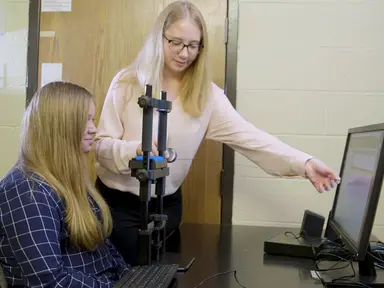
After obtaining consent and recording all relevant participant information, explain the experimental procedure and deliver instructions clearly. State that there are two tasks in the experiment. In the first, ask the participant to detect the presence or absence of a target noun in a displayed category.
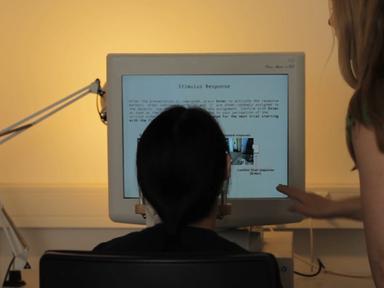
In the second task, the participants must try to remember all the words in a given sequence. After explaining the tasks, explain how to use the response keys. The rapid serial visual presentation or RSVP task is performed using a standard monitor and stimulus presentation software.
The words are presented in black courier font size 14 on a white background. Each trial begins with a display of the target category for 1.2 seconds, followed by a fixation cross for 500 milliseconds and a blank screen for 200 milliseconds. Next eight nouns are presented using stimulus, onset, asynchronous, or SOAs of either 120 240 or 360 milliseconds per item.
Allow the participant to complete a total of 96 trials, including eight practice trials and 16 repetitions for each condition. A typical session will take a subject 15 to 20 minutes to complete. For the target detection task, prepare two nouns, one, belonging to the target category and the other not belonging to the target category.
To act as a decoy, present the target noun in half of the trials and the decoy noun in the other half. Ensure these nouns are never in one of the first or last positions in the sequence. After the RSVP, give participants two seconds to respond, yes or no to indicate whether the presentation contained a word from the target category.
The first memory task is for a word presented either immediately before or immediately after the target word in the sequence, show the test word randomly on the right or left side of the screen next to a word that was not in the sequence. Keep these words on the screen until the participant makes a response using the left or right arrow keys. Next, present the second memory test.
Use a word in the sequence not directly before or after the target. This will keep participants from paying extra attention to the words around the target to avoid fatigue or eye strain. Encourage the participants to take a few seconds of rest between experimental trials to examine attentional blink effects on non-target items.
Used the same RSVP procedure with a counterbalanced between subjects design. Use three memory tests after the detection task. Make sure that the test words are equally likely to be from positions two, the seven around the target for target present trials or around the decoy noun in the target.
Absent trials after testing, debrief with the participants about the purpose of the study. To analyze the data afterwards, use a nova's or planned contrast T tests to compare memory performances in target. Present versus target absent conditions.
For the first memory task, this subject showed difficulty remembering targets immediately after the category noun for both 120 and 240 millisecond SOAs, but fairly high accuracy with encoding at 360 milliseconds. OA.Words that were immediately before the category noun were all remembered with fairly high accuracy. In the second memory.
Task accuracy again increased with longer SOAs and stayed consistently high in the before group. During category noun detection, all items from lag negative three, negative two and negative one were remembered around 70%of the time, independent of whether the target was present or absent at lag one, two, and three. In target absent trials, non-target words were remembered more accurately.
While memory for non-target words at lag two was hindered the most in target present trials, these results also show that memory for non-target words at lag two was worse. If there was a target present in the trial. After watching this video, you should have a good understanding of how to test different aspects of attentional blank.