The overall goal of this procedure is to perfuse human donor Liver grafts exe you at body temperature using machine perfusion. This is accomplished by first preparing the necessary perfusion fluid. The second step is to prime the perfusion device by adding the different components of the perfusion fluid to the machine.
Simultaneously, the procured liver graft is prepared on the back table to be connected to the perfusion device. The final step is to connect the liver to the perfusion device and to start norm themic perfusion. Ultimately, changes of the arterial and portal flows displayed on the screens are used to assess hemodynamics of the liver and blood gas analysis of samples taken from the arterial perfusion fluid is used to monitor the pH and oxygenation of the perfusion fluid.
The main advantage of this technique over the traditional method of statical storage is that you keep a liver alive at normal temperature outside the human body. You provide oxygen and nutrients to the graft, keeping it metabolically active. It helps to reduce ischemia and reperfusion and cold induced injury.
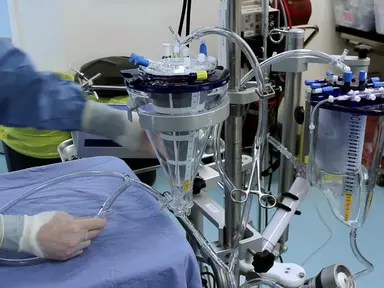
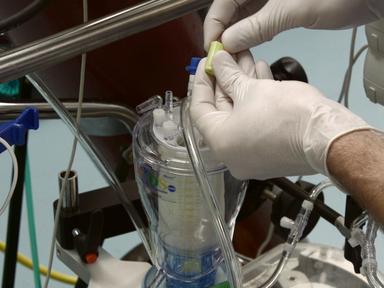
And since the liver is metabolically active at 37 degrees, you can assess the graft in its viability prior to transplantation. The procedure of exci norm tur machine perfusion of a human liver graft will be demonstrated step by step by Alex Mehan, who is a PhD student working in my lab. To begin this procedure, add the components of the perfusion fluid to the machine via the connector on top of the oxygenator.
The perfusion fluid is composed of human packed red blood cells, fresh frozen plasma, human albumin, and other components. Switch on the Venus and arterial pumps. Follow the manufacturer's instructions on the screen to increase the pump output on both sides.
Remove all the air bubbles from the closed system in a systematic manner. Null the pressure meter against atmospheric pressure by following the instructions on the screen. This ensures that the pressure measure during the perfusion is the real pressure at the level of the portal vein.
Adjust the set temperature of the device to 37 degrees on the portal side. Set the mean portal venous pressure at 11 millimeters of mercury. Repeat the pressure knulling procedure on the arterial side of the device.
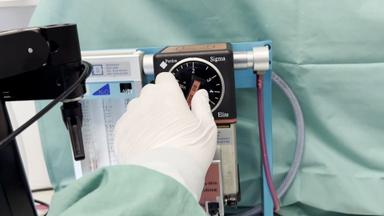
Set the temperature to 37 degrees and the mean arterial pressure at 70 millimeters of mercury. Start the oxygenation using carbogen at a flow rate of four liters per minute. The airflow will be divided among the two oxygenator, and this should result in an oxygen pressure of around 60 kilopascals in the perfusion fluid.
For longer perfusions. It is advisable to use separate sources of oxygen and carbon dioxide. This allows for small adjustments in the oxygen carbon dioxide ratio, which can be used to adjust the pH and carbon carbon dioxide pressure of the perfusion fluid.
Check the pH of the perfusion fluid by performing a blood gas analysis. Be sure to discard about three milliliters of perfusion fluid before taking a sample. As this fluid is in the peripheral tubing and does not represent the perfusion fluid in the system, remove all air bubbles from the blood gas sample.
Add an 8.4%sodium bicarbonate solution for buffering capacity, aiming for a physiological pH. Typically 15 to 30 milliliters of 8.4%Sodium bicarbonate solution is added. At this stage, the donor liver is procured in the donor hospital using the standard technique of in situ cooling and flushed out with cold preservation fluid to facilitate cannulation of the artery.
A segment of the supra truncal aorta should be left attached to the hepatic artery immediately upon arrival of the donor liver in the operating room of the machine perfusion center, start the back table procedure. Remove a sample of at least 10 milliliters of the preservation fluid for microbiological testing. The cystic duct of the liver was ligated during its procurement in the donor hospital with surgical scissors, remove the diaphragmatic attachments to the bare area of the liver as well as any remaining cardiac muscle from the upper cuff of the vena cva.
Using dissecting scissors, dissect the artery and portal vein. Use surgical sutures or heoc clipse to ligate the side branches. Close the distal end of the supra truncal aorta segment using a non-absorbable monofilament suture, such as 3.0 proline.
Insert arterial cannula into the proximal end of the supra truncal aorta and secure with sutures. Next, insert the venous cannula into the portal vein and secure with sutures. The hepatic vein should remain un cannulated.
Flush out the bile duct with the preservation solution. Insert a silicon catheter into the bile duct and secure with sutures. Do not insert the catheter too deeply into the bile duct as this may cause injury to the biliary epithelium.
Lastly, flush out the liver with a 0.9%saline solution via the portal vein cannula. If the graft has been preserved in the University of Wisconsin solution, flush it out with two liters of cold saline solution followed by half a liter of warm saline solution. If the graft has been preserved in HTK solution, flush out the liver with one liter of cold saline solution followed by half a liter of warm saline solution to prepare for machine perfusion.
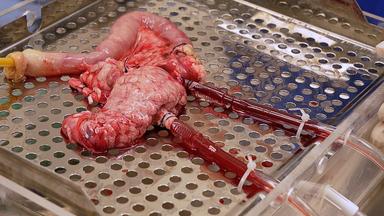
First position the liver in the organ chamber with the anterior surface facing downward. Immediately connect the liver to the primed perfusion device by connecting the portal vein cannula to the portal inflow tube of the device and the arterial cannula to the arterial inflow tube of the device. The most critical aspect to this protocol is connecting the portal vein in the hepatic artery cannulas to the profusion device.
Adequate profusion should begin immediately thereafter. Start perfusion on both portal and arterial sides by following the manufacturer's instructions on the screen. In case of kinking of the tubing and or high intrahepatic resistance, a pressure alarm may occur.
Check the mean arterial pressure and the mean portal venous pressure and set them again if necessary. Note the bile production of the metabolically active graft and pulsating hepatic artery during normal themic machine perfusion. During the perfusion, close the organ chamber with the sterile cover provided at different time points.
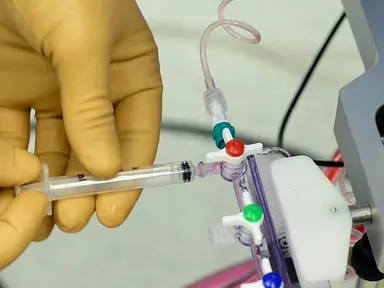
Collect perfusion fluid samples for immediate analysis of blood, gas and biochemical parameters using a new one milliliter syringe. For each sample, aspirate the perfusion fluid from the sampling connectors that are part of the disposable tubing set of the perfusion device. Again, be sure to discard a few milliliters of perfusion fluid before taking the samples.
Immediately remove any air bubbles from the syringe. Insert the one milliliter syringe in the blood gas analyzer and follow the manufacturer's instructions for analysis of blood gas and biochemical parameters. Take perfusion fluid samples for later analysis.
Transfer them to blood collection tubes and store on melting ice. Centrifuge the samples at 1400 times g and four degrees Celsius for five minutes. Collect plasma from the perfusion fluid and freeze and store the plasma at minus 80 degrees Celsius for later biochemical analyses to assess the amount of graft injury to evaluate the quality of the liver during perfusion.
Monitor the macroscopic homogeneity of the liver. Shown here is a liver before perfusion and at 30 minutes and six hours after the start of normal themic machine perfusion. The hemodynamics of the livers were assessed by monitoring the changes in the arterial and portal flows during norm themic machine perfusion.
An initial increase and subsequent stabilization of the flows indicates stable hemodynamics of livers during fusion. Blood gas analysis was used to monitor oxygenation of the perfusion fluid and extraction of carbon dioxide. Oxygenation with carbogen at a flow of four liters per minute resulted in a continuous oxygen saturation of 100%Bile production was used as an indicator of liver function.
An increase in the concentration of total bilirubin and bicarbonate represented an improvement in the quality of the bile produced. A gradual darkening shade of the bile color was observed. Over time.
Stable concentrations of hepatic injury markers such as a LT alkaline phosphatase, gamma gt, and potassium in the perfusion fluid reflected minimal injury of the grafts. Furthermore, histological examinations of liver tissue and the distal end of the extra hepatic bile duct did not reveal any additional injury to the grafts during normal themic machine perfusion. The per biliary glands and vasculature are indicated.
After watching this video, you should have a good understanding of how to normal term machine perfusion of a human liver graft. This technique offers the potential to improve and assess graft viability prior to transplantation.